

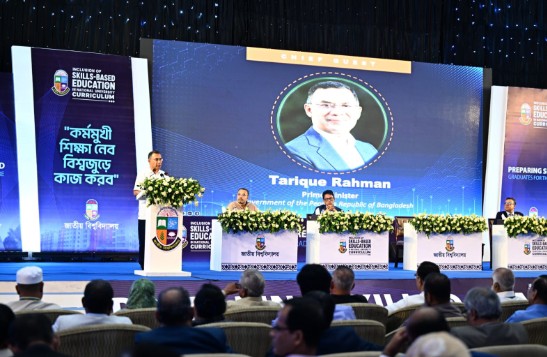
Prime Minister Tarique Rahman today called for developing a skill and technology-based practical and job-oriented education system in the country instead of certificate-based education.
“In this era of the Fourth Industrial Revolution, there is no alternative to modernising and updating the traditional education curriculum to face the challenges of artificial intelligence (AI) and automation,” he said.
The Prime Minister made the remarks while addressing the inaugural session of a training programme on job-oriented and technical education for teachers at the Bangladesh-China Friendship Conference Center in the capital.
The National University (NU) organised the programme under the theme, “We will take job-oriented education, we will work around the world,” with the goal of developing 12,000 college teachers as skilled educators.
Tarique Rahman said more than a decade and a half of authoritarian rule had not only deprived people of their democratic rights but also disrupted the country’s education system.
“It is now our turn to turn around in democratic Bangladesh,” he said.
Emphasising the need to build a knowledge-based state and society, the Prime Minister said Bangladesh must prepare itself in education, science, technology and innovation to remain competitive in the global arena.
Highlighting the role of the National University, he said more than 40 lakh students are currently studying in over 2,000 affiliated colleges across the country.
He noted that former Prime Minister Begum Khaleda Zia established the university in 1992 to address challenges in higher education management and expand access to education.
The Prime Minister said rapid technological change is transforming the global job market, creating new opportunities while making some traditional professions obsolete.
“To cope with this technological revolution, it is essential to include subjects like artificial intelligence, cybersecurity, programming, digital entrepreneurship, quantum computing, nanotechnology and 5G technology in the education curriculum,” he said.
He added that the government has already started efforts to make the education curriculum more practical and technology-oriented at all levels.
Tarique Rahman stressed the need to reduce unemployment among educated youth by strengthening apprenticeships, internships and industry-academia collaboration.
He said these initiatives are initially being implemented in divisional cities so that students can acquire practical skills alongside their academic studies.
Highlighting entrepreneurship development, the Prime Minister said the government has decided to provide seed funding and innovation grants through a competitive process to help commercialise innovative business ideas developed in colleges and universities.
“As a result, young people will be able to create employment themselves instead of chasing jobs,” he said.
The Prime Minister also emphasised the importance of moral education, mental health, social inclusion and environmental awareness alongside technological advancement.
He said learning a third language in addition to Bangla and English could significantly expand employment opportunities both at home and abroad.
Urging teachers to act as agents of social change, Tarique Rahman said a technologically skilled workforce would help build a prosperous and self-reliant Bangladesh.
Describing national development as a collective effort, he called for cooperation from universities, teachers, students, guardians, civil society and the industrial sector in building a knowledge- and merit-based society.
Education Minister ANM Ehsanul Hoque Milon, Prime Minister’s Adviser for Education Mahdi Amin and NU Vice-Chancellor Professor Dr ASM Amanullah also spoke at the programme.