
A recent wave of commentary from India-favored Awami League (AL) activists has intensified what they present as a counter-narrative to the July movement, with a clear focus on discrediting the military’s role and reshaping public memory of events. At the center of this effort lies an attempt to recast the mass uprising that led to the collapse of the deeply unpopular Sheikh Hasina-led AL government.
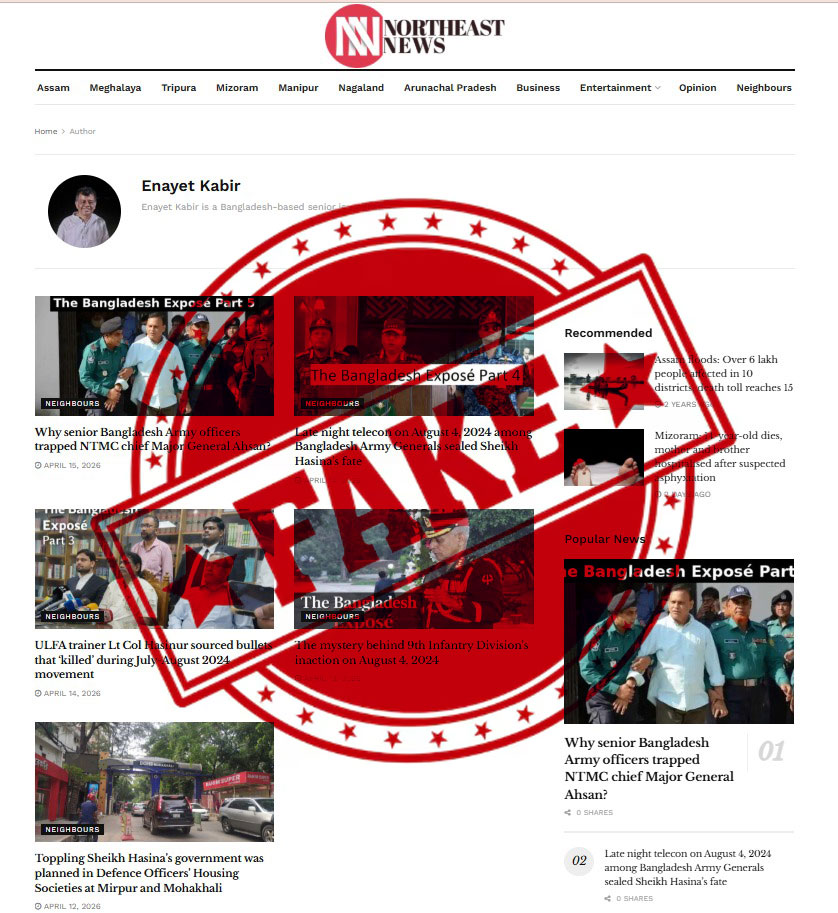
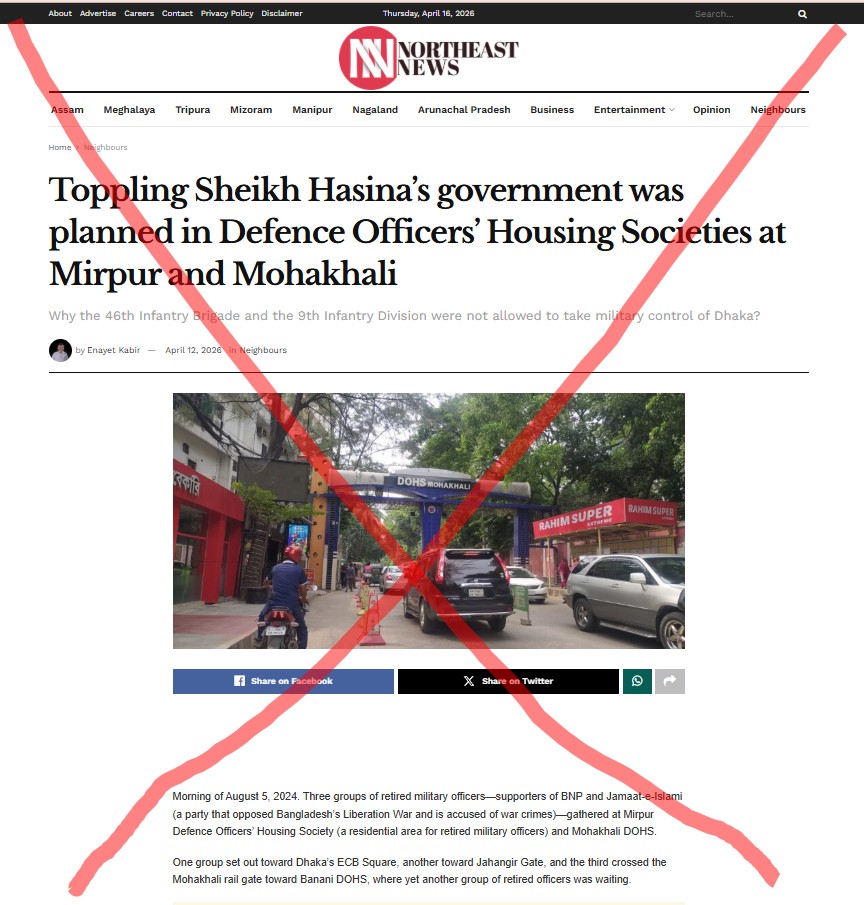
Within this framing, the political objective appears to extend beyond reinterpretation. It seeks not only to restore Sheikh Hasina’s political standing but also to rehabilitate the broader image of the Awami League. A central claim in this narrative reduces the turning point of 5 August to a single incident: the withdrawal of the Uttara barricade. This interpretation has been reinforced by an Indian outlet, Northeast News, which asserts that on the afternoon of 5 August, officials of the Special Security Force (SSF) were uncertain about the destination of the Prime Minister.
However, accounts from within the same sequence of events suggest a different understanding at the highest level of the state. Sheikh Hasina had reportedly already concluded that she had been betrayed. Approximately one hour before, she was informed that the curfew barricade in the Uttara area had been suddenly removed under the direction of Brigadier Rafiq of the Artillery Division. This development was interpreted as a decisive moment that effectively sealed the fate of the government.
Soon after, a public announcement emerged from Dhaka Cantonment indicating that Army Chief General Waker-Uz-Zaman would address the nation. In the context of unfolding political uncertainty, this was widely read as a clear indication of an imminent transfer of power.
The narrative advanced by Northeast News, however, does not appear isolated. It fits within a wider pattern of messaging, echoed across several Bengali-language platforms, which collectively attempt to shape public interpretation of the events in Bangladesh. In this broader discourse, reducing the complexity of the moment to a singular act of military betrayal risks stripping the episode of its political and social depth.
Such a reduction also overlooks what lay beyond the Uttara barricade. There was no empty space awaiting direction or orchestration. Instead, there was a vast convergence of citizens, students, and ordinary people whose trust in the political system had already eroded. The July movement of 2024 did not emerge abruptly; it was the outcome of accumulated grievances over time. Interpreting the collapse of the government solely through a military lens therefore excludes the agency of the population that shaped the streets.
At the same time, it is misleading to frame the military as an instrument designed to execute repression in the manner of authoritarian regimes. The armed forces of Bangladesh are neither extensions of any political party nor mechanisms of a declining regime. Their institutional mandate is grounded in safeguarding sovereignty, maintaining territorial integrity, and ensuring constitutional continuity along with public trust.
This raises a more fundamental question about political endurance: how long can a system remain stable when a significant portion of its population perceives itself as excluded from democratic participation? Can the mechanisms through which citizens were distanced from their voting rights simply be disregarded?
Despite securing a decisive mandate in 2008, the ruling establishment struggled to maintain public confidence in subsequent electoral cycles. The 2014 election proceeded without meaningful participation from opposition forces. The 2018 election was widely questioned amid allegations that ballot manipulation had occurred the night before polling. The 2024 election, in contrast, unfolded in an environment marked by the absence of genuine competition. Over time, these processes increasingly appeared disconnected from public trust and voter engagement.
This trajectory contributed to a growing perception of one-party dominance, which deeply affected public consciousness. Three consecutive national elections conducted under such conditions further reinforced doubts regarding the credibility of democratic practice.
Simultaneously, decision-making within the Awami League and the broader administrative structure became progressively centralized. Independent intellectual voices diminished, while authority became increasingly concentrated within a single leadership core. Although institutional structures remained formally intact, they gradually lost internal autonomy and accountability.
To disregard this trajectory or to reframe it through softened language that diminishes the record of the past seventeen years fails to reflect the lived political reality of Bangladesh. The central issue is not merely the removal of a barricade in Dhaka, but the conditions that made such a barricade necessary in the first place. A widening gap emerged between the Sheikh Hasina-led government and the public, shaped by political exclusion, contested elections, and weakening institutional independence.
Within this environment, student-led dissatisfaction driven by allegations of favoritism, coercive practices, and unchecked actions by partisan actors expanded into broader civic resistance. The perception of absent accountability intensified public frustration, eventually extending well beyond university campuses into wider society. These dynamics played a significantly greater role in shaping public sentiment than any isolated event on 5 August.
Ultimately, the removal of Sheikh Hasina and the fall of the Awami League government cannot be reduced to the lifting of a barricade or the decisions of individual military officers. It represents the culmination of a longer and more complex political trajectory.
The Uttara barricade, in this sense, was not the cause of Dhaka’s fall. It functioned instead as a visible moment within a longer process already set in motion by sustained political, institutional, and social strain under the AL administration. Distinguishing between symbolism and causation is essential to moving beyond simplified narratives and toward a more grounded understanding of events.
Northeast News
A Constructed Conspiracy: How the August 2024 Narrative Ignores Evidence, Context, and Political Reality
The Indian news outlet NorthEast News published article titled “Late night telecon on August 4, 2024 among Bangladesh Army Generals sealed Sheikh Hasina’s fate”, by Enayet Kabir on April 14, 2026, presents itself with a pretension as an insider account of a decisive moment in Bangladesh’s recent political history. But in reality, it functions less as an investigation and more as a constructed narrative designed to reduce a complex political rupture into a single institutional conspiracy. This kind of simplification, in the form of a movie script, is very reductive and misleading.
This appeared at a moment when Bangladesh’s political course is being intensely trying to take a practical political course for the people’s betterment. And, also examined both domestically and internationally, the responsibility of serious analysis is to engage with complexity, evidence, and context. This report fails on all three counts in any meaningful sense.
Narrative Without Verifiability
Beyond question, a defining weakness of the article lies in its complete reliance on unnamed sources and unverifiable claims. The statement, “Hours before Sheikh Hasina was packed off in a helicopter, on her way to Delhi, Army chief Gen Waker-uz-Zaman gave false assurances to her – situation under control,” reflects the broader pattern of dramatic reconstruction that runs throughout the piece.
Alleged late night teleconferences and internal military dynamics are presented without documentary backing, recorded communication, or on record testimony. This absence is not a minor journalistic gap. It fundamentally undermines the credibility of the entire narrative.
Serious investigative reporting requires triangulation of evidence and demands that claims of this scale be supported by verifiable material. Instead, what emerges here is a narrative designed to appear authoritative while remaining largely insulated from scrutiny. The structure resembles intelligence fiction more than institutional analysis, in effect an emotional diary that appears to advocate a clean portrayal of Sheikh Hasina and the Awami League.
The Systematic Removal of Political Context
More significant than the absence of evidence is the deliberate removal of political context. The article treats the fall of Sheikh Hasina’s government as an isolated event, detached from the broader trajectory of governance over the preceding years. It makes no effort to engage with public sentiment, examine the role of political opposition, or acknowledge the structural tensions that had been building within the system.
Governments do not collapse in a vacuum. They lose legitimacy over time through a combination of political decisions, institutional conduct, and public response. By excluding these realities, the report constructs an artificial narrative in which a single institutional actor appears decisive.
This is not analysis. It is selective storytelling.
But why did they publish it? Answer lies here:
In the entire writeup, there is no mention of any wrongdoing by the Awami League government during its long 16 years in power. There is no discussion of how public dissatisfaction and anger gradually built up against the Hasina regime. It also fails to address allegations of election manipulation aimed at marginalizing the opposition and engineering controlled elections under continued state power.
In the name of Mujib ideology and the glorification of the 1971 Liberation War, the Awami League government is widely accused of suppressing political opposition. Over time, individuals with significant local influence, including MPs and ministers, allegedly operated with unchecked brutal authority in their respective areas. These developments contributed to growing public frustration, ultimately leading large segments of the population to take to the streets demanding the ouster of the government, a widely documented phase in Bangladesh’s recent political history.
However, The NorthEast News and the respective writer Enayet Kabir appear to adopt a denialist position, presenting a narrative that fully shields the Hasina government. The fall of the regime is instead framed primarily as the outcome of a military conspiracy, as if there was no mass public uprising and no nationwide mobilization of citizens. This portrayal effectively ignores the scale and significance of the July uprising, reducing it to an alleged institutional plot.
Indeed, the overall construction of the report appears to obscure the political realities and controversies surrounding Sheikh Hasina’s leadership and her administration. The framing appears to align, whether directly or indirectly, with a broader narrative that serves the strategic interests of the Indian state, rather than offering an objective account centered on the people of Bangladesh.
From this perspective, the implication is that India continues to provide political support and refuge to Sheikh Hasina and senior figures within her political circle, despite multiple allegations against them. In this context, narratives that emphasize military conspiracy over political causation may serve to shape external perception, portraying Awami League leaders as victims of military institutional plotting rather than subjects of political accountability.
This raises an important question regarding the motivations of the contributor, Enayet Kabir. In political analysis, understanding the perspective and background of the writer is essential to interpreting the framing of the argument. Enayet Kabir has previously been associated with the Awami League student wing, the Bangladesh Chhatra League. He also studied in Moscow during the Soviet era, a period that may have influenced his ideological outlook. During the Awami League’s tenure in power, he is believed to have benefited in various ways.
According to fact checks, Enayet Kabir has never been established as a verified journalistic identity but is instead described as an Awami League activist and an associate of Indian journalist Chandan Nandy, who is on record for publishing contested and fictitious narratives about the Bangladesh military in Northeast News.
It is also notable that Enayet Kabir’ elder brother, filmmaker and architect Enamul Karim Nirjhar, has had professional and personal connections within circles close to Sheikh Hasina, including involvement in designing and constructing her private residence, Sudha Sadan, in Dhanmondi Road 5. Taken together, these factors suggest a broader network of proximity to the Awami League leadership. On a personal level, Enayet Kabir remains active on social media in support of efforts aimed at rehabilitating the Awami League politically.
While such background does not automatically invalidate an argument, it does require that the work be evaluated with greater critical attention, especially when evidentiary support is lacking.
Thus, in the absence of transparency and methodological rigor, perspective risks becoming bias, and narrative risks becoming advocacy.
Connecting to this aspect, one of the most consequential distortions in the report is its implicit denial of mass political participation. The events of July and August were marked by visible, widespread public mobilization across multiple cities and social strata. This was not an episode confined to elite circles or institutional maneuvering. By reducing the outcome to a military driven scenario, the article effectively erases the role of ordinary citizens. This is not simply an analytical oversight. It reflects a deliberate narrative choice to replace public agency with institutional conspiracy. In doing so, it diminishes the political weight of popular mobilization and reframes it as secondary, if not irrelevant.
Internal Contradictions of the Coup Thesis
The central claim of an indirect military intervention collapses under its own internal inconsistencies. Coordinated military actions follow clear and recognizable patterns of control, consolidation, and communication. They are defined by rapid stabilization of key institutions and a visible chain of command.
What the article describes is the opposite. It presents a picture of disorder, fragmented authority, and exposed state structures. Administrative coherence appears weakened rather than reinforced. Institutional vulnerability is highlighted instead of control being asserted. These are not the features of a calculated takeover. They are the markers of systemic breakdown.
This contradiction leads to a fundamental question. If the military was orchestrating events with precision, why does the outcome reflect a loss of control rather than its consolidation?
Selective Attribution of Responsibility
Another critical limitation of the article is its asymmetrical assignment of responsibility. The focus remains overwhelmingly on alleged military decisions while the actions and policies of the government itself are left largely unexamined. There is no serious attempt to interrogate governance choices, crisis management, or political strategy during the period in question.
This selective approach is not analytically neutral. It functions to redirect accountability away from political leadership and toward institutional actors. In doing so, it narrows the field of inquiry and shapes the reader’s perception in a predetermined direction.
Conclusion: Beyond a Single Night Explanation
Reducing the fall of Sheikh Hasina’s government to a single alleged late-night teleconference is not serious analysis. It is a deliberate oversimplification of a complex political rupture.
Political change of this scale does not occur in one night, and it is never driven by a single room, a single call, or a single institution. It is the outcome of accumulated pressure, shifting public sentiment, and a gradual erosion of political legitimacy. To ignore these forces is to ignore political reality itself.
Any narrative that replaces this broader context with a neat conspiracy does not clarify events. It distorts them.
A credible understanding of August 2024 requires engagement with the full political landscape, not selective fragments of it. Until that standard is met, such narratives remain what they are, constructed interpretations rather than reliable accounts of reality.
Exposing the Propaganda of Northeast News: A Bangladesh-Bashing, RAW-Backed, Awami League-Funded Outlet
Northeast News, an Indian website notorious for its consistent anti-Bangladesh stance, has once again peddled fabricated narratives against Bangladesh. The portal, widely regarded as operating in the interest of India’s RAW and now functioning as a paid propaganda arm of the Awami League, continues its smear campaign against the July–August 2024 mass uprising.
Enayet Kabir (believed by many to be a pseudonym or close associate of Chandan Nandi) has claimed in a recent article that “senior Bangladeshi army officers trapped NTMC chief Major General Ziaul Ahsan.” This is a completely fabricated and malicious story designed to distort facts and undermine Bangladesh’s democratic transition.
Accountability, Not a ‘Trap’
Major General Ziaul Ahsan was one of the most controversial figures of the Sheikh Hasina era. He served for years in the intelligence wing of the Rapid Action Battalion (RAB), a force widely accused of enforced disappearances, extrajudicial killings, and torture. Later, as head of the National Telecommunication Monitoring Centre (NTMC), he occupied one of the most sensitive surveillance positions in the country.
Following the fall of the Hasina regime on August 6, 2024, he was forced into retirement and subsequently arrested on serious charges including murder, enforced disappearance, and corruption. This is not a “trap” or a conspiracy to seize phone recordings. It is simply a process of accountability for alleged grave crimes committed during the previous authoritarian rule.
July 2024: A Mass Uprising, Not an Army Coup
The July–August 2024 mass uprising claimed over 1,400 lives, with thousands more injured and permanently disabled. According to UN reports, the majority of those killed died from gunfire by state forces — police, RAB, ruling party activists, and alleged snipers.
This was not merely a student movement. It was a full-scale people’s uprising against a regime that had turned its weapons against its own citizens. The Hasina government unleashed unprecedented repression, with credible allegations of external support in the brutal crackdown.
The Bangladesh Army did not participate in the mass killing. Senior officers, including Army Chief General Waker-uz-Zaman, reportedly refused to issue orders for lethal force against unarmed civilians. As a result, Hasina was forced to flee the country, and Bangladesh was saved from what could have become a full-blown civil war.
Instead, the army:
- Protected police stations from mob attacks
- Provided shelter to police personnel inside cantonments
- Helped prevent the situation from escalating into nationwide armed conflict
This is the undeniable reality.
What the Awami League Is Doing Now
The Awami League, under Sheikh Hasina’s leadership, is now desperately trying to whitewash 15 years of alleged authoritarianism, corruption, enforced disappearances, extrajudicial killings, and political repression. With alleged backing from external actors, they are aggressively pushing conspiracy theories to reframe the July uprising as an “army coup,” a “militant agenda,” or a “foreign plot.”
Outlets like Northeast News are actively serving this propaganda machinery. Their clear objective is to delegitimize the sacrifices of the Bangladeshi people and portray the popular uprising as illegitimate.
The Jamaat–NCP Factor
At the same time, overstatements and unnecessary political posturing by groups like Jamaat-e-Islami and the National Citizen Party (NCP) are providing the Awami League with ammunition to push the “Islamist/militant agenda” narrative. Such actions only strengthen the hands of the anti-July forces and their propaganda network.
The Way Forward
This is the time for all patriotic forces to unite against the remnants of authoritarianism and disinformation.
Those who truly respect the martyrs of July–August 2024 must stand firmly together.
July 2024 was a people’s uprising. The Bangladesh Army stood with the people and helped prevent a national catastrophe. Holding figures like Major General Ziaul Ahsan accountable is not a conspiracy — it is a necessary step toward justice and reform.
Reject the propaganda of Northeast News. Honor the blood of the martyrs. Stand united against authoritarianism and foreign-backed disinformation.
Northeast News has long positioned itself as an anti-Bangladesh platform, consistently working against Bangladesh’s sovereignty and national interest while advancing RAW’s agenda and now openly serving as a mouthpiece for the fallen Awami League regime. It is high time such paid propaganda outlets are exposed and their malicious narratives countered with facts and truth.