

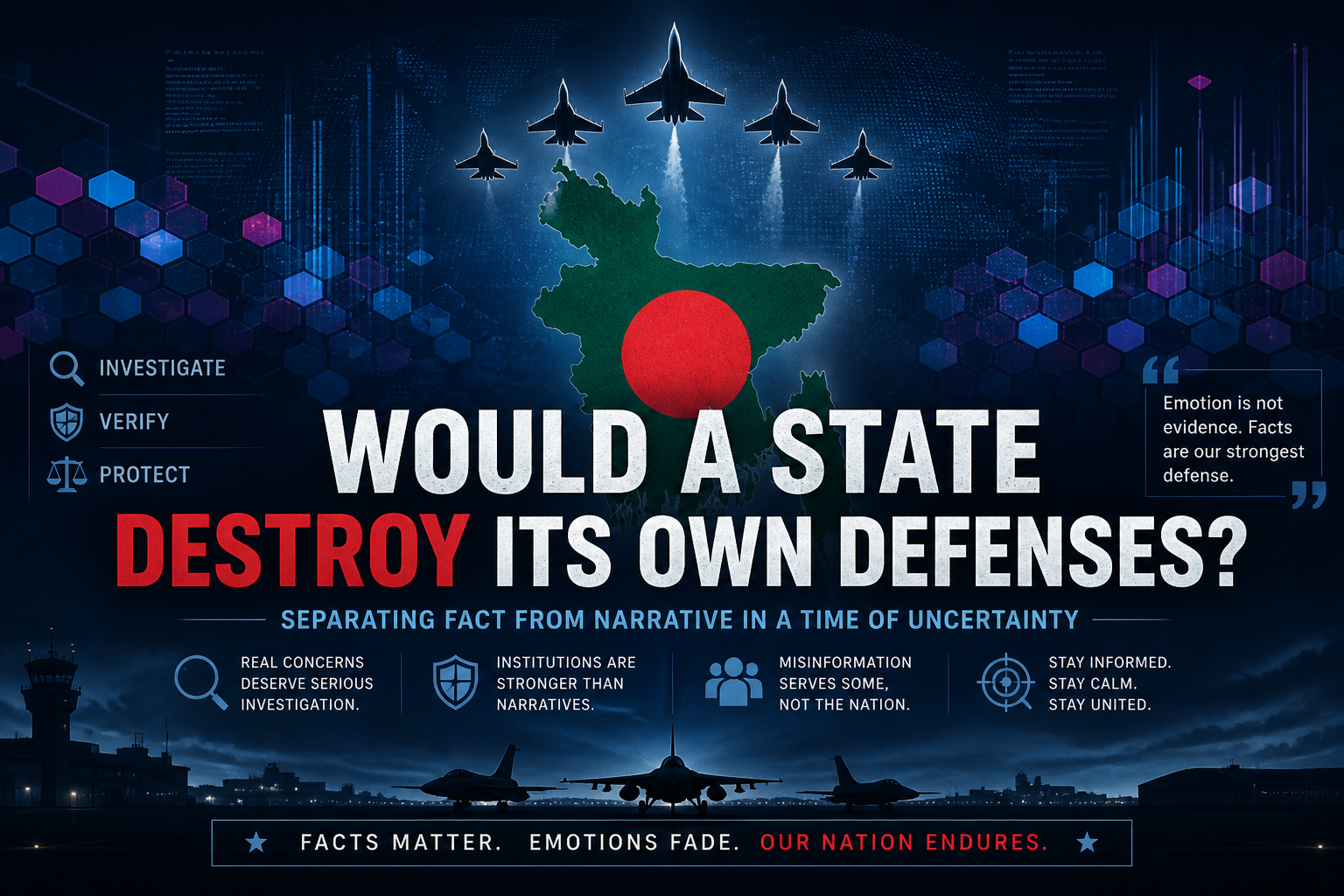
There is a narrative spreading rapidly right now that what is happening inside Bangladesh’s Air Force is a staged drama, that officers are being disappeared, that the entire episode is running on a foreign script. It travels fast, as these things always do, because it is built not on documentation but on the one currency that never runs short in the digital age: outrage. But when you step back and look at it through facts and logic rather than feeling, a very different picture begins to emerge.The first question any honest reader should ask is a simple one: where is the proof? “Enforced disappearances,” “secret detentions,” “foreign control” these are extraordinarily serious allegations. Claims of this gravity ordinarily arrive with verifiable documentation, formal are willing to be held accountable for what they publish. What we have instead is largely social media dependent, thin on verification, and heavy on atmosphere. Emotion is not evidence. And in matters of national security, the distance between the two can carry a very serious cost.
That said, the facts that have surfaced cannot simply be waved away. There are credible reports of personnel traveling to Pakistan under suspicious circumstances, a significant number of arrests on allegations of links to a banned militant network, and a number of suspects who have since absconded. If intelligence agencies are genuinely receiving signals of this nature, then the only responsible course for any state is to pursue them seriously. An apparatus that sits on such information that hesitates out of political caution or institutional embarrassment would be failing the very people it exists to protect. Conducting interrogations, detaining suspects for questioning, expanding the scope of an investigation as new information emerges: none of this is evidence of a state gone rogue. These are the standard, necessary functions of any government that takes its own security seriously.
This is precisely where a fundamental confusion is taking root in public conversation. Interrogation is not conviction. Investigation is not conspiracy. Security screening is a continuous, living process in every professional military in the world. To take a bounded, ongoing investigation and present it to the public as confirmation that an entire institution has been corrupted is not analysis. It is a dramatic simplification dressed as revelation, and the damage it can cause is not merely intellectual.
There is another argument making the rounds that all of this is itself a deliberate plan to weaken the Air Force from within. But follow that logic carefully. Would any functioning state willingly dismantle its own defense infrastructure? Does questioning a handful of personnel, however senior, bring a professional military to its knees? Defense policy, modernization, strategic doctrine these are built across years and held up by institutional depth that no single episode can simply dissolve. The argument sounds urgent. It does not survive scrutiny.
The question of foreign involvement has also been raised, and it deserves a careful answer. The same evidentiary standard applies here as everywhere else verifiable proof must precede serious public accusation. Without it, the habit of attributing every domestic development to an external hand weakens the analysis rather than sharpening it. What is entirely fair to acknowledge, however, is that in the current reality of regional geopolitics and information warfare, various actors do build and circulate narratives designed to serve their own interests. When something happens inside Bangladesh, those who benefit from instability will move quickly to amplify the most damaging version of events. That India, the Awami League, and RAW would find their interests neatly served by a portrayal of Bangladesh’s military as compromised and its institutions as unreliable that is not a conspiratorial leap. It is a straightforward reading of incentive. That so many of these narratives appear to be woven from the same loom, at the same moment, should give any careful reader reason to pause.
One honest concession is necessary here. If members of an international militant network genuinely succeeded in recruiting individuals with connections to Bangladesh’s armed forces, then multiple quarters will respond some out of legitimate concern, some for domestic political reasons, and some for purposes that have nothing to do with Bangladesh’s safety at all. The manufactured panic and the real concern will exist in the same space simultaneously, feeding off each other, and separating them requires a discipline that viral outrage does not naturally encourage.
The most grounded reading of this entire situation, then, is this: there may well be a real but limited security concern that Bangladesh’s intelligence and law enforcement are actively and appropriately pursuing. Around that real concern, an inflated and emotionally driven narrative has been constructed one that serves agendas entirely external to Bangladesh’s actual wellbeing. Both of these things can be true at the same time. In fact, in the current information environment, they almost always are.
What should a careful and responsible reader do with all of this? Not spread unverified claims that deepen panic. Not consume a story without first asking who produced it, through which outlet, and toward what end. Not allow a sensitive matter of national security to be dragged into the arena of political point-scoring or raw emotion, because in these domains a wrong interpretation does not merely mislead it can actively damage the very security architecture it claims to be defending.
Bangladesh’s strength has always resided in its institutions, in the professionalism of its armed forces, and in the quiet resilience of its people. Any narrative from whatever direction it arrives that works to erode public confidence in those foundations deserves to be met not with matching emotion, but with clear eyes, verified facts, and steady judgment. In the current information environment, that is not a passive response. It may, in fact, be the most consequential one available.
