

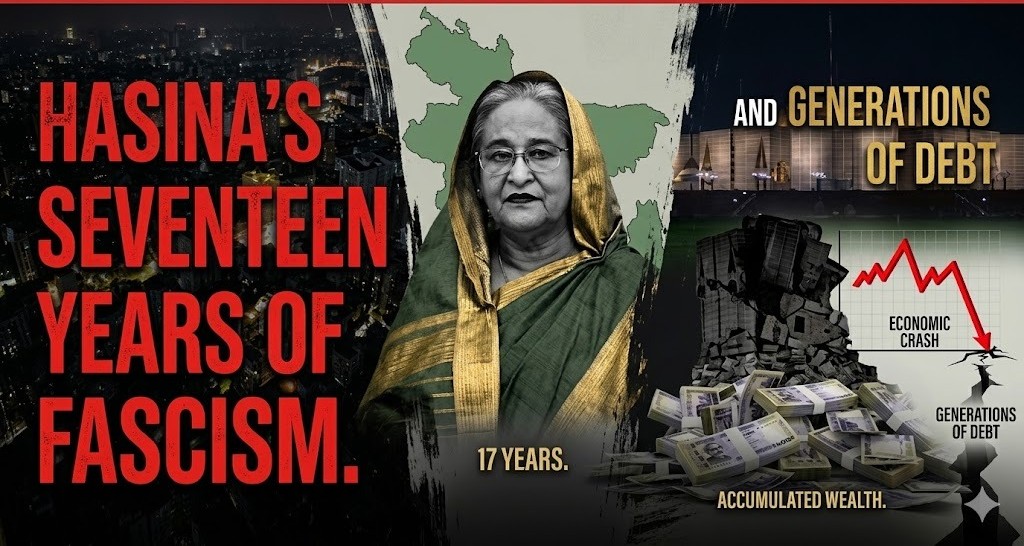
Sheikh Hasina boarded a helicopter and left Bangladesh. She had governed the country for seventeen years through fascism. What she left behind was a financial hole so deep that economists estimate every Bangladeshi citizen now carries a personal share of over 100,000 taka in public debt, many of whom have never taken out a loan in their lives and never will.
The numbers are stark. Bangladesh’s total public debt by the time of her departure had crossed 18 trillion taka. External debt alone stood at approximately 100 billion dollars. For a country where a significant portion of the population lives on daily wages, these figures are not merely economic statistics. They are a structural constraint on the future on schools that will not be built, hospitals that will go under-resourced, and a currency that will continue to feel the pressure of obligations that compound quietly every year.
Debt, by itself, is not evidence of misgovernance. Developing nations borrow. Infrastructure costs money. The question that matters is whether borrowed capital translates into proportionate public value. In Bangladesh under Hasina, the evidence increasingly suggests it did not.
The White Paper committee, formed by the interim government following her removal, concluded that capital flight during her fifteen-year tenure averaged 16 billion dollars annually. Cumulatively, that figure exceeds 234 billion dollars money that passed through the Bangladeshi economy and then, through various mechanisms, left it. Transparency International Bangladesh had separately estimated annual outflows of between 12 and 15 billion dollars for over a decade. The two figures, from different sources using different methodologies, point in the same direction.
The architecture for moving this money was not improvised. Investigators have identified a network of entities allegedly constructed years in advance. Prochaya Limited, a Bangladeshi company registered in March 2009, was linked to Hasina’s sister Sheikh Rehana and brother-in-law Tarique Ahmed Siddique. According to investigators, this company operated in conjunction with Destiny Group — a Ponzi scheme-style investment company to move approximately 900 million dollars into offshore accounts spanning multiple jurisdictions, including the United Kingdom. A separate US-registered company, Zumana Investment, has also appeared in related financial investigations. These were not the instruments of opportunistic corruption. They suggest deliberate, pre-meditated infrastructure for systematic capital extraction.
Nothing illustrates this more clearly than the Rooppur Nuclear Power Plant, Bangladesh’s single largest infrastructure project and, arguably, its most consequential financial decision of the past two decades. In January 2013, Hasina traveled to Moscow with her son Sajeeb Wazed Joy and niece Tulip Siddiq, a British Member of Parliament. At the Kremlin, two agreements were signed: a 12.65-billion-dollar nuclear energy cooperation deal with Russia’s state nuclear corporation Rosatom, and a separate 1-billion-dollar arms procurement agreement the largest defence purchase in Bangladesh’s post-independence history. The nuclear plant would be financed through a Russian loan covering ninety percent of construction costs, with repayment guaranteed through Gazprom’s access to Bangladeshi gas fields.
The financial terms of the deal raised questions from the outset. Independent analysis found the per-unit construction cost at Rooppur to be substantially higher than comparable Rosatom-built plants in India and Belarus countries at similar or earlier stages of nuclear development. The excess could not be fully explained by Bangladesh’s first-mover costs or logistical factors alone.
Bangladesh’s Anti-Corruption Commission has since initiated a formal inquiry into allegations that approximately 5 billion dollars was extracted from the project through artificially inflated costs, with funds allegedly transferred from Russian slush funds held in Malaysian banks into offshore accounts connected to Hasina and her family. Joy and Siddiq are named in the investigation as alleged intermediaries. Rosatom has categorically denied involvement in any financial misconduct and stated its readiness to defend its position legally. Siddiq has described the allegations as politically motivated and without evidentiary basis. The investigation remains ongoing.
What is not in dispute because it was documented, investigated, and resulted in arrests is what happened further down the supply chain. Engineers tasked with furnishing 966 residential apartments for Rooppur plant workers filed procurement invoices that, when they became public in 2019, prompted immediate national outrage. Each pillow had been billed at 5,957 taka, against a market price of 250 to 300 taka an inflation factor of nearly twenty. The cost of transporting each pillow to its designated flat was separately invoiced at 931 taka. A single bed was recorded at 43,357 taka. A dining table set at 114,674 taka. To ensure these purchases avoided the mandatory central government review triggered by expenditures exceeding 30 crore taka, procurement was deliberately fragmented across multiple smaller contracts. Thirteen individuals were arrested. The episode entered public consciousness as the “pillow scandal.” It was not an aberration within an otherwise clean system. It was the system made visible.
The pattern that emerges across these cases from offshore holding companies to inflated nuclear contracts to fraudulent furniture procurement is one of a state apparatus systematically redirected toward private accumulation. Loans were negotiated in Bangladesh’s name, cost estimates were engineered to create extractable margins, and the surplus moved outward through networks built precisely for that purpose. The debt stayed. The money did not.
Bangladesh is now governed by an interim administration navigating the consequences. The loans taken under Hasina’s government remain on the national balance sheet, accruing interest, demanding repayment. The IMF, the World Bank, and bilateral creditors do not distinguish between borrowed funds that built genuine infrastructure and those that financed someone’s offshore portfolio. Bangladesh owes what Bangladesh owes.
The people who will repay it through decades of fiscal constraint, through foregone public investment, through the slow, grinding mathematics of sovereign debt servicing had no meaningful say in how it was accumulated. That is perhaps the most precise definition of what was done to them.
Hasina’s Seventeen Years of Fascism and Generations of Debt
124
