

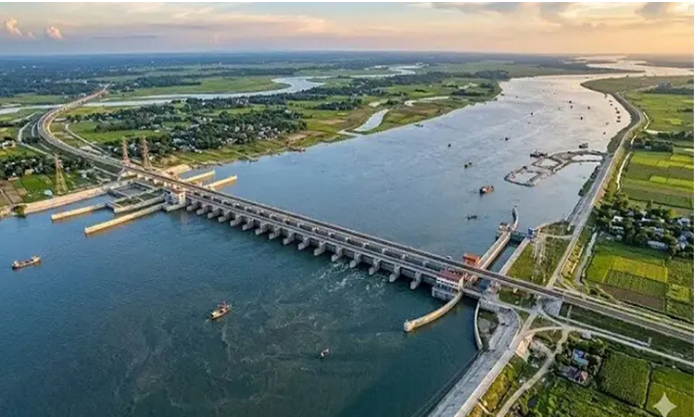
The Padma Barrage Project is emerging as one of Bangladesh’s largest water management and regional development initiatives, with officials and experts expecting it to boost agricultural production, create jobs and transform the economy of the southwestern region.
The government has approved the project at an estimated cost of Tk 34,497 crore to address water shortages, improve river management and revive dying rivers in the region. The project will be financed entirely through domestic resources and is scheduled for completion by June 2033.
State Minister for Water Resources Farhad Hossain Azad said the project is not only about river management but also about improving the lives and livelihoods of millions of people.
“The full potential of the region’s river system could not be utilized due to navigability problems and limited management over the years,” he said.
According to the state minister, the project will improve river management, water conservation, irrigation facilities, riverbank protection and flood control.
He said the initiative is expected to benefit nearly five crore people living in 161 upazilas across 24 districts in the southwestern region.
Major Boost for Agriculture
Agricultural experts believe the project could significantly increase crop production by ensuring a reliable supply of freshwater for irrigation.
More than 200,000 hectares of single-crop land could be converted into double-crop land, while over 100,000 hectares may become suitable for triple-crop cultivation.
The availability of freshwater in coastal and southwestern areas is also expected to improve soil fertility and increase food production.
Researchers estimate that average Boro rice yields could rise from the current 4.5-5 tonnes per hectare to between 6 and 7 tonnes per hectare.
Wheat production could increase from 3.5 tonnes to 4.5 tonnes per hectare, maize production from 8 tonnes to 10-12 tonnes per hectare and potato production from 25 tonnes to 30-35 tonnes per hectare.
Experts estimate that increased agricultural production could directly benefit three to four million people while raising farmers’ incomes by 25 to 40 percent.
Flood Control and River Erosion Protection
The project is also expected to play a major role in addressing river erosion and flood risks in the Padma basin.
According to the Bangladesh Water Development Board (BWDB), hundreds of hectares of agricultural land are lost every year due to erosion along the 341-kilometre stretch of the Padma River within Bangladesh.
Over the past two decades, an estimated 8,000 to 10,000 hectares of farmland have been affected by erosion, while 10,000 to 15,000 families face direct threats from riverbank erosion annually.
Experts say regular dredging, improved flow management and protective structures could reduce erosion rates by 30 to 50 percent.
The project is also expected to provide protection from flooding and river erosion for between two and 2.5 million people while safeguarding farmland, roads, bridges, educational institutions and homesteads.
Improved drainage systems and increased water-carrying capacity could reduce flood risks by 20 to 30 percent, according to water resource specialists.
New Opportunities for Industry and Employment
Officials believe the project will stimulate economic activity across the region through increased agricultural production and agro-based industries.
Experts say the improved availability of water and agricultural raw materials could support the establishment of more than 1,000 small and medium-sized agro-based enterprises.
According to economic analysts, each agro-based enterprise generates employment for 20 to 30 people on average.
Based on these estimates, project-related investments could create between 100,000 and 200,000 new jobs in the long term.
Increased agricultural output is also expected to inject additional income into local economies, benefiting three to four million people directly and indirectly.
Long-Term Regional Development
State Minister for Cultural Affairs and Rajbari lawmaker Ali Newaz Mahmud Khaiyam said people across the southwestern region are eagerly awaiting implementation of the project.
He described the initiative as a long-cherished demand of the region and expressed optimism about its economic impact.
Water resource experts believe the Padma Barrage Project has the potential to become a transformative development initiative by addressing water scarcity, improving agricultural productivity, reducing flood and erosion risks and creating new opportunities for employment and industrial growth.
Officials say the project could play a key role in narrowing regional disparities while strengthening the national economy through improved water management and sustainable development.
