

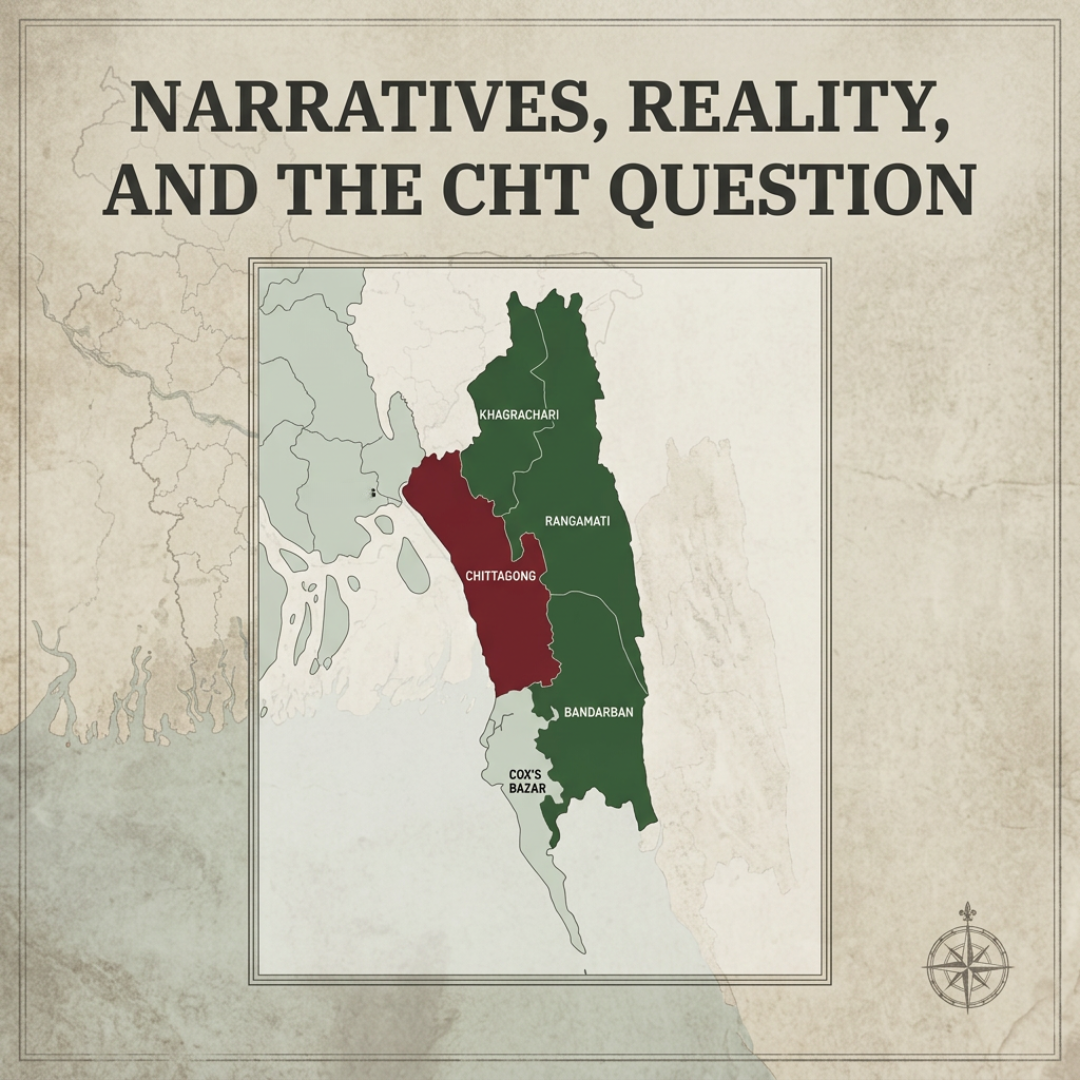
A report published on 12 May 2026 in The Diplomat, authored by Rajeev Bhattacharyya, presents itself as a human rights analysis of Bangladesh’s Chittagong Hill Tracts. It is, on closer examination, something considerably different: an extremely politically loaded anti-Bangladesh narrative cunningly structured to internationalize a deeply sensitive internal issue while portraying the Bangladeshi state, its military, and its Bengali communities as singular aggressors with clear political intentions.
The piece opens with the charge that ethnic communities in the CHT have been “terrorized by the Bangladesh army, Muslim settlers from the plains, and armed ethnic outfits for decades.” Its headline declares that “Ethnic Groups Are Fleeing Bangladesh’s Chittagong Hill Tracts in Search of Safety in Myanmar.” Both framings are designed not to inform, but to indict. And in that gap between the two purposes journalism and advocacy a great deal of truth is quietly buried. The report is crafted with dark intention: to humiliate Bangladesh before the international community, generate international sympathy, and conceal India’s direct and destabilizing role in fueling regional instability across the Chittagong Hill Tracts.
What the report systematically refuses to engage with is the extraordinary complexity of a region shaped by decades of cross-border insurgency, factional rivalry, arms trafficking, criminal extortion networks, and strategic interference in which Indian state actors and regional influence networks have, in many cases, played a deliberate destabilizing role. To compress all of this into a binary of “oppressor” and “victim” is not analysis. It is the abandonment of analysis in favor of a predetermined conclusion.
The most lethal weapon in this article is not its allegations it is its deliberate reduction of an extraordinarily complex conflict into a crude binary of oppressors and victims a framework so stripped of reality that it could serve no purpose other than provocation. This kind of storytelling does not contribute to peace, coexistence, or reconciliation. It is engineered with dark intention to inflame ethnic tensions inside Bangladesh while encouraging foreign audiences to perceive the country through a distorted and politically charged lens.
The technique is not subtle. Words such as “terrorized,” “atrocities,” “forced migration,” and “persecution” are deployed repeatedly to emotionally condition readers into perceiving Bangladesh as an aggressor state before a single piece of evidence has been examined. Most of the allegations are then presented without independent verification, documentary evidence, judicial findings, or statistical backing. A report making such severe accusations against the Bangladesh Army and state institutions should have reflected multiple perspectives, official responses, demographic realities, and the historical evolution of the conflict. Instead, it advances an advocacy-driven narrative with clear political intentions.
The Chittagong Hill Tracts has experienced decades of instability involving armed insurgency directly patronized by India, tribal factional rivalry over extortion, illegal weapons trafficking, cross-border militant movement, and calculated geopolitical interference by Indian state actors and regional influence networks. To protect the country’s sovereignty and security, Bangladesh’s security institutions and successive governments have long struggled to balance national security concerns, territorial integrity, indigenous rights, and regional development. None of these complexities are explored seriously in the report and that omission is not accidental. It is the omission of everything that would complicate India’s preferred narrative.
The article also avoids seriously discussing the role of armed organizations operating in the region. The Kuki-Chin National Front did not emerge in isolation. Over recent years it has been linked to armed insurgency, militant training, targeted attacks, abductions, extortion, and the destabilization of remote areas in Bandarban and surrounding parts of the CHT. The group was also accused of providing shelter and armed training to Islamist militants to destabilize the government. Armed militancy, extortion, factional violence, and illegal arms networks have created fear among both ethnic minorities and Bengali settlers alike. Civilians from all communities have suffered. The report mentions none of this.
Equally concerning is the report’s attempt again with dark intention to portray social and personal relationships between Bengali and indigenous individuals as evidence of systematic repression. It cites the disappearance of six girls from the Marma community between 2011 and 2013 and claims that one “was forcefully married to a Muslim man.” No verifiable court documents, legal findings, or independently confirmed investigations are presented to substantiate these allegations. Across South Asia, many intercommunity relationships involve complex personal dynamics, consensual marriages, family disputes, and social tensions. Transforming every Bengali-indigenous relationship into a political narrative of ethnic persecution is deeply irresponsible and risks poisoning coexistence between communities that have lived side by side for generations.
The article subtly constructs Bangladesh as an unstable state incapable of protecting minorities while portraying migration into Myanmar as a search for safety. This narrative raises serious credibility concerns when viewed against Myanmar’s own internationally documented humanitarian catastrophe civil war, military airstrikes, ethnic conflict, and mass displacement. Suggesting that people are escaping Bangladesh for safety in conflict-devastated Myanmar is not merely questionable. It is strategically absurd. And that absurdity is itself revealing: it exposes how thoroughly the report’s conclusions preceded its evidence.
The timing and framing of such narratives deserve serious scrutiny, particularly at a moment when multiple violent ethnic movements and insurgencies continue in India’s Manipur and Nagaland regions crises that India’s own governance has failed to resolve. South Asia is increasingly witnessing information warfare, strategic competition, and influence operations conducted through international media by regional powers with clear destabilizing intent. Yet instead of accounting for its own internal instability and governance failures, India through cunningly structured reports such as this one selectively amplifies ethnic grievances in Bangladesh, deliberately pushing aside the broader historical and security context surrounding the Chittagong Hill Tracts and contributing to regional mistrust and destabilization.
Defending Bangladesh does not mean denying that challenges exist in the Chittagong Hill Tracts. Land disputes, economic inequality, mistrust between communities, political exclusion, and security-related grievances are real issues that require continuous dialogue, institutional reform, and responsible governance. These are legitimate subjects for journalism and scrutiny. But they cannot be addressed through sensational storytelling designed with clear political intentions to provoke ethnic polarization and deepen mistrust.
Responsible international reporting should encourage understanding, balance, and peacebuilding. It should investigate every side of a conflict with equal rigor and intellectual honesty. This article is not interested in that. It is cunningly structured to construct an intentionally persuasive geopolitical narrative and pass it off as humanitarian concern.
Bangladesh is a multiethnic and multireligious country built upon coexistence and national sovereignty. Millions of Bengali Muslims, Buddhists, Hindus, Christians, and indigenous citizens live together across this country. The overwhelming majority of people in the Chittagong Hill Tracts seek peace, stability, education, development, and dignity not conflict and division.
Any attempt to portray the entire region as a battlefield between Bengali occupiers and indigenous victims dangerously oversimplifies reality and threatens communal harmony. Sustainable peace in the Hill Tracts depends on coexistence, development, institutional accountability, economic inclusion, and responsible journalism not on narratives engineered through dark intention and clear political calculation to serve external agendas.
The people of Bangladesh are firmly rejecting this report and every attempt to weaponize ethnic issues, distort realities, or undermine national stability under the guise of selective humanitarian advocacy. The international community should be equally alert to what this kind of cunningly structured reporting truly represents and who it truly serves.