

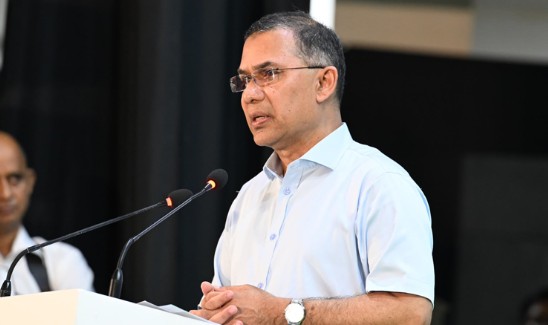
Prime Minister Tarique Rahman said public confidence in Bangladesh’s healthcare system can be fully restored through compassionate treatment, professionalism and a stronger sense of responsibility among doctors and healthcare workers.
He made the remarks while addressing a views exchange meeting titled “DMCians’ Thoughts on the Modernisation of Bangladesh’s Healthcare System” at the Dhaka Medical College (DMC) auditorium on the occasion of the institution’s 81st founding anniversary.
Prime Minister’s spouse Dr. Zubaida Rahman attended the programme as the special guest.
Humane Care Key to Restoring Trust
The Prime Minister said punctuality, accountability and compassionate behaviour toward patients are essential for strengthening the country’s healthcare system.
“Many people from this country are going abroad for medical treatment. As a result, five billion US dollars leave the country every year for treatment expenses,” he said.
“Why can’t we provide that treatment in our own country? Why can’t we earn the trust of our people? This cannot be achieved through the enforcement of law. Only doctors can fully restore the people’s confidence and trust through their humanitarian approach and proper treatment. Therefore, I urge doctors to be more humane in earning the trust of patients,” he added.
Focus on Preventive Healthcare
The Prime Minister said the government has already started recruiting 100,000 health workers, with 80 percent of them being women, to provide family-based preventive and primary healthcare services at the grassroots level.
“A healthy nation is not built by hospitals alone. Rather, physical well-being depends largely on family awareness, a clean neighbourhood and environment, health advice, safe food, regular exercise, and responsible citizenship,” he said.
Referring to the principle that “Prevention is better than cure,” he said the government aims to take healthcare services directly to people’s doorsteps through timely advice on nutrition, vaccination, maternal health, child development, diabetes, hypertension, kidney disease, heart disease and cancer.
Record Health Budget
Highlighting the government’s healthcare priorities, Tarique Rahman said the current national budget has allocated Tk 69,409 crore for the health sector—the highest allocation in the country’s history after education.
He said the allocation represents 1.02 percent of GDP, with a long-term target of increasing health expenditure to 5 percent of GDP over the next five years.
The Prime Minister also noted that the government has reduced or withdrawn VAT and taxes on several essential medical products, including dialysis filters, heart stents, heart valves, pacemakers, oxygenators, peripheral vascular stents, radiofrequency ablation fibres, intraocular lenses and selected raw materials used in cancer treatment.
Expanding Hospital Capacity
Tarique Rahman announced that the government has decided to gradually upgrade every upazila hospital to 101 beds.
He said only five upazilas currently have 100-bed hospitals, forcing many patients to seek treatment in major cities.
To improve healthcare delivery, he said all existing 31- to 51-bed hospitals will be upgraded in phases, while rooftop solar power systems will be installed to ensure uninterrupted electricity supply.
Child Healthcare and Medical Workforce
The Prime Minister said child healthcare remains a priority, adding that the government has taken steps to quickly operationalise five specialised children’s hospitals, including newly built 200-bed hospitals in Barishal and Rajshahi.
He said the initiative would decentralise specialised paediatric healthcare services and make them accessible outside the capital.
To strengthen the healthcare workforce, Tarique Rahman said the recruitment process for 5,000 additional MBBS doctors has already begun, alongside efforts to fill vacant positions for doctors, nurses, pharmacists, medical technologists, midwives and other healthcare professionals.
He also announced that 10 Ansar personnel will be deployed at every upazila health complex to enhance security for hospitals and healthcare workers.
Preserving DMC’s Legacy
Describing Dhaka Medical College as a “living history” and a “witness to time,” the Prime Minister said the institution has played a significant role not only in medical education but also in the Language Movement of 1952, the Liberation War of 1971, the anti-autocracy movement of 1990, and the 2024 mass uprising.
“This campus has not only produced some of the finest doctors at home and abroad; it has also produced teachers, researchers, social leaders, freedom fighters and noble individuals who did not hesitate to sacrifice their own lives and interests to save the lives of others,” he said.
Earlier in the day, the Prime Minister formally inaugurated DMC Day-2026 by releasing balloons and pigeons at Shaheed Milon Chattar and later participated in an open discussion with teachers, doctors and students, who called for preserving the institution’s heritage and transforming Dhaka Medical College into a world-class centre for medical education, research and healthcare.
