

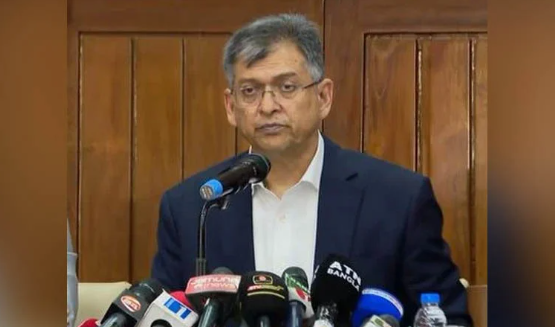
The special committee on constitutional amendments will work to implement the July National Charter exactly as it was signed, committee chairman and Home Minister Salahuddin Ahmed said.
He said the committee would hold discussions with political parties, constitutional experts, former judges, lawyers, teachers, journalists, July fighters, representatives of the Anti-Discrimination Student Movement, families of martyrs and people from different professions and sections of society.
Speaking to journalists at the Jatiya Sangsad Media Centre after the committee’s second meeting, Salahuddin said the committee would try to hold at least one meeting every week and complete its discussions by December.
He said the committee had already started preparing its report and would submit recommendations to parliament after gathering views from all concerned parties.
Of the 26 political parties that signed the July National Charter, 15 sent representatives directly to the latest discussion. Several parties sent more than two representatives, while one party submitted a written statement. Representatives of another party could not attend because of illness and family reasons.
Salahuddin identified the AB Party as the party that submitted the written statement, while representatives of the Jatiya Ganofront were absent.
He said the committee’s door would remain open to political parties that did not sign the charter. Written proposals from both registered and unregistered political parties would also be considered.
The Home Minister said the committee had no intention of excluding any particular party or group from the process. Those who had not yet participated would have the opportunity to submit written proposals and could be invited for further discussions if necessary.
He said the July National Charter separately identifies issues that require constitutional amendments and those that can be implemented through laws, ordinances, rules and executive orders.
According to Salahuddin, political parties have agreed to implement issues on which they reached consensus, while issues carrying a “note of dissent” would also be considered along with the respective views.
The committee will also consider some constitutional proposals included in political parties’ election manifestos beyond the July National Charter.
Regarding a possible change in the fiscal year to better reflect Bangladesh’s seasonal cycle, Salahuddin said work was underway and such a change might require an amendment to the Constitution.
On the proposed upper house of parliament, he said political parties had agreed in principle that it would have 100 members, but differences remained over how members would be selected or elected.
Some parties have proposed allocating seats according to the number of parliamentary seats won, while others have suggested using the proportion of votes received by political parties.
Salahuddin said if a political party clearly states its position on the issue in its election manifesto and receives a public mandate, the matter could be addressed accordingly later.
Rejecting what he described as misleading propaganda concerning the BNP’s position, the Home Minister said the party had pledged to implement the July National Charter exactly as signed.
He said after the special committee completes its report, the Law Ministry would prepare a constitutional amendment bill based on its recommendations and place it before parliament. The bill would then be considered through detailed debate and discussion.
Salahuddin said the Constitution is a living state document and that constitutions in different countries have been amended over time in response to changing social needs and public demands.
He reiterated that Bangladesh did not need a new Constitution to implement the July National Charter and that the necessary changes could be made through constitutional amendments.
Political parties also raised the possibility of bringing back proposals made by six earlier reform commissions for further discussion.
Salahuddin said those recommendations had already been extensively discussed with political parties and later contributed to the formulation of the July National Charter through the National Consensus Commission. Bringing all the proposals back for fresh discussion could make the process more complicated, he said.
However, he added that any party could submit a new and important proposal in writing for consideration.
The issue of changing the constitutional name of the state was also raised. Some political parties proposed using “Democratic Bangladesh” or a similar term as the Bangla translation of “People’s Republic of Bangladesh.” Salahuddin said the issue had previously been discussed and settled, but the new proposal would be recorded for consideration.
On the upper house, he said it would not function as a chamber representing states in a federal system because Bangladesh is a unitary state. Instead, discussions had included the possibility of representing people from different professions and sections of society and individuals capable of making important contributions to the state.
A constitutional amendment bill will be placed before parliament after the special committee submits its recommendations. The bill will then go through detailed parliamentary discussion and debate.
A 12-member special committee was formed on July 13, 2026, with Home Minister Salahuddin Ahmed as its chairman. The provision allows the committee to be expanded to 17 members by including representatives of the opposition.
