

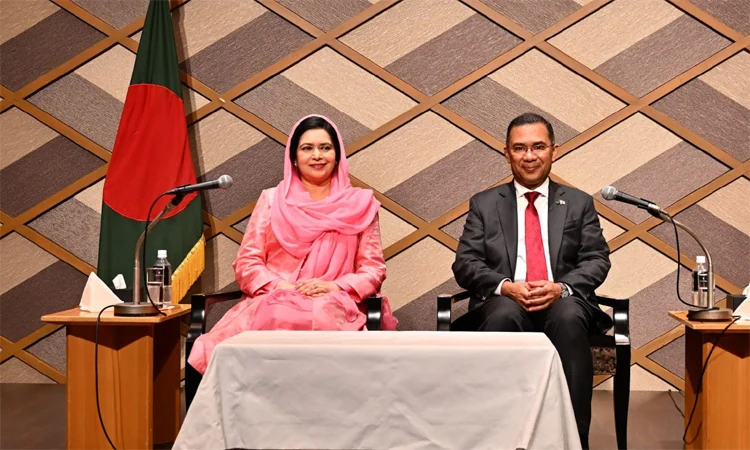
Prime Minister Tarique Rahman has called on expatriate Bangladeshis and citizens at home to work together for national development and public welfare, saying a better Bangladesh would benefit everyone, regardless of where they live.
“Our first plan is to do something good for the country. Whether we live at home or abroad, wherever we are, we should try to do whatever we can to benefit the country and its people,” he said at an exchange of views with members of the Bangladeshi community in Japan at Hotel New Otani in Tokyo.
His wife, Dr Zubaida Rahman, was present at the meeting.
The Prime Minister said Bangladeshis living abroad remained citizens of the country and could make important contributions to its progress. He urged collective efforts to strengthen the economy, education, healthcare and workforce skills.
Responding to questions from expatriates, Tarique Rahman outlined government plans to improve education and healthcare, develop a skilled workforce and expand employment opportunities for Bangladeshis in Japan.
Focus on Skilled Workers for Japan
Emphasising the need to prepare workers for Japan’s labour market, the Prime Minister said Bangladeshi workers should receive proper vocational training, Japanese-language education and an understanding of Japanese culture before travelling to the country.
Such preparation would strengthen Bangladesh’s position in Japan’s labour market and help sustain demand for Bangladeshi workers over the long term, he added.
He also called on expatriate Bangladeshis proficient in Japanese to consider working as language instructors in Bangladesh. He noted that a recent recruitment notice for Japanese-language teachers had received fewer applications than expected.
Expatriates interested in teaching Japanese could contact the Ministry of Education or the Ministry of Expatriates’ Welfare and Overseas Employment to explore opportunities, he said.
Foreign Languages and Vocational Education
On education, Tarique Rahman said the government was prioritising stronger primary education while planning to introduce a third language alongside English to expand students’ opportunities for higher education and employment.
“Opportunities will be created to learn Japanese, German, French and several other foreign languages. Students will be able to choose a language according to their preferences,” he said.
Planning for the initiative had already begun, and the government hoped schools could start offering Japanese and other foreign languages next year.
He added that students would be encouraged to participate in sports, arts and cultural activities alongside their academic studies, while technical and vocational education would receive greater priority.
According to the Prime Minister, foreign-language proficiency and opportunities to develop skills in sports and cultural activities would give students additional advantages in education and employment, both at home and abroad.
Upazila Health Facilities to Be Expanded
The Prime Minister said improving healthcare quality was a major government priority, particularly in ensuring access to essential medical services for rural communities, women and children.
He announced plans to increase the number of beds in upazila health complexes from the existing 50 to 150 each over the next five years.
The government also plans to introduce dialysis services at the upazila level and expand specialised healthcare for women and children. These measures, he said, would reduce the need for rural patients to travel to district and divisional cities for advanced treatment.
Tarique Rahman noted that major hospitals were facing heavy patient loads and said stronger healthcare services at the grassroots level would ease pressure on larger facilities and improve treatment for seriously ill patients.
100,000 Health Workers Planned
The Prime Minister also announced plans to recruit 100,000 health workers to raise awareness about health issues at the village level. Women would account for at least 80 percent of the proposed workforce.
The workers would visit households to promote healthy lifestyles and raise awareness about nutrition and the prevention of diabetes, heart disease and high blood pressure.
Tarique Rahman said greater emphasis on preventive healthcare would help reduce disease rates and ease pressure on the country’s healthcare system.
Japan BNP President Mir Rezaul Karim Reza chaired the meeting, which was attended by leaders and activists from different units of Japan BNP.
