

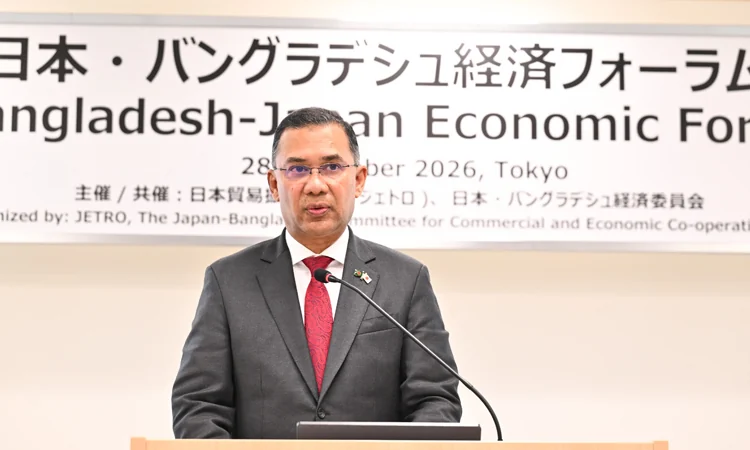
Prime Minister Tarique Rahman has invited Japanese companies to explore investment opportunities in five priority sectors in Bangladesh, aiming to turn longstanding bilateral ties into stronger trade and investment.
The sectors are automotive manufacturing, energy, technology and space cooperation, rail and logistics, and agro-processing and manufacturing.
“I invite Japanese companies to explore five key areas for future cooperation and business opportunities for mutual benefits,” he said while delivering the keynote speech at the Bangladesh-Japan Economic Forum Dialogue at JETRO Hall in Tokyo.
Highlighting the untapped potential of economic relations, the prime minister said around 350 Japanese companies were operating in Bangladesh, while Japanese direct investment in the country remained below US$500 million.
Bangladesh exported goods worth US$1.36 billion to Japan and imported US$2.16 billion worth of goods from the country in the last fiscal year, he said, stressing the need to move beyond development cooperation and expand trade and investment.
Recalling the longstanding friendship between the two countries, Tarique Rahman said Japan was among the first countries to recognise Bangladesh in February 1972 and had remained its largest development partner for more than five decades.
He also recalled the contributions of his parents, Shaheed President Ziaur Rahman and former Prime Minister Begum Khaleda Zia, who visited Japan several times and helped strengthen bilateral relations.
“I want to speak about the next 30-50 years of partnership and collaboration,” he said.
The prime minister noted that Bangladesh and Japan had signed an Economic Partnership Agreement (EPA) this year, the first such agreement Bangladesh had concluded with any country. Under the agreement, 7,379 Bangladeshi products will receive duty-free access to Japan, while Japanese goods, including steel, automotive parts and electronic components, will enjoy preferential access to Bangladesh.
He highlighted Bangladesh’s market of more than 180 million people, young workforce with a median age of 27 and growing middle class as major advantages for investors. Bangladesh is expected to become one of the world’s top 10 consumer economies by 2030, he added.
Automotive Manufacturing
Identifying automotive manufacturing as a priority, Tarique Rahman welcomed Toyota’s plan, announced earlier this month, to begin work on a vehicle manufacturing facility in Bangladesh, with full production targeted for 2029.
He assured the company of the government’s full support.
Energy and Renewable Power
In the energy sector, he invited Japanese companies to invest in liquefied natural gas (LNG) infrastructure, efficient gas-fired power generation and renewable energy.
He said Bangladesh had short-, medium- and long-term plans for gas, electricity and the broader energy sector, urging Japanese firms to explore the opportunities. Bangladesh was also working closely with JERA, he added.
Technology and Space Cooperation
The prime minister said Bangladesh planned to establish a Bangladesh-Japan Technology Park, including an innovation-focused information technology park covering artificial intelligence, cloud computing, robotics and electronics manufacturing.
The initiative would involve Japanese companies, universities and investors.
He also highlighted the potential for cooperation in space technology, saying Bangladesh wanted to strengthen its capabilities by working with Japanese institutions and drawing on Japan’s experience in space science, technology and satellite engineering.
Rail and Logistics
Tarique Rahman identified rail and logistics as another priority, announcing plans for a nationwide elevated high-speed rail network connecting major cities, including Dhaka, Chattogram, Sylhet, Rajshahi, Khulna and Barishal.
“We plan to build a national network master plan, develop passenger and freight demand analysis, route prioritisation and feasibility studies. We will very much welcome Japanese institutions to invest in this critical and priority initiative,” he said.
Agro-Processing and Manufacturing
The prime minister also invited Japanese companies to invest in food processing and manufacturing, highlighting Bangladesh’s diverse production of crops, fruits and vegetables.
“Japanese companies can explore opportunities in food processing in Bangladesh. We invite Japanese companies to invest in the Bangladesh Special Economic Zone at Araihazar. Sumitomo Corporation is developing this zone to Japanese standards,” he said.
Investment Climate and Skills Development
Tarique Rahman said the government was working to address concerns raised by Japanese companies over reliable energy supplies, efficient infrastructure, customs clearance and predictable taxation.
“We have listened. We are working to address these concerns and deliver better outcomes,” he said, adding that businesses needed certainty and investors needed confidence.
“Our job is creating the right environment to deliver both,” he said.
Emphasising people-to-people ties and skills development, the prime minister said Bangladeshi students travelled to Japan every year for higher education, gaining valuable skills and experience before returning home.
He said teaching Japanese to Bangladeshi students was a government priority, outlining a vision of millions of young people learning the language alongside technical skills.
Highly skilled Bangladeshi professionals with Japanese-language proficiency could help meet employment needs in both countries, he added.
“Japan stood beside Bangladesh as we built our foundations. Now, we invite you to build our industries, create new opportunities, and grow together,” he said.
“Let us turn our longstanding friendship into a stronger partnership. Let us create mutual opportunities for our people, and prosperity for both of our nations,” he added.
The Bangladesh-Japan Economic Forum Dialogue was organised by the Japan External Trade Organization (JETRO) in cooperation with the Japan-Bangladesh Committee for Commercial and Economic Co-operation (JBCCEC), with support from the Bangladesh Embassy in Japan.
JETRO President Susumu Kataoka delivered the opening remarks, while Japan’s Parliamentary Vice-Minister of Economy, Trade and Industry Shinji Wakayama addressed the event as a guest speaker. The programme also featured an MoU exchange ceremony and announcements of investment and cooperation projects.
Finance and Planning Minister Amir Khosru Mahmud Chowdhury spoke on building an investment-led economy in Bangladesh, while Invest Bangladesh Chairman Ashik Chowdhury presented reforms and initiatives to facilitate investment.
Kenichiro Kawamoto, branch general manager and country chairperson of Mitsui & Co. (Asia Pacific) Pte. Ltd.’s Dhaka branch, delivered a presentation titled “Together for a Brighter Bangladesh”.
Reisuke Aratani, vice-president of YKK Corporation’s Global Sales Headquarters, discussed the company’s business journey in Bangladesh and its future prospects. Prime Minister’s Adviser Rehan Asif Asad also spoke about emerging high-growth businesses in Bangladesh.
