

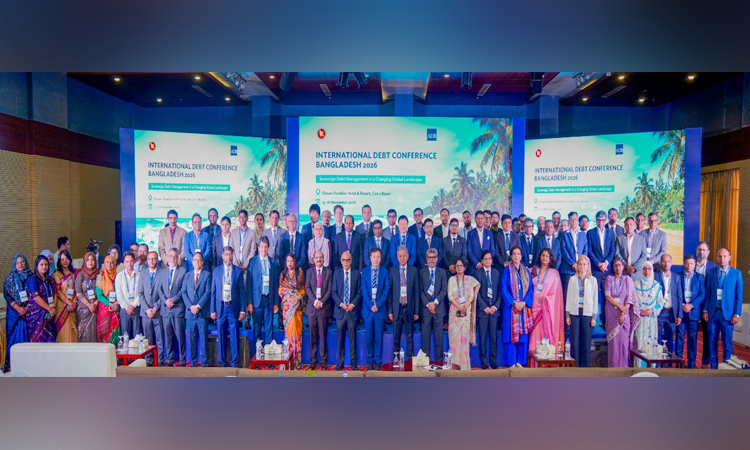
Finance and Planning Minister Amir Khosru Mahmud Chowdhury has said the government aims to transform Bangladesh into a trillion-dollar economy by 2034, stressing the importance of prudent borrowing, fiscal discipline and sustainable financing.
Addressing the inaugural session of the two-day International Debt Conference Bangladesh 2026 in Cox’s Bazar on Sunday, he identified rising debt-servicing obligations, weak revenue mobilisation and limited fiscal space as major economic challenges.
“Our objective must be to ensure that every taka borrowed contributes meaningfully to economic growth, productivity and public welfare,” he said.
“Our ambition is not simply to access international capital markets, but to do so responsibly and sustainably,” he added.
The minister said the government was also considering innovative financing instruments, including sovereign Sukuk, green and blue bonds, and blended finance.
“The true measure of successful sovereign borrowing is not how much a country borrows, but how effectively those resources contribute to economic growth, public welfare and long-term prosperity,” he said.
The Finance Division and the Asian Development Bank (ADB) jointly organised the conference from November 15 to 16 under the theme “Sovereign Debt Management in a Changing Global Landscape”.
The event brought together policymakers, government officials and financial experts from Bangladesh and abroad to discuss sustainable borrowing strategies amid rising financing costs, global economic uncertainty and changes in international capital markets.
Participants included officials from the Finance Division, Economic Relations Division, Internal Resources Division, Financial Institutions Division, National Board of Revenue and Bangladesh Bank. Representatives from the debt offices of Sri Lanka, Pakistan, Indonesia and Malaysia also attended, alongside officials from the ADB, World Bank and International Monetary Fund (IMF).
Experts stress stronger debt management
The opening session was chaired by Finance Division Secretary Dr Md Khairuzzaman Mozumder. Prime Minister’s Special Assistant Tanvir Shahriar Ghani, Financial Institutions Division Secretary Nazma Mobarek and ADB Country Director for Bangladesh Qingfeng Zhang also addressed the session.
Finance Division Additional Secretary Hasan Khaled Foisal presented an overview of the conference, while ADB-BRM Lead Social Sector Officer S M Ebadur Rahman delivered the welcome remarks.
Tanvir Shahriar Ghani said Bangladesh should explore raising funds through dollar-denominated Eurobonds and Sukuk while carefully assessing its borrowing capacity.
He said Bangladesh’s inclusion in a JP Morgan emerging-market government bond index could increase the international profile of its securities. However, attracting foreign investors would require strong economic fundamentals, transparent trading and reliable arrangements for repatriating investment proceeds.
He also called for stronger links with international settlement platforms and closer cooperation between banks and capital markets to finance large industrial projects.
Dr Md Khairuzzaman Mozumder said the Finance Division was working to publish an annual borrowing plan to make government financing more predictable and transparent as Bangladesh prepares to graduate from the least developed country (LDC) category.
He noted that changing global interest rates and exchange-rate volatility had made government borrowing more complex.
The secretary outlined plans to improve reporting on domestic and external debt and debt-servicing obligations, strengthen Treasury bill and bond auctions, and broaden the investor base.
Financial Institutions Division Secretary Nazma Mobarek said annual interest payments on external debt, measured in taka, were projected to more than double between FY2024-25 and FY2028-29.
She said public debt stood at less than 39 percent of GDP at the end of FY2024-25 and was expected to remain close to that level through FY2028-29.
ADB calls for greater transparency
ADB Country Director for Bangladesh Qingfeng Zhang said rising debt-servicing costs were squeezing development spending and increasing the government’s reliance on domestic borrowing.
He said total debt servicing rose to 3 percent of gross domestic product in FY2024-25 from 2.3 percent in FY2020-21.
Zhang called for fuller disclosure of public debt, including government guarantees, and closer coordination among borrowing, cash management and budget planning to ensure smoother repayments.
He also urged Bangladesh to deepen its domestic bond market, improve project appraisal and procurement, and strengthen oversight of state-owned enterprises and public-private partnerships to contain fiscal risks.
Focus on productive investment
The conference is being held at a time when developing economies face increasingly complex decisions over financing public investment, managing debt obligations and maintaining fiscal stability.
A key focus is how countries can use borrowing to support infrastructure development, employment generation and economic growth without creating unsustainable pressure on public finances.
Prasad Ananthakrishnan, an ADB consultant and former adviser at the IMF, delivered a special address on the relationship between sovereign borrowing, productive investment and economic growth.
His presentation examined when public borrowing can generate economic benefits and how excessive debt can undermine fiscal stability or limit private investment.
The conference is also giving particular attention to the challenges facing countries graduating from LDC status, especially the need to diversify financing sources and expand access to international capital markets.
