

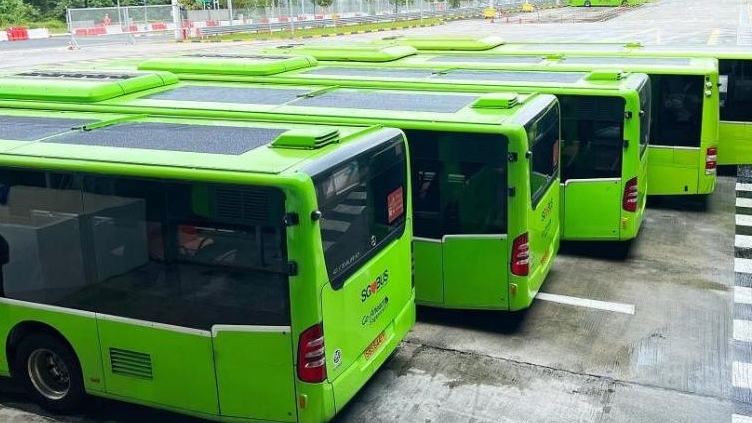
The government plans to import 1,000 electric buses over the next three years to promote environmentally friendly public transportation across the country.
Of the total, 200 buses are planned for operation in Dhaka, while the remaining vehicles will be deployed on different routes outside the capital.
Road Transport and Highways Secretary Dr Mohammed Ziaul Haque disclosed the plan to BSS, saying the initiative aims to improve public transport services.
According to the plan, 100 buses are expected to arrive in the initial phase by February. Of these, 50 will be Pink buses exclusively reserved for women passengers to ensure safer and more comfortable journeys. The other 50 will be red buses offering general services to both male and female passengers.
Sources at the Bangladesh Road Transport Corporation (BRTC) said the buses would come in different sizes. The Pink buses for women will be relatively smaller, measuring nine metres in length and carrying around 50 passengers. The red general-service buses will be larger, measuring 12 metres and accommodating around 70 passengers.
The government also plans to allocate adequate space in Dhaka for bus maintenance and other technical facilities to ensure the smooth operation of the electric fleet.
However, the exact seating capacity of the buses has not yet been confirmed. The number of seats is expected to vary depending on the size and configuration of each vehicle.
The initiative aims to reduce dependence on conventional fuels, minimise air pollution and establish a more sustainable and passenger-friendly public transport system in Dhaka and other parts of the country.
As part of the implementation of the current government’s election manifesto, Pink buses have already been introduced on various routes to ensure safe transport for women.
Speaking to BSS, BRTC General Manager (ICWS and Training) Engineer Fatima Begum said the government aimed to ensure a safe transport system for women.
She said BRTC had already introduced Pink bus services operated by female drivers for women passengers. The corporation is also preparing to launch air-conditioned electric Pink buses to further improve the service.
Fatima said the Pink bus service was not profit-oriented but aimed at ensuring a safe environment for women in metropolitan areas and across the country.
She also said the government had set a target of reducing road crash fatalities by half by 2030.
In this regard, BRTC, with financial support from the World Bank and the Asian Development Bank (ADB), has been providing training, particularly to young people, to develop skilled drivers who can secure decent jobs and salaries at home and abroad.
BRTC is providing free light-vehicle driving training to new learners under two projects: the World Bank-funded Bangladesh Road Safety Project and the ADB-funded Skills for Industry Competitiveness and Innovation Program (SICIP). The projects aim to train around 68,000 people.
A significant number of women have already received light-vehicle driving training under the two projects and secured jobs both at home and abroad.
Fatima also noted that various surveys suggested female drivers tended to drive more defensively than male drivers.
“Women passengers feel safe and comfortable in public transport if vehicles are operated by female drivers and helpers in a society like Bangladesh where patriarchal mentality dominates. From that point of view, the government has introduced Pink bus service and it will be further expanded,” she said.
