

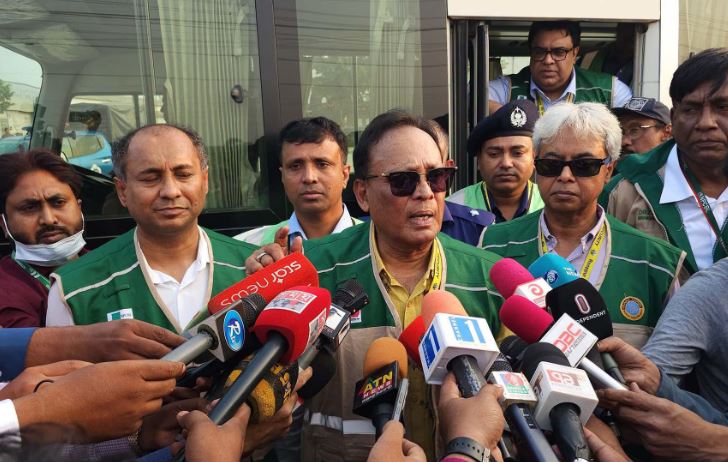
Science and Technology Minister Faqir Mahbub Anam has described the successful trial connection of electricity from the first unit of the Rooppur Nuclear Power Plant (RNPP) to the national grid as a historic achievement, saying Bangladesh has emerged as the world’s 33rd nuclear power country.
He called the development “very happy news for the entire nation” while speaking to journalists in front of the plant in Ishwardi after the successful grid connection.
According to a ministry press release, Bangladesh’s first nuclear power plant began trial power supply after successfully completing synchronisation with the national grid.
The first unit started supplying 350 megawatts of electricity to the national grid at 3:00 pm in the presence of the minister.
Briefing journalists on the trial operation, Faqir Mahbub Anam said up to 350 megawatts had been supplied to the grid and the initial results were “very satisfactory”. The supply was later reduced and stabilised at 300 megawatts to maintain grid stability.
He said the electricity connection followed a long period of technical work and complex tests at different stages of the project.
Referring to observations by the International Atomic Energy Agency (IAEA), the minister said its delegation was highly satisfied with the project’s overall progress and safety arrangements, helping make the successful grid synchronisation possible.
Prime Minister Tarique Rahman congratulated everyone involved in the achievement, while the minister expressed gratitude to the people of the country.
He described the development as an important milestone in the plant’s power generation and grid connection process.
Prime Minister’s Adviser on Science and Technology Rehan Asif Asad, Science and Technology Ministry Secretary Md Anwar Hossain, RNPP Construction Project Director Dr Md Kabir Hossain and Nuclear Power Plant Company Bangladesh Limited (NPCBL) Managing Director Dr Zahedul Hasan, among others, were present during the briefing.
Kabir Hossain said that, according to the plan, electricity from the initial trial connection would be supplied to the national grid for around eight to 10 hours.
During this period, important technical tests will be conducted to assess the performance and stability of the plant’s turbine, generator and operating systems connected to the national grid.
He said the plant would later be disconnected from the grid for further technical tests. After a break of around 28 hours, it would be reconnected for four to six hours to complete the necessary technical and operational checks.
The performance of the plant’s various systems, including the turbine and generator, and their coordination with the national grid will be closely monitored at every stage, he added.
Once all technical tests produce satisfactory results and the work planned for this stage is completed, approval from the Bangladesh Atomic Energy Regulatory Authority (BAERA) will be required before proceeding to the next phase of trial operation.
Subject to BAERA’s approval, the plant will be connected to the national grid again on a trial basis, allowing the next phase of power supply to move forward, Kabir said.
Under the agreement with the Russian contractor, commercial electricity supply from the first unit at full capacity will begin permanently after completion of a 10-month trial operation.
The Bangladesh Atomic Energy Commission will then take provisional handover of the first unit from the Russian contractor. Later, NPCBL will begin operating the unit following a government gazette notification.
Each of the two units of the Rooppur Nuclear Power Plant has a generation capacity of 1,200 megawatts, giving the facility a total capacity of 2,400 megawatts.
The plant is expected to make a significant contribution to meeting the country’s growing electricity demand, strengthening energy security and ensuring sustainable power generation.
The successful trial connection marks a historic step forward for Bangladesh’s power and energy sector, the ministry said, adding that the country had moved closer to establishing nuclear technology-based electricity generation.
