

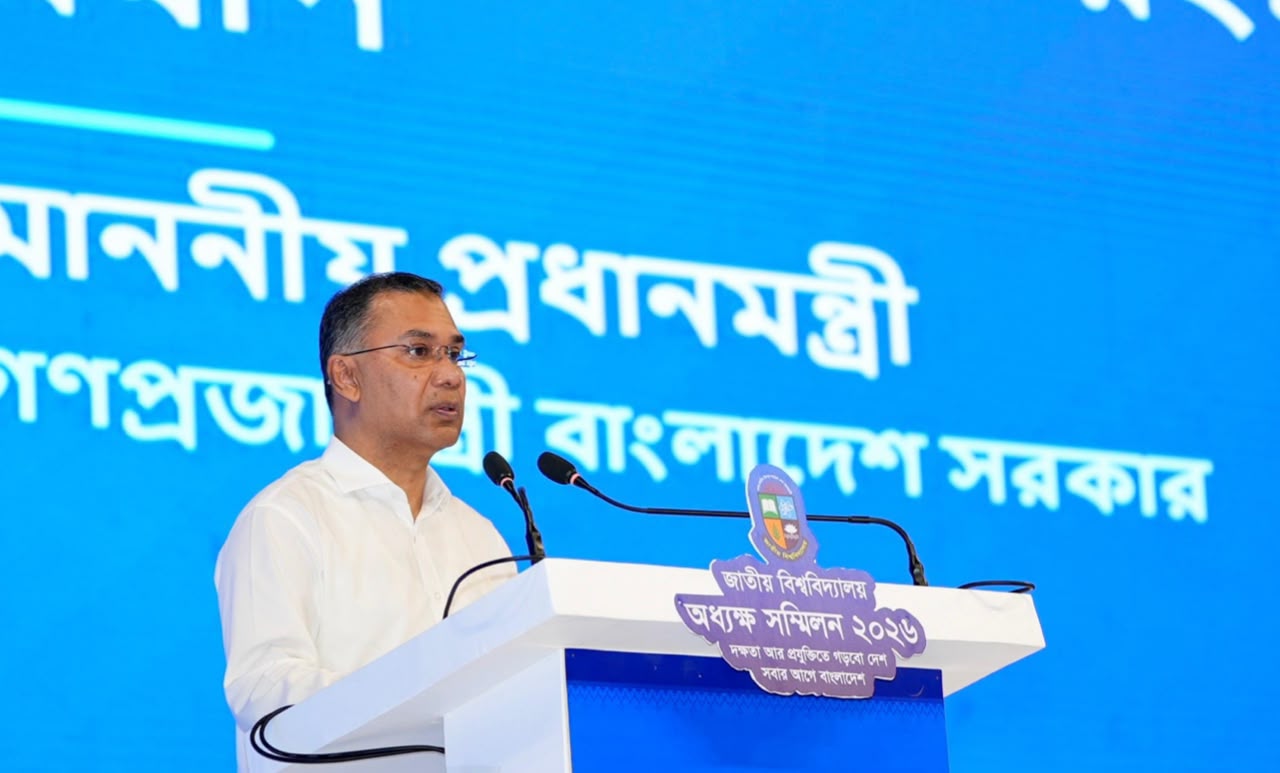
Prime Minister Tarique Rahman has urged teachers to keep educational institutions free from factionalism and personal rivalry, stressing that political differences must not disrupt academic activities or student safety.
He also called for a modern, skills-based education system featuring student-centred and research-based teaching methods.
“Differences in political opinion and belief are natural in a democratic society. But teachers must remain alert and conscious so that such differences do not disrupt the learning environment, teaching activities, administrative discipline and the safety of students,” he said.
The Prime Minister made the remarks as the chief guest at a conference of principals of the National University (NU) at Shaheed Suhrawardy Indoor Stadium in Mirpur.
Principals from all 2,318 colleges affiliated with the National University attended the conference, held under the theme “Building the country through skills and technology, Bangladesh First”.
Describing the responsibilities of a college principal, Tarique Rahman said a principal was not merely the administrative head of an institution but also its leader, moral guide and one of the architects of the future generation.
“The overall progress of an institution depends largely on his or her merit, competence, decisions, prudence and foresight,” he said.
Recalling the contribution of late Begum Khaleda Zia, the Prime Minister said she had established the National University on October 21, 1992, to expand higher education opportunities for people in both urban and rural areas.
He noted that the number of affiliated colleges had increased to nearly 2,500 since the university’s establishment. However, he questioned whether the quality of education had improved at the same pace as the growth in the number of colleges and students.
He said the education sector, like other sectors, had suffered during the previous regime and called for collective efforts to make the system modern, quality-oriented and suitable for current needs.
The government was preparing plans and taking necessary steps in this regard, but principals would have to play a leading role in implementing them, he added.
Focus on teacher training and technology-based education
Stressing the importance of teacher training, Tarique Rahman said there was no alternative to developing teachers’ skills to build a modern, technology-based education system.
He called for replacing traditional teacher-centred methods with student-centred and research-based teaching.
“Instead of the prevailing teacher-centred education, student-centred and research-based teaching methods must be introduced. The ‘Training of Trainers’ programme can play an effective role in this regard,” he said.
Warning against failure to adapt to technological changes, he said the number of people holding academic certificates could continue to rise without reducing unemployment if teachers and students could not adjust to modern education methods.
He identified the lack of practical and technical knowledge alongside academic qualifications as a major reason for graduate unemployment.
The Prime Minister said artificial intelligence, robotics, big data, the Internet of Things, blockchain, automation, genetic engineering, cybersecurity and 5G were transforming the future job market.
While these technologies were making some traditional professions obsolete, they were also creating new employment opportunities, he said.
“In this reality, there is no alternative to building a technology-based, innovation-oriented, skills-based and employment-friendly education system,” he added.
Stronger links between education and industry
Emphasising coordination between educational institutions and industries, Tarique Rahman said academic institutions should provide the foundation of knowledge while industries should help turn that knowledge into practical skills.
He asked the authorities to consider allowing experienced and skilled industry professionals to teach at colleges and universities as guest lecturers.
He also called on entrepreneurs to expand internship opportunities, industrial attachments and practical training for students.
“If students can acquire goal-oriented skills and experience during their academic life, they will be able to become entrepreneurs themselves and create jobs for others instead of waiting for jobs,” he said.
The Prime Minister stressed that technical education must be combined with humanistic learning.
He said education should go beyond job preparation and provide opportunities for students to develop human values, creativity, reasoning and leadership through literature, philosophy, history, science, social science and cultural activities.
He also called for opportunities to learn Arabic, Mandarin, Japanese, Korean, French and German alongside English. Colleges should introduce career counselling, skills development programmes, language clubs and entrepreneurship initiatives, he added.
Teacher recruitment and institutional development
Tarique Rahman said the government was mindful of protecting the interests of educational institutions and teachers.
He urged the relevant authorities to work together to assess teacher shortages at individual colleges, fill vacant posts, recruit and appoint necessary teachers and arrange training and skills development.
He specifically called on the Ministry of Education, Directorate of Secondary and Higher Education, Non-Government Teachers’ Registration and Certification Authority (NTRCA) and National University authorities to take the necessary initiatives.
Colleges with suitable rooftop space should also consider installing solar power systems, he said.
The Prime Minister urged teachers and students to work together to keep their institutions, homes and surroundings clean and strengthen tree plantation activities. He noted that nearly 200,000 trees had already been planted at educational institutions.
He also called on every college to adopt a positive approach towards financially disadvantaged, marginalised and students with special needs.
“The government wants to build a Bangladesh that is rich in knowledge and virtue, self-reliant in work, advanced in humanity and will stand tall with its own dignity on the world stage,” he said.
He concluded by wishing success for the National University’s “One Student, One Tree” programme.
Disaster response app unveiled
The programme began with the national anthem and recitation from the Holy Quran, followed by a one-minute silence in honour of the martyrs of the Liberation War and the July 2024 mass uprising.
A documentary highlighting the social activities of Shaheed President Ziaur Rahman and late Begum Khaleda Zia was screened.
National University Vice-Chancellor Professor Dr A S M Amanullah presented the keynote paper and handed a sapling to the Prime Minister on behalf of the university.
A documentary was also unveiled on “Durjog Theke Shosti (Relief from Disaster)”, an application developed by NU student Shahjahan Molla.
The app provides emergency alerts and assistance during disasters and earthquakes. It also offers information on commodity prices, transport, health warnings and government services.
Around 40 lakh students study at the 2,318 colleges affiliated with the National University, accounting for approximately 70 percent of all higher education students in the country.
Education Minister Dr A N M Ehsanul Hoque Milon, Prime Minister’s Education Adviser Mahdi Amin and Senior Secretary of the Secondary and Higher Education Division Abdul Khaleque attended the conference as special guests.
The programme was chaired by NU Vice-Chancellor Professor Dr A S M Amanullah. Pro-Vice Chancellor Professor Dr Mohammad Ali Jinnah, Treasurer Professor Dr Md Nazmul Hossain, Bogura Government Azizul Haque College Principal Professor Md Mahfuzul Islam and Lalmatia Government Mahila College Principal Sultana Mahmuda Yasmin also addressed the event.
