

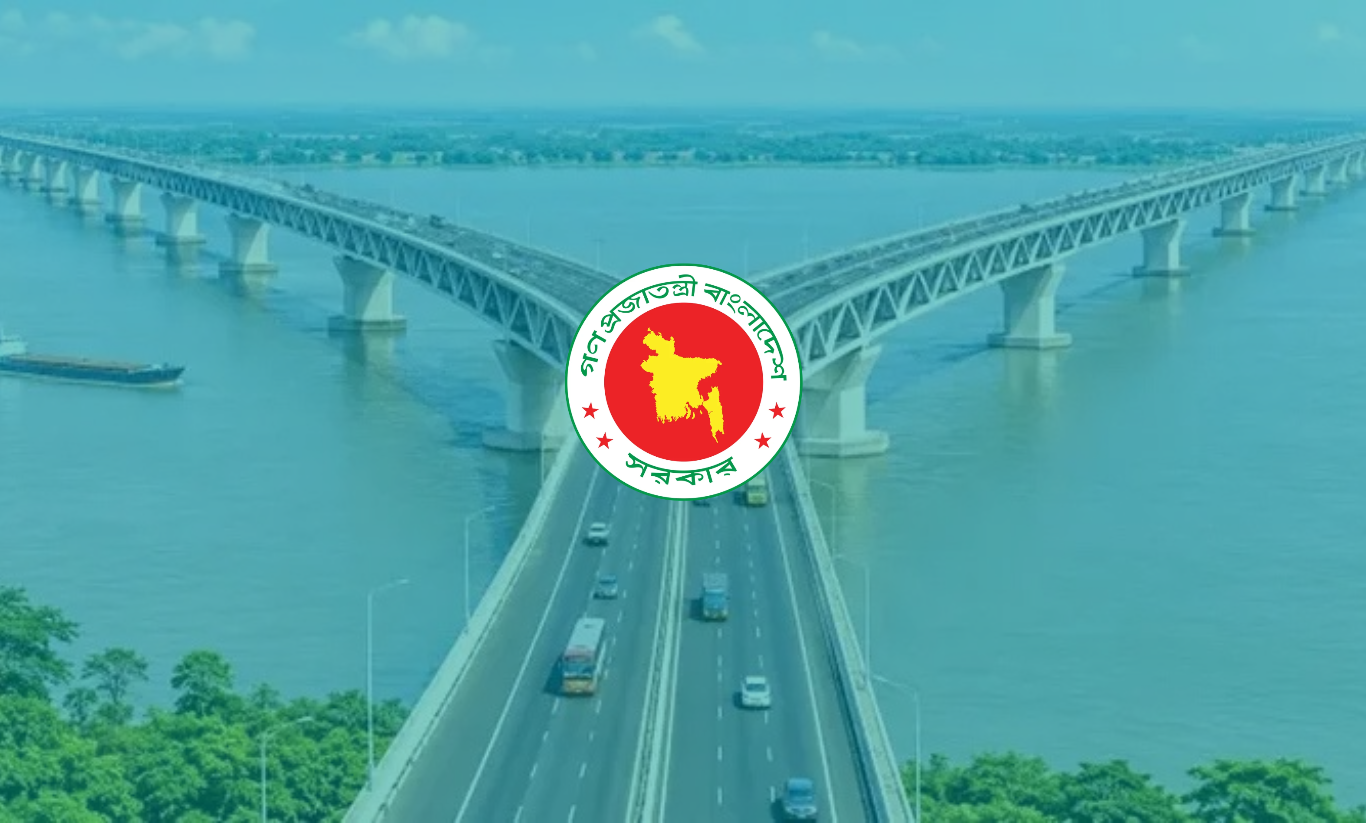
A proposed Y-shaped second Padma Bridge connecting Paturia, Goalanda and Pabna could significantly reduce travel time between Dhaka and Pabna, bringing the journey down from the current five to seven hours to around two to two-and-a-half hours.
The plan also includes upgrading key roads in Pabna town to four lanes to ease traffic congestion and improve regional connectivity.
The proposed bridge would have a junction in the middle of the Padma River near Paturia in Manikganj, with one branch connecting to Goalanda in Rajbari and the other to Kazirhat or Nagarbari in Pabna.
Once completed, the project would establish a direct road connection between Dhaka and Pabna, eliminating the need for the long detour through the Jamuna Bridge.
Alongside the bridge proposal, infrastructure development plans worth around Tk4,000 crore to Tk9,000 crore have been discussed to widen internal roads in Pabna town and improve connecting highways.
Assessing the feasibility of the second Padma Bridge has received priority in the government’s road communication development plan. At the same time, initiatives to upgrade several roads to four lanes are under discussion to reduce congestion in Pabna and improve regional transport links.
However, the proposed Y-shaped design has not yet been finalised. The government’s initial plan considers connecting Manikganj, Rajbari and Pabna, and a feasibility study is underway. The bridge’s final location, length, design and construction cost will be determined based on the study’s findings.
If implemented, the project could benefit several neighbouring districts beyond Pabna. Residents of Pabna, Rajbari, Manikganj, Natore and Sirajganj would gain improved access to the capital and regional commercial centres.
Travel from different upazilas of Pabna, including Ishwardi, Chatmohar, Sujanagar and Santhia, would also become easier.
According to official information, construction of the second Padma Bridge at the Paturia-Daulatdia point was included in the government’s election manifesto. The Bangladesh Bridge Authority’s master plan also considers this corridor.
An allocation of Tk4.50 crore has been made in the 2026-27 fiscal year for the feasibility study, although the final construction cost and financing arrangements have yet to be determined.
Bridges Division Secretary Mohammad Abdur Rouf told BSS that construction of the second Padma Bridge along the Paturia-Daulatdia corridor had received priority in the government’s development plan.
He said a detailed feasibility study was essential before undertaking such a major infrastructure project. The government would consider river morphology, water flow, navigability, river training, bridge design, construction costs and economic viability before making a decision.
He added that the proposed Y-shaped design also needed to be assessed from technical and economic perspectives. The study’s findings would help determine the bridge’s location, design and implementation plan.
Three major roads in Pabna proposed for four-lane upgrade
Alongside the second Padma Bridge, a proposal has been made to upgrade three important roads in Pabna town to four lanes to improve internal communication.
Initiated by Pabna-5 lawmaker Advocate Shamsur Rahman Shimul Biswas, the proposal covers around seven kilometres of roads to be developed in three phases.
In the first phase, the road from Chakchhatiani Mosque through Chakchhatiani Graveyard to the Pabna-Ishwardi Highway in front of Baliahalat Model Mosque would be upgraded to four lanes.
The second phase would cover the road from Chandmari intersection to Power House intersection through Poilanpur intersection.
The third phase proposes widening the road from the Central Bus Terminal to Gachhpara intersection through Mujahid Club, Ananta Cinema Hall and Abdul Hamid Road.
Speaking to BSS, lawmaker Advocate Shamsur Rahman Shimul Biswas said Pabna had long faced infrastructure challenges in its transport system.
He said people travelling from Dhaka to Pabna had to take a longer route through the Jamuna Bridge, increasing both travel time and costs.
He said the objective was to establish direct connectivity between Pabna and the capital through the second Padma Bridge.
“There is a proposal to link one branch of the Y-shaped bridge from Paturia to Goalanda and the other to Kazirhat or Nagarbari in Pabna. Along with this, steps have been taken to upgrade three key roads in Pabna town to four lanes. Implementing these plans will bring a revolutionary change to Pabna’s communication system,” he added.
Improved connectivity expected to boost trade and industry
Pabna is an important agricultural, industrial and commercial district in the country’s northwestern region. A large number of vehicles operate daily around Ishwardi Export Processing Zone (EPZ), Rooppur Nuclear Power Plant, sugar mills, agro-based industries and various commercial centres.
Improved road connectivity is considered essential for transporting agricultural and industrial products from Ishwardi, Sujanagar, Santhia, Bera, Chatmohar and Bhangura.
Once the second Padma Bridge is built, direct road connectivity between Pabna, Manikganj and Rajbari would be established. This could create new opportunities for travel to Dhaka and the transportation of goods to southwestern districts.
Faster transportation of agricultural produce, fish, dairy products and industrial goods would help reduce delivery times and costs while expanding trade and commerce.
Replacing river-dependent transport with direct road connections from Pabna’s Bera and Kazirhat areas could also benefit the local economy and improve connectivity for people in Rajbari, Manikganj, Natore and Sirajganj.
Pabna Chamber of Commerce and Industry (PCCI) President Md Forkan Reza Biswas Badsha told BSS that the district had significant potential in agriculture, industry and business but faced transport limitations that increased the time and cost of moving goods.
He said transportation costs were a major factor when sending agricultural and industrial products to Dhaka and other major markets.
“Traders will greatly benefit if the second Padma Bridge and the four-lane upgrades of key town roads are completed. It will cut freight time, create opportunities for new industries and boost local employment. We want effective initiatives taken for the swift implementation of these projects,” he said.
Stakeholders believe that improving Pabna’s transport network could strengthen economic links between the northern and southwestern regions, not just ease travel for local residents.
However, the successful implementation of the plans will depend on transparent project management, securing the necessary funds and completing each stage on time, from feasibility studies and approvals to construction.
