

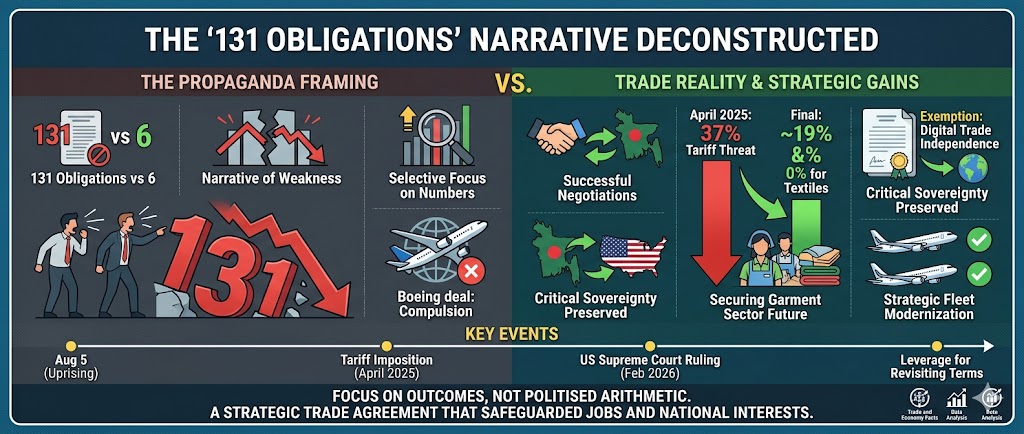
When political opponents run out of legitimate arguments, they resort to arithmetic. The “131 obligations versus 6” framing currently circulating in Bangladesh’s public discourse is a masterclass in exactly that numbers stripped of context, deployed as propaganda. It deserves to be dismantled clearly.
Trade agreements are not symmetrical by design. They are structured around who is seeking market access and who is granting it. Every tariff schedule, every compliance timeline, every sector-specific commitment generates a numbered clause. That is the mechanics of international trade law, not evidence of subjugation. When Bangladesh secured an exemption that both Malaysia and Cambodia failed to obtain the right to negotiate digital trade agreements with third parties without prior American consultation it demonstrated precisely the kind of diplomatic competence that its critics claim was absent. That fact has received almost no coverage. Its absence from the debate is telling.
The economic context matters enormously and is being consistently ignored. In April 2025, the United States imposed a 37 percent reciprocal tariff on Bangladeshi goods under Executive Order 14257. For a country where the readymade garment sector employs over four million workers and constitutes the overwhelming majority of export revenue, that figure was not an abstraction it was an existential threat. The interim government entered negotiations immediately, worked the process, and returned with a rate of 19 percent, subsequently reduced further, alongside a zero-tariff mechanism for textiles. To characterize that outcome as weakness requires either ignorance of the baseline or deliberate misrepresentation of it. Neither reflects well on those making the argument.
The Boeing controversy follows the same pattern of selective memory. Biman Bangladesh Airlines was operating an ageing, inefficient fleet an operational reality that existed entirely independent of this agreement. The question before the current government was never whether to purchase aircraft but which manufacturer under what terms. Embedding that procurement within a broader trade negotiation, where it contributed to reducing bilateral trade imbalance and thereby strengthening Bangladesh’s overall position at the table, reflects strategic thinking rather than compulsion.
The US Supreme Court’s February ruling striking down the IEEPA-based tariff architecture has been weaponized by critics as retrospective proof that negotiations were unnecessary. This is an intellectually dishonest argument. Governments do not have the luxury of negotiating in hindsight. The tariff threat was legally operative and economically real at the moment Bangladesh acted. Furthermore, the ruling does not void the bilateral framework it introduces legal ambiguity that Bangladesh’s negotiators can now exploit to revisit specific terms from a position of greater leverage. The government’s critics have somehow transformed a potential diplomatic advantage into a talking point against the very people who created the conditions for it.
What unites these criticisms is not economic analysis. It is political motivation. The most vocal opposition to this agreement comes from quarters with a vested interest in undermining the legitimacy of the post-August 5 order forces that have consistently sought to recast a popular democratic uprising as foreign interference. The trade deal has become a vehicle for that project. Portraying a framework designed to protect millions of Bangladeshi garment workers as an instrument of national betrayal is not dissent. It is the deliberate manufacture of confusion in service of a political agenda that has already been rejected by the Bangladeshi people once.
Bangladesh entered a negotiation under genuine pressure, extracted meaningful concessions, preserved critical sovereign flexibilities, protected its primary industry, and maintained its most important bilateral trade relationship. That is not the record of a government that failed its people. It is the record of one that understood what was at stake and acted accordingly.