

Dhaka: Every July reopens wounds that have never truly healed for the families who lost sons, brothers and loved ones during the July Mass Uprising of 2024. Two years after the movement that ended Sheikh Hasina’s 16-year rule, their grief remains undiminished—and so does their unwavering demand for justice.
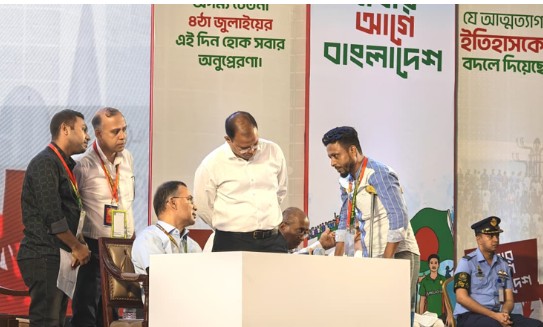
At the July National Conference held at the Bangladesh-China Friendship Conference Center in Agargaon on Friday, family members of the July martyrs and injured fighters transformed a commemorative event into an emotional testimony of sacrifice, loss and hope before Prime Minister Tarique Rahman.
The conference, chaired by Jatiya Sangsad Chief Whip Nurul Islam Moni, was attended by cabinet members, ambassadors and high commissioners, senior military and civil officials, and representatives from various professional groups.
Jointly organised by the July ’24 Martyrs’ Families Society and the Central Executive Committee of Amra July Joddha (We Are July Fighters), the programme echoed with deeply personal accounts from families whose lives were forever changed by the uprising.
“Every July brings back unbearable pain”
For Abdul Rob Mia, father of martyred Miraj Hossain, the arrival of July is no longer a date on the calendar but a painful reminder of the day he lost his son.
“Every July brings back unbearable pain,” he said through tears. “On August 5, police of the fascist Hasina government riddled my son’s chest with bullets. I am a helpless father seeking justice for this crime and for every July fighter who was killed.”
His grief was shared by Shafiul Alam, father of martyred Wasim Akram from Chattogram.
“I have lost my son. No other parent should have to endure such loss,” he said.
While demanding justice, he also appealed for support for those permanently disabled during the movement.
“I urge the government to stand beside the July fighters who lost their limbs so they do not have to live in hardship,” he said.
“Many families lost their only breadwinner”
Abu Hossain, brother of martyr Abu Sayeed, said the sacrifices extended far beyond his own family.
“My brother sacrificed his life fighting against the fascist government,” he said. “Inspired by him, many others also gave their lives or were permanently disabled. Many martyr families lost their sole breadwinner and are living in extreme hardship.”
He urged the government to provide support to affected families, ensure swift justice and preserve the memories of the July martyrs for future generations.
“Our only demand is justice”
For Fatematuz Johra, the pain of losing her eldest son, Abdullah Bin Jahid, was compounded when her younger son was later diagnosed with cancer.
“In my desperation, I knocked on every possible door for help but received none,” she recalled. “However, every member of Amra BNP Paribar stood by us.”
She said Prime Minister Tarique Rahman had personally enquired about the family’s condition while he was in London.
“Now our only demand from the BNP government is justice for all July martyrs,” she said. “I hope every martyr’s family receives the same support. I can never get my son back, but I ask everyone to pray for him.”
Abul Hasan, father of martyr Alvi, said his son was killed in Mirpur on August 4.
“We protested on the streets demanding justice, yet nothing visible happened,” he said. “We waited in hope that Tarique Rahman would return to the country, assume office and ensure justice for our children’s murders.”
Survivors recount life after the uprising
The conference also provided a platform for those who survived the movement but continue to live with permanent physical and emotional scars.
Shahin Malu, who lost both legs during the uprising, said he had no regrets.
“I have no regret over losing both my legs. My only wish is to witness justice for the July fighters,” he said.
Millat Hossain described being shot while leading a procession demanding the fall of the government.
“I lost a great deal of blood but could not receive treatment at any hospital,” he said. “My family was initially told that I had died. Since then, my father became bedridden and later passed away.”
“We are not only July fighters—we have been fighting for the past 17 years,” he added.
Sujan Molla said he had joined the protests following Tarique Rahman’s one-point call from London.
“That demand was achieved and the autocratic ruler fled the country. Yet our regret remains that justice for the slain fighters has not been delivered,” he said.
Alamin, who lost one hand during the movement, appealed for rehabilitation.
“I lost one of my hands, and the pain still overwhelms me. I cannot afford proper treatment. Hundreds of fighters like me lost their limbs. I request the government to ensure proper treatment and rehabilitation for all disabled July fighters.”
Mehedi Hasan Miraj also spoke about the challenges faced after the uprising.
“I was subjected to police torture simply because I supported the BNP,” he said. “During the interim government, we received no assistance. We were told we were not July fighters but BNP activists.”
A shared demand for justice
Although each family carried its own story of loss, their voices converged around a single demand: justice for those who lost their lives during the July Mass Uprising.
The programme began with recitation from the Holy Quran, followed by prayers for the martyrs, the national anthem and the screening of a documentary on the July Movement.
Prime Minister Tarique Rahman presented July Memorial Awards to representatives of martyrs’ families and injured fighters, including Rob Mia, father of martyr Miraj; Ujjal Hossain, brother of martyr Selim; injured fighter Al Miraj; and Aminul Islam Emon. Organisers later announced that commemorative plaques would be distributed to all participants, while representatives of the martyrs’ families also presented a memorial plaque to the Prime Minister.
The July 2024 movement began as student protests demanding reform of the government job quota system before evolving into a nationwide anti-government uprising. After 36 consecutive days of demonstrations, Sheikh Hasina left the country on August 5, 2024.
According to the government’s official gazette, 834 people have been recognised as martyrs of the July uprising. A United Nations investigation into alleged human rights violations estimated that more than 1,400 people may have been killed between July 1 and August 15, 2024.
