

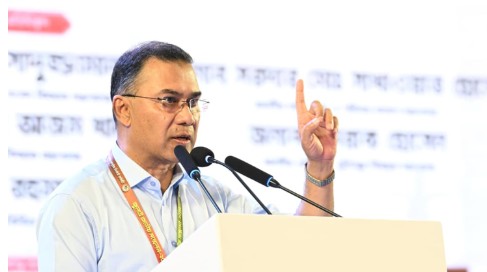
Prime Minister Tarique Rahman today pledged to ensure proper recognition, rehabilitation and long-term support for the families of those killed and those injured during the July Mass Uprising, reaffirming the government’s commitment to preserving their legacy and bringing those responsible for the killings to justice through due process.
The Prime Minister made the pledge while addressing the July National Conference at the Bangladesh-China Friendship Conference Center in the capital’s Agargaon.
“We are working to ensure the highest respect, recognition, improved quality of life, comprehensive rehabilitation and necessary support for the families of the martyrs and July fighters,” he said.
Reflecting on personal loss, Tarique Rahman said he often wondered what advice his late mother would have given him regarding revenge for the injustices committed against her.
“I believe she would say, ‘Your duty now is to unite everyone and move the country forward.’ I know my brother would have given me the same answer,” he said.
The Prime Minister stressed that while the government remains committed to prosecuting those responsible for the killings during the July uprising, justice must be ensured through legal process.
He said the sacrifices made during the movement were driven by the people’s aspiration for a better future.
“The achievement of August 5 does not belong to any individual or political party. It belongs to every democracy-loving citizen of the country. It is the outcome of the collective sacrifices of the people,” he said.
Calling for national unity, the Prime Minister said no country could move forward if it remained divided.
Addressing the families of the martyrs and those injured, he acknowledged that their losses could never be fully compensated.
“You have lost your loved ones. Some of you have lost parts of your bodies. Those losses can never truly be restored. But if together we can build a stronger Bangladesh, one day you will be able to say with pride that your loved ones’ sacrifices helped change the destiny of this nation. Let us all unite for the welfare of our country and its people,” he said.
The Prime Minister said thousands of people had suffered persecution, torture and repression during the period of authoritarian rule leading up to the July Movement and August 5.
“Many of you are still living with the pain caused by those abuses. I, too, continue to endure physical and emotional suffering. That is why I am able, at least to some extent, to understand and feel your pain—whether it is physical or mental,” he said.
Referring to findings of the United Nations, Tarique Rahman said 65 children were killed during the movement.
“What crime had they committed? They had committed no crime. Yet, in the struggle to free the country from authoritarian rule, these children gave their lives,” he said.
Recalling the events of the uprising, he said the United Nations estimated that around 1,400 people were killed during the unrest.
“According to my own estimate, around 2,000 people were killed during the July Movement alone, and about 30,000 people suffered injuries or other forms of intimidation,” he said.
The Prime Minister also highlighted the persecution, legal cases and attacks faced by BNP leaders and activists during the previous regime, saying the party had repeatedly demonstrated its willingness to make sacrifices for the nation.
The conference was jointly organised by the July ’24 Martyrs’ Families Society and the Central Executive Committee of Amra July Joddha. Hundreds of relatives of those killed and injured attended the programme, with many sharing emotional accounts of their personal experiences.
The event, held under the slogan “Bangladesh First,” featured the banner “A proud history, an indomitable spirit. Let this 4th of July inspire everyone—the sacrifice that changed history.”
The programme began with recitation from the Holy Qur’an, prayers for the martyrs, the national anthem and the screening of a documentary on the July Movement.
During the event, the Prime Minister presented commemorative “July Memorial” plaques to representatives of martyrs’ families and injured participants, while representatives of the families also presented a commemorative plaque to the Prime Minister.
Cabinet members, members of parliament, ambassadors, high commissioners, senior military and civil officials, and representatives of various professional organisations attended the conference.
According to the government’s official gazette, 834 people have been recognised as martyrs of the July uprising. A United Nations investigation into alleged human rights violations during the unrest estimated that more than 1,400 people may have been killed between July 1 and August 15, 2024.
