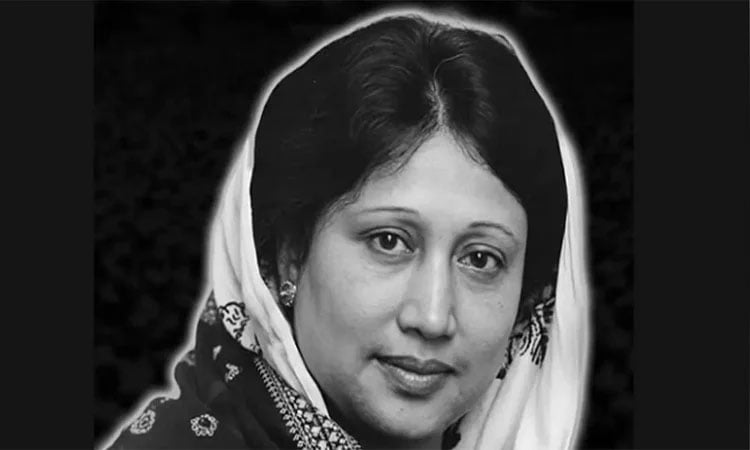
The 82nd birthday of former BNP Chairperson and former Prime Minister Begum Khaleda Zia will be observed tomorrow with various programmes organised by the Bangladesh Nationalist Party (BNP).According to a BNP press release, doa and milad mahfils will be held at party offices and mosques across the country to mark the occasion.In Dhaka, the main programme will begin at 11:00am at the BNP central office in Nayapaltan, where senior party leaders are expected to attend.Begum Khaleda Zia, widely regarded as a prominent leader of Bangladesh’s democratic movement, served as BNP chairperson from 1983 until her death on December 30, 2025. She was the country’s first elected female prime minister and served as prime minister three times.She was born to Iskandar Majumder and Taiyaba Majumder in Dinajpur on August 15, 1945. Her family originally hailed from Feni. She studied at Dinajpur Government Girls High School and later at Surendranath College.In 1960, she married Ziaur Rahman, who later became a Liberation War hero, declared independence on behalf of the nation and served as president of Bangladesh. As First Lady, Begum Khaleda Zia accompanied him on visits and met several world leaders.Following the assassination of President Ziaur Rahman in 1981, she joined the BNP as a general member on January 2, 1982. She became the party’s vice-chairperson in March 1983 and subsequently took over as chairperson.
deskreport
Fresh Start Essential for Bangladesh-India Relations: Home Minister
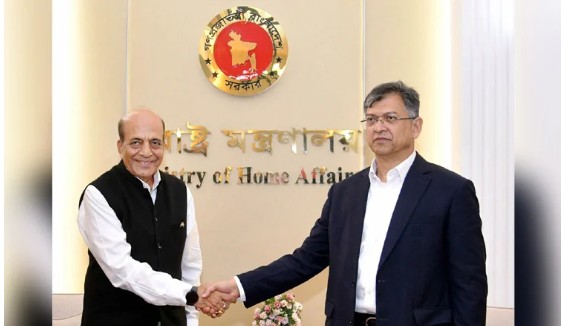
Home Minister Salahuddin Ahmed called for a “fresh start” in Bangladesh-India relations, saying differences between the two countries can be resolved through mutual cooperation and dialogue based on equality.
“Bangladesh and India are interdependent in many ways, including geographically, socially, politically and economically. Leaving the past behind, a fresh start is essential to strengthen the friendly relations between the two countries,” he said.
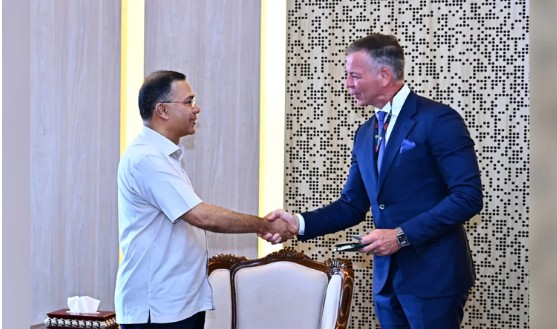
The home minister made the remarks when Indian High Commissioner to Bangladesh Dinesh Trivedi paid a courtesy call on him at his office at the Bangladesh Secretariat today.
“There are some differences and issues between the two countries, but these can be resolved through mutual cooperation and dialogue. We must move forward with our friendly relations through discussions based on equality. India must come forward with sincerity in this regard,” he said.
During the meeting, the two sides held fruitful and positive discussions on bilateral relations and various issues of mutual interest.
The Indian high commissioner expressed his commitment to further strengthening bilateral ties, saying, “We do not only share geographical boundaries; we also share the dream of prosperity.”
He said differences over various issues are normal in a democratic culture and that the existence of such issues is part of the democratic process.
“There is no such complicated issue between the two countries that cannot be resolved through dialogue and diplomatic means,” Trivedi said, expressing hope that Bangladesh-India relations would become stronger and brighter in the coming days.
Senior officials of the Home Ministry and representatives of the Indian High Commission attended the meeting.
No Decision Taken on Teacher Appointment by Managing Committees: Education Minister
Education Minister Dr A N M Ehsanul Haque Milon today urged all concerned not to spread misinformation about the appointment of teachers in private educational institutions by managing committees, saying the government has not taken any decision on the matter.
The minister made the appeal in a post on his verified Facebook page on Monday night following widespread speculation over the issue.
He said the Non-Government Teachers’ Registration and Certification Authority (NTRCA), the government agency under the Ministry of Education responsible for registering and certifying teachers for private educational institutions under the Monthly Pay Order (MPO) system, was established in 2005 by the BNP government led by former Prime Minister Begum Khaleda Zia.
The Education Ministry is continuously reviewing the activities of the NTRCA and examining how its teacher recruitment process can be made more transparent, efficient and effective, he said.
Referring to reports about teacher appointments through school managing committees, Dr Milon said the government has not taken any decision to introduce such a system.
He urged everyone not to spread misinformation on the issue.
The minister said the NTRCA currently conducts interviews centrally and recommends candidates for appointment based on merit and qualifications to ensure an impartial recruitment process.
He added that the government is working to make the teacher recruitment system more transparent and modern.
PM’s Chattogram Visit Highlights Simplicity, Discipline and Party Unity
Prime Minister Tarique Rahman’s recent visit to Chattogram drew widespread public attention, with his simple approach and emphasis on avoiding unnecessary expenditure becoming notable features of the tour.
During his visit to Banshkhali, local BNP members and their affiliates had constructed several ceremonial arches, or ‘torans’. Police removed them the night before the Prime Minister’s arrival, saying Tarique Rahman had instructed that unnecessary torans and banners should not be displayed to avoid wasteful expenditure.
Kamrul Islam Hossaini, former mayor of the municipality and host of the Prime Minister’s Banshkhali programme, said the Prime Minister was demonstrating through his actions what he meant by building a new Bangladesh.
The Prime Minister’s rehabilitation programme was held at the West Banshkhali High School ground near the Baharchhara coast, where he handed over keys to newly built houses to 100 families whose homes were destroyed by floods.
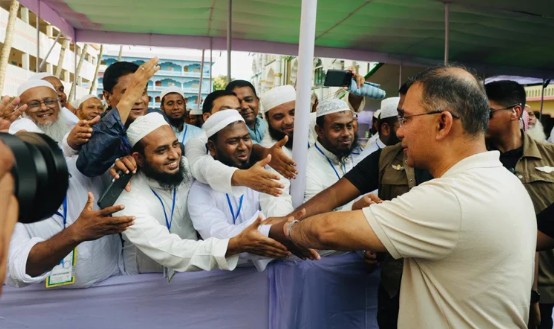
During the programme, Tarique Rahman personally inspected the condition of the houses and interacted with the beneficiaries. He also visited the newly built home of a widowed woman who lives about a kilometre from the event venue.
The woman, whose husband died two years ago, has four daughters and two sons. The Prime Minister entered her new home, spoke with her and her children, inquired about their wellbeing and planted a tree on the property.
The woman said she knew the government had built the house but never imagined that the Prime Minister would personally visit her home and speak with her.
The visit also attracted thousands of people in Banshkhali. Local BNP leaders said people began gathering at the event venue from early morning, with many arriving from different unions despite the heat. Around 80 buses were used to bring BNP leaders and activists to the programme.
After Banshkhali, the Prime Minister travelled to Fatikchhari, where he paid a courtesy visit to Hefazat-e-Islam Ameer Allama Shah Muhibullah Babunagari at Al-Jamiatul Islamia Azizul Uloom Babunagar Madrasa.
Large crowds gathered along the Fatikchhari-Khagrachari regional highway and surrounding areas to see the Prime Minister. Many people climbed onto rooftops and trees to get a closer view of his motorcade.
At the madrasa, Tarique Rahman interacted with students, exchanged greetings and waved to them.
He later travelled to Hathazari, where he provided funds for housing for flood victims and assistance for people with disabilities. He also spoke with disabled people individually and encouraged them.
In the evening, the Prime Minister held an organisational meeting with leaders and activists of Chattogram BNP and its affiliated organisations at Hotel Radisson Blu in the city.
At the meeting, Tarique Rahman stressed the importance of unity and coordination among party leaders and activists. He urged BNP’s main organisation and its affiliated bodies to work together as members of the same family.
He also called on party leaders and activists to remain united ahead of the upcoming local government elections and work collectively for the party’s interests.
The Prime Minister warned leaders and activists against becoming confused by rumours and unverified information circulating through traditional and social media. He advised them to verify information before believing or sharing it.
The meeting, which began at around 8:15pm and lasted about two hours, was the BNP chairman’s first organisational meeting with Chattogram leaders since the government was formed.
Participants said the central message of the meeting was unity. Tarique Rahman stressed that strengthening the party organisation was as important as running the government and called for greater cooperation among leaders and activists.
He also urged party members to view the government as their own and take responsibility for its activities, while maintaining discipline and avoiding actions that could damage the party’s reputation.
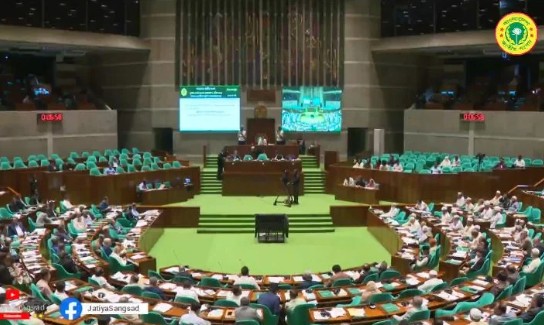
A preparatory meeting on the upcoming presidential election will be held at the Jatiya Sangsad Bhaban today, with Acting Speaker Barrister Kayser Kamal in the chair, according to a press release from the Parliament Secretariat.
The Election Commission (EC) announced the schedule for the presidential election on August 6.
According to the schedule, the deadline for submitting nomination papers is August 13. The nomination papers will be scrutinised on August 16, while candidates can withdraw their candidature until 4:00pm on August 18.
Voting in the presidential election will be held from 2:00pm to 5:00pm on August 20 in the Jatiya Sangsad session chamber.
Visa President for Asia-Pacific Stephen Karpin today expressed the global financial technology company’s interest in expanding its investment and business operations in Bangladesh.
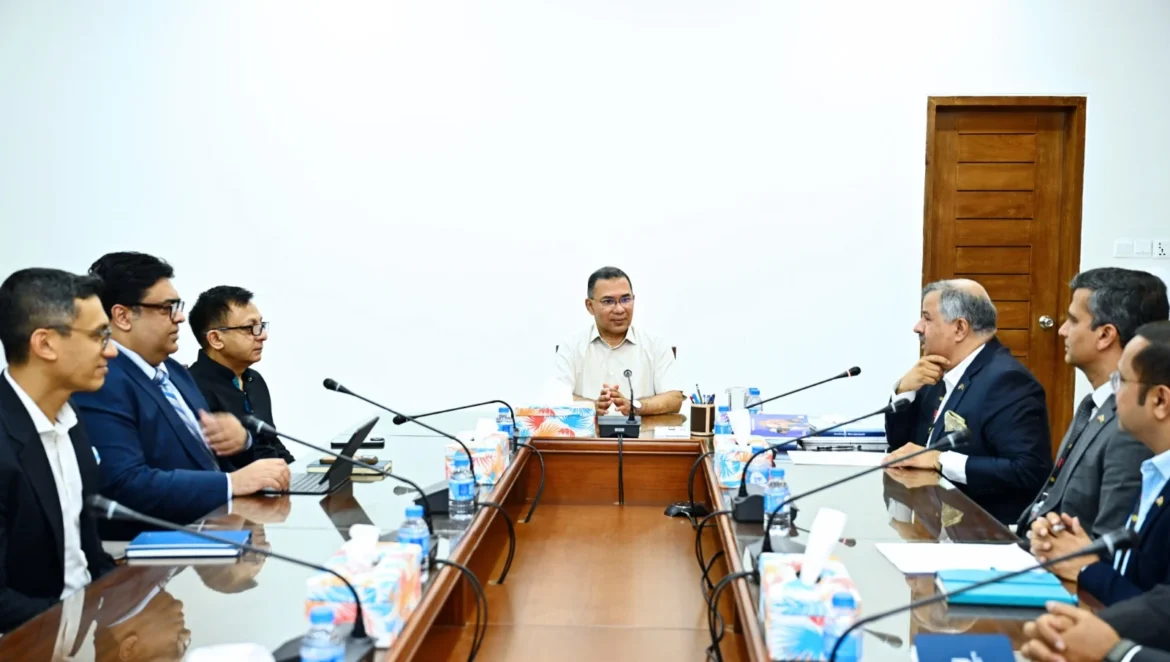
He made the remarks during a courtesy call on Prime Minister Tarique Rahman at the Cabinet Division of Bangladesh Secretariat this morning.
Prime Minister’s Deputy Press Secretary Shahadat Swadhin said Karpin told the Prime Minister that Bangladesh has significant potential for Visa to expand its activities in digital financial services, technology and innovation.
He said Visa wants to invest and provide technological support to encourage bank account holders who do not yet use cards to adopt card-based transactions and expand digital payments across the country.
Karpin also expressed interest in using artificial intelligence (AI) to make Bangladesh’s banking and digital payment systems more secure, convenient and efficient.
The meeting discussed expanding the use of Visa cards in government and public services, including metro rail, toll plazas and expressways, to make everyday transactions easier.
Visa also expressed interest in contributing to the development of Bangladesh’s digital and creative economies.
The two sides discussed developing an effective digital payment system to enable Bangladeshi freelancers to bring their overseas earnings into the country securely and conveniently.
Karpin was also invited to establish a technology development centre or global service centre in Bangladesh, which could create employment opportunities.
Prime Minister Tarique Rahman welcomed private-sector partnerships to expand digital financial services and technology in Bangladesh and stressed the importance of international companies such as Visa in strengthening the country’s digital economy, investment and technological capabilities.
Prime Minister’s Adviser on Posts, Telecommunications, Information Technology, Science and Technology Rehan Asif Asad, Bangladesh Investment Development Authority (BIDA) Executive Chairman Chowdhury Ashik Mahmud Bin Harun, Bangladesh Bank Governor Md Mostaqur Rahman and senior Visa officials were present at the meeting.
Prime Minister Tarique Rahman today assured foreign investors of the government’s all-out support, saying Bangladesh is ready to facilitate investment and provide a favourable business environment.
“Bangladesh currently offers a favourable environment for investment. The government is ready to provide all necessary support to interested foreign investors,” he said.
The Prime Minister made the remarks when a delegation of the American Chamber of Commerce in Bangladesh (AmCham) paid a courtesy call on him at the Cabinet Division meeting room at Bangladesh Secretariat this afternoon.
PM’s Assistant Press Secretary Gazi Shahriar Pami said an eight-member AmCham delegation, led by its president and Mastercard Vice President Syed Mohammad Kamal, met the Prime Minister.
During the meeting, the AmCham representatives informed the Prime Minister that the organisation’s new committee, which assumed office about two months ago, is working to attract greater US investment to Bangladesh and further deepen commercial ties between the two countries.
Commerce Minister Khandakar Abdul Muktadir, Prime Minister’s Adviser on Posts, Telecommunications, Information Technology, Science and Technology Rehan Asif Asad and Bangladesh Investment Development Authority (BIDA) Executive Chairman Chowdhury Ashik Mahmud Bin Harun were present at the meeting.
A new assertiveness defines Bangladesh’s approach to its largest neighbor
Realist theories of interstate bargaining rest on a simple premise: asymmetry of power translates into asymmetry of outcomes. A larger state sends senior emissaries to a smaller neighbor, the visit itself functions as pressure, and the weaker party concedes ground to avoid friction. This model has governed India’s approach to Bangladesh for decades, largely because it worked. This week, in Dhaka, it stopped working, and the gap between what Delhi expected and what it got reveals something more consequential than a single failed negotiation.
Consider the sequence. India’s intelligence chief arrived in Dhaka within the same window that the Indian High Commissioner secured a meeting at the Prime Minister’s Office, a coordinated show of institutional weight rarely deployed without an expected return. The return never materialized. Bangladesh conceded nothing at any table where core national interests were under discussion. The High Commissioner, rather than departing with a negotiated outcome, returned to Delhi to recalibrate an approach that had clearly misjudged its target.
The deeper explanation lies in a category error. Indian foreign policy toward Dhaka since 5 August 2024 has continued to operate on the assumptions of the previous decade and a half, a period in which the relationship functioned less as diplomacy between sovereign equals and more as management of a dependent partner. That framework produced consistent results under Sheikh Hasina. It has produced almost nothing but missteps since her departure, most visibly in India’s tolerance of her continued political activity from its soil, conducted with apparent disregard for how that choice would register with the Bangladeshi public. What Delhi failed to anticipate was not that Dhaka would object. It was the calibration and consistency of the objection.
The clearest evidence of that recalibration predates this week’s visits. When Prime Minister Tarique Rahman selected Malaysia and China, rather than India, for his government’s first bilateral engagements abroad, the choice functioned as a diplomatic signal in the formal sense: a deliberate act intended to be read and interpreted by the intended recipient. Delhi’s response followed a familiar script, an invitation offered not as a bilateral state visit but folded into the multilateral BIMSTEC framework, carrying conditions rather than parity. Dhaka declined it without deliberation. In signaling theory, a rejected overture of that kind carries more information than an accepted one; it establishes where the threshold for engagement actually sits. India appears to have absorbed that lesson only after the fact.
The foreign ministry’s language following Sheikh Hasina’s recent press appearance made the underlying position explicit, describing a Bangladesh no longer willing to function as a client state in the region’s power structure. Whatever weight that phrase carried in domestic politics, its real audience was Delhi, and by the evidence of this week’s scramble, it was heard.
What emerges from this episode is not simply a story about one failed round of pressure diplomacy. It is a data point in a broader recalibration of how power is distributed and perceived in South Asia. Bangladesh’s position for much of the post-independence period has been that of a secondary actor, absorbing the expectations of larger neighbors without the leverage to set its own terms. The events of the past several days suggest that arrangement is no longer operative, and that any Indian strategy premised on its continuation will keep producing the same result it produced this week.
None of this forecloses a working relationship between the two countries. A visit by Bangladesh’s prime minister to India remains plausible, and even likely, in time. But the terms of that visit, and of the relationship it would represent, are now a matter for negotiation between equals rather than an outcome India can assume. Whether Delhi is prepared to operate on those terms is a question only Delhi can answer, and the coming months will show whether it has understood the message or simply absorbed the inconvenience of it.
How a “private” press club let Hasina break India’s political silence rule
Sheikh Hasina picked up a microphone in Delhi and announced she’s coming back to lead her party. That single fact should embarrass New Delhi more than it appears to.
For months, India’s position has been simple and repeated at every level: Hasina is on Indian soil for humanitarian reasons only. No political platform. No political activity. That line was echoed almost word for word in the Congress-commissioned report on India-Bangladesh relations led by Shashi Tharoor, which described her status as strictly humanitarian, with no space allowed for political operations. It’s a formulation with real legal weight behind it, asylum on humanitarian grounds is a recognized international norm precisely because it’s supposed to come with a condition: the guest doesn’t turn the host country into a base of operations against the government of the country they fled.
Then came a virtual press conference, hosted by the Foreign Correspondents’ Club of South Asia, where Hasina did exactly what Delhi insists, she isn’t allowed to do. She spoke as a party leader. She talked about a return to power. She addressed her supporters as a politician still in the fight, not a guest quietly waiting out asylum. The distance between the policy on paper and the event on screen wasn’t subtle.
India’s government response followed a script familiar to anyone who has studied how states manage embarrassment without admitting fault. The event, officials said, was organized by a private body, not the state. Technically true. Practically meaningless and worth naming for what it is. Statecraft has a term for this maneuver: plausible deniability, the practice of keeping leadership formally uninformed and communication deliberately vague; a nod, a wink, an unwritten understanding, so that if an operation surfaces, the state can disclaim knowledge and let a “private” or “rogue” actor absorb the blame. The Cold War is full of case studies where this exact mechanism let governments run operations abroad while keeping their hands clean on paper. What’s happening with Hasina’s press appearances fits the pattern closely enough that pretending otherwise requires more credulity than the facts support.
Look at who that “private body” actually is, because the deniability only works if the organization is genuinely arm’s-length from the state. The FCC South Asia brands itself as an international press organization, but its roughly 500 members are overwhelmingly Delhi-based, and Indian nationals sit atop its leadership, the club’s president and its secretary among them, alongside diplomats, lawyers, and corporate-media figures drawn into its associate membership. A handful of foreign correspondents on the rolls doesn’t change what the club functions as in practice: a Delhi institution, staffed and run by people embedded in India’s own media and political ecosystem, on Indian soil. An organization built like that does not stage a politically charged event for a foreign fugitive on a whim. Somewhere between the invitation and the livestream, someone made a judgment call about what would and wouldn’t draw consequences and concluded, correctly, that it wouldn’t.
There’s a structural asymmetry underneath all of this that’s worth naming directly. Plausible deniability as a strategy only works when the state deploying it has enough regional weight that the smaller neighbor’s objections can be absorbed without real cost. Bangladesh raised concerns about this kind of programming before it happened. India was free to intervene, discourage it, or distance itself in advance, the way governments do when they actually intend to honor a stated policy. It didn’t. It let the press conference happen, absorbed a diplomatic complaint it had already anticipated, and reached for the explanation it had pre-loaded. That’s not incompetence. That’s a calculation that the relationship can take the strain, a calculation smaller states are rarely in a position to make about larger ones.
The Tharoor report’s language, “humanitarian refuge, no political space”, deserves scrutiny on its own terms, not just as a description contradicted by events. It was written to sound like a firm boundary. In practice it functions as a boundary India controls the enforcement of, case by case, appearance by appearance, with no independent mechanism ensuring it actually holds. A policy that only constrains behavior when someone chooses to enforce it isn’t a policy. It’s a discretionary courtesy, extended or withdrawn as convenient, which is precisely what a live political address from a fugitive prime minister, broadcast from Indian soil, exposes.
As for the comeback Hasina announced: it may not travel far, whatever platform Delhi permits her. The party she once ran with total control is now scattered, its leaders scrambling in different directions, its internal cohesion bleeding out along with her personal standing. Fifteen years of rule left behind more resentment than loyalty in Bangladesh, and no press conference staged from Delhi changes what’s waiting for her at home. Declaring an intent to return is easy from a studio in Delhi. Facing the country she left is a different proposition entirely and no amount of institutional cover from across the border will substitute for it.
PM Urges Democratic Forces to Stand United Against Attempts to Derail Development
Prime Minister Tarique Rahman urged all democratic forces to remain united against those seeking to create disorder, spread confusion and obstruct the country’s development, saying nobody would be allowed to play with the fate of the people.
“Now is the time to build the country, now is the time to shape the destiny of the nation. Therefore, we have to turn the 40 crore hands of our 20 crore people into the hands of workers and take our country forward,” he said.
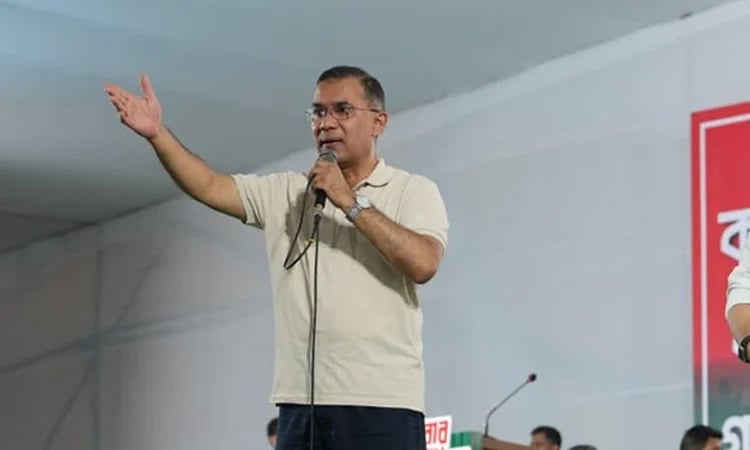
The Prime Minister made the remarks while addressing a rehabilitation programme for flood-affected people at the Hathazari Government College ground this evening.
Highlighting the prevailing situation, Tarique Rahman said some political parties were spreading confusion and attempting to obstruct the government’s development activities.
“Today, we have to make a decision. All democratic people of Bangladesh who believe in democracy and freedom of expression have to decide what steps we should take against those who want to create disorder, block roads by coming onto the streets and mislead people,” he said.
Calling on people to remain united against such attempts, he urged democratic forces to stand together against those seeking to undermine the country’s development and progress.
“Changing the fate of the people is our vision and mission. We will work, we will build the country, Bangladesh First — Korbo Kaj, Gorbo Desh, Sobar Agee Bangladesh,” he said.
The Prime Minister said BNP firmly believes that the people are the source of all political power and that the party has a responsibility to implement its 31-point development agenda following the support it received from the people.
Describing the 31-point agenda as a programme of the people, Tarique Rahman said BNP would continue working to overcome obstacles, fulfil people’s aspirations and transform Bangladesh into a developed country.
Finance Minister Amir Khosru Mahmud Chowdhury and Home Minister Salahuddin Ahmed also addressed the programme.