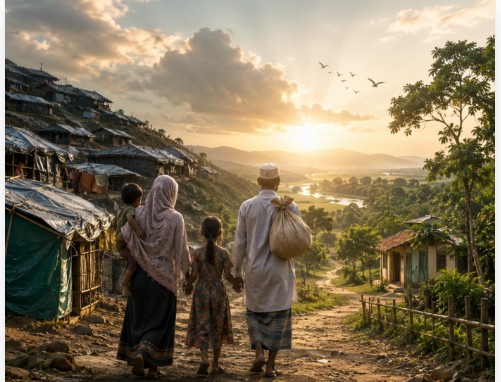
Three hundred thousand people. That’s the number now attached to a possible first wave of Rohingya repatriation, a figure that would have sounded like fantasy just two years ago. After a decade of talks that went nowhere, something has actually shifted, and it’s worth understanding why before getting too excited about what comes next.
The shift traces back to an unlikely combination: patient Bangladeshi diplomacy that never let the issue drop off the international agenda, and Malaysian Prime Minister Anwar Ibrahim stepping in as a mediator Myanmar was apparently willing to listen to. Myanmar has already agreed in principle to take back around five thousand Rohingya currently sheltering in Malaysia. The larger conversation about Bangladesh’s own million-plus Rohingya population has moved further than it has in years.
To grasp what’s at stake, rewind to August 2017. A military crackdown in Rakhine State sent more than seven hundred thousand Rohingya fleeing into Bangladesh within weeks, on top of earlier waves in 1978 and 1991-92 that had already established the pattern. Today the camps around Ukhiya and Teknaf, plus the relocated population on Bhasan Char, hold well over a million people. None of this originated in Bangladesh. It originated in a 1982 Myanmar law that stripped Rohingya of citizenship, followed by decades of restrictions on where they could go, what they could study, whether they could work. The 2017 violence was the culmination of that system, not a departure from it, a distinction that matters because it’s why Gambia took Myanmar to the International Court of Justice in 2019 over the Genocide Convention, and why the International Criminal Court is still investigating separately.
That legal backdrop is precisely why “repatriation” can’t just mean trucking people back across a border. International law is explicit: nobody gets returned somewhere their safety is in danger. Voluntary, safe, dignified, those aren’t diplomatic pleasantries, they’re the actual bar that has to be cleared, and Myanmar’s Rakhine State still doesn’t clear it easily. Fighting between the military and armed opposition groups continues in parts of the region, which means the question hanging over every returnee is whether citizenship, land, and basic services will actually materialize once they’re home, or whether they’ll be walking back into the same uncertainty they fled. The 2018 and 2019 repatriation pushes collapsed for exactly this reason, Rohingya families simply didn’t trust that going back was safe, and no amount of diplomatic signaling changed that calculus.
There’s also a layer to this that rarely makes the headlines. Rakhine sits on real estate that China and India both care about deeply. Beijing’s Kyaukphyu deep-sea port and the China-Myanmar Economic Corridor give it a Bay of Bengal outlet that bypasses the Malacca Strait entirely. India’s Kaladan transit project runs through the same territory, linking its northeastern states to the sea. Washington and European capitals, meanwhile, have mostly engaged through the human rights track; sanctions, legal backing, statements, which has kept pressure on Myanmar’s military without actually producing a repatriation framework. None of this proves a grand conspiracy behind the crisis; there’s no evidence of that from the UN or any court. But pretending Rakhine’s strategic value has nothing to do with how slowly this has moved would be naive.
Meanwhile, the burden has sat almost entirely on one country. Bangladesh took in refugees on humanitarian grounds and has kept feeding, housing, and protecting them for going on ten years, with agencies like UNHCR, WFP, UNICEF, WHO and IOM running programs that depend on international funding now drying up. Cox’x Bazar has absorbed the cost in ways that don’t always show up in press releases, deforestation, hollowed-out hillsides, strain on jobs and services for the local population, and security problems including trafficking that a small minority exploit while the overwhelming majority of Rohingya remain exactly what they’ve always been: people waiting to go home.
So, what happens now matters more than what’s been announced. If these diplomatic opening holds, it eases pressure that’s been building in Cox’s Bazar for a decade and gives the rest of Bangladesh’s Rohingya population a real path forward, genuinely significant, and a credit to the sustained effort behind it. But announcements alone have burned this process twice before. What makes this attempt different has to be structural: UNHCR embedded at every stage, independent observers on the ground, and a coalition wider than Bangladesh and Myanmar talking bilaterally; the UN, ASEAN, the OIC, the EU, China, India, the US and Japan all need to be pulling in the same direction, because Myanmar has little incentive to follow through on a promise made to Dhaka alone.
Two things need to happen in parallel. Bangladesh has to keep making its case internationally, not just as a humanitarian actor but as a country absorbing genuine long-term economic and environmental costs, because global attention drifts, and funding follows attention. And the communities hosting the camps, in Teknaf, Ukhiya, and Bhasan Char, need investment and support on the same footing as the refugees themselves; border security has to stay firm without punishing an entire population for the actions of a criminal few.
Frame this crisis as regional, because it is one. Rakhine’s location makes it central to Bay of Bengal security, and Bangladesh has an opening to lead more assertively through BIMSTEC and ASEAN rather than treating this purely as a bilateral problem with Myanmar.
The real measure of success was never going to be a joint statement or a diplomatic photo op. It will be the day a Rohingya family crosses back into Rakhine and finds citizenship where there was statelessness, and a future where there was only waiting. Get there, and it won’t just be a win for Bangladesh’s foreign policy, it will be one of the rare moments international laws actually delivered on its promises.
deskreport
US Business Delegation to Visit Bangladesh to Explore Investment Opportunities
Dhaka: Prime Minister’s Adviser and PMO Spokesperson Mahdi Amin has said around 45 senior executives from 25 leading US companies are scheduled to visit Bangladesh by the end of next week to explore investment opportunities and strengthen Bangladesh-US economic relations.
The visiting business delegation is expected to hold meetings with officials from different ministries and government agencies and is also likely to meet Prime Minister Tarique Rahman.
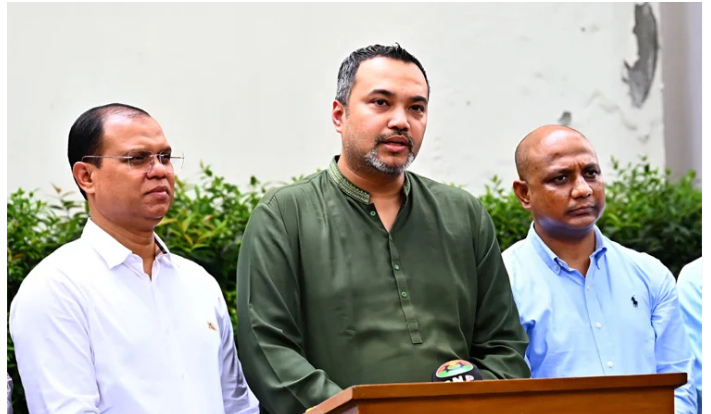
Mahdi Amin made the remarks while briefing reporters outside the Prime Minister’s Office (PMO) in Tejgaon following a meeting between Prime Minister Tarique Rahman and visiting US President’s Special Envoy for South and Central Asia Sergio Gor.
He said the visit would mark an important step towards increasing US investment in Bangladesh and deepening the economic partnership between the two countries.
Mahdi said the US envoy expressed strong confidence in the leadership of Bangladesh’s elected Prime Minister during discussions held earlier in the day.
“They noted that political stability has returned to Bangladesh under Prime Minister Tarique Rahman’s leadership and that the country’s democratic journey is progressing positively,” he said.
He added that the US side appreciated the government’s policies and initiatives undertaken over the past five months, while both sides held detailed discussions on advancing multidimensional and multilateral relations through a stronger economic partnership.
The PMO spokesperson said growing international confidence in Bangladesh is increasingly being reflected globally.
Referring to the revised US State Department travel advisory, he said the decision would encourage American investors and visitors to explore new economic opportunities in Bangladesh.
“This visit will help expand bilateral trade and investment and create substantial employment opportunities in the country,” he added.
Mahdi also referred to the Prime Minister’s recent meeting with leading entrepreneurs and industrialists, attended by ministers, state ministers, advisers and heads of government agencies.
He said the BNP-led government has been working over the past five months to address challenges in governance, trade and investment inherited from the previous administration.
According to Mahdi, business leaders urged the government to address long-term shortages of electricity and gas, ensure energy security, reform the tax and tariff systems, and remove investment bottlenecks in economic zones, including those under the Bangladesh Economic Zones Authority (BEZA) and the Bangladesh Export Processing Zones Authority (BEPZA).
“The Prime Minister listened attentively to their proposals and assured them of ensuring a pro-business and pro-investment environment,” he said.
Mahdi added that the Prime Minister also made immediate decisions based on recommendations from the business community to make import and export trade faster and more efficient.
He said the Prime Minister directed the authorities concerned to ensure round-the-clock services at Chattogram Port, Hazrat Shahjalal International Airport and other ports to keep commercial activities uninterrupted.
Reiterating the government’s priorities, the PMO spokesperson said the administration is focused on harnessing the country’s demographic dividend by equipping young people with the skills needed for employment and self-employment.
“The government is committed to successfully implementing people-oriented budgets and policies under the slogan, ‘Korbo Kaj Gorbo Desh, Sobar Agee Bangladesh (We Will Work, We Will Build the Nation, Bangladesh First)’,” he said.
Prime Minister’s Additional Press Secretary Atikur Rahman Rumon, Deputy Press Secretary Jahidul Islam Rony and Assistant Press Secretary K M Nazmul Haque, among others, were present at the briefing.
PM Seeks Continued US Investment in Bangladesh During Meeting with Special Envoy
Dhaka: Prime Minister Tarique Rahman has called for continued US investment in Bangladesh, particularly in warehousing, soybean, cotton, wheat and the information technology sector.
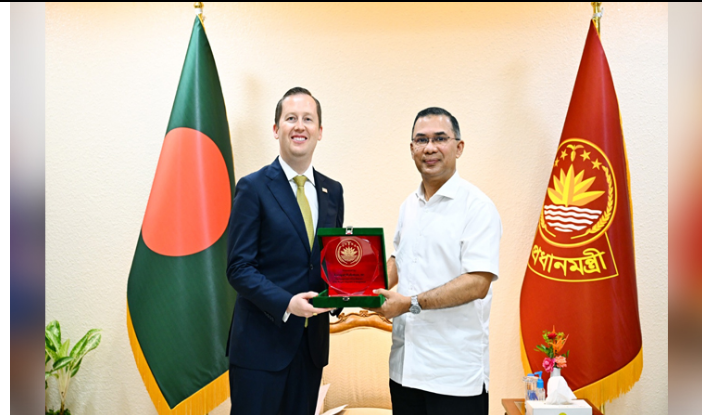
He made the call during a courtesy meeting with visiting US President’s Special Envoy for South and Central Asia Sergio Gor at the Prime Minister’s Office in Tejgaon.
The two sides discussed bilateral relations, trade and investment, regional cooperation and other issues of mutual interest during the meeting, which was held in a warm and cordial atmosphere, according to Prime Minister’s Deputy Press Secretary Shahadat Shadhin.
The Prime Minister invited US investment in warehousing, soybean, cotton, wheat and other agricultural sectors, saying such investments would help build a strong and competitive supply chain. He also highlighted Bangladesh’s interest in attracting US investment in the information technology sector.
The two sides exchanged views on investment opportunities through the US International Development Finance Corporation (DFC). Tarique Rahman urged the United States to continue investing in Bangladesh, while Sergio Gor said Washington would work positively to expand DFC investment cooperation in the country.
Gor informed the Prime Minister that US investors in Dhaka were interested in organising a US Investor Summit in Bangladesh in the near future and that he was personally working to facilitate the initiative.
The proposed visit of a delegation from the US-Bangladesh Business Council to Bangladesh next month also came up for discussion.
The meeting also discussed expanding cooperation between Bangladesh and the US Food and Drug Administration (FDA). Gor assured the Prime Minister that he would support the resumption of FDA inspection activities in Bangladesh.
During the meeting, the US Special Envoy praised Prime Minister Tarique Rahman’s leadership, saying stability was returning to Bangladesh under his leadership.
As an indication of this, he said the United States had positively revised its travel advisory for Bangladesh, which would send an important message to US investors that the country was now ready for investment.
Gor also said Bangladesh has significant potential in the information technology sector and could become a partner in the PAX Silica initiative in the future. He assured the Prime Minister that he would take initiatives in this regard.
The Rohingya crisis also featured prominently in the discussions.
Sharing his experience from visiting the Rohingya camps in Cox’s Bazar, Gor praised the government and people of Bangladesh for providing shelter and humanitarian assistance to forcibly displaced Myanmar nationals.
The Prime Minister noted that the United States provides more than half of the international assistance for the Rohingya population and expressed gratitude to the US government and people for their continued support.
The US Special Envoy stressed the need for a swift, sustainable and political solution to the Rohingya crisis and underscored the importance of coordinated efforts involving ASEAN, neighbouring countries and other relevant stakeholders.
Foreign Affairs Minister Dr Khalilur Rahman, State Minister for Foreign Affairs Shama Obaed Islam, Prime Minister’s Adviser on Foreign Affairs Humaiun Kobir, Prime Minister’s Advisers Mahdi Amin and Rehan Asif Asad, Bangladesh Ambassador to the United States Tareq Md Ariful Islam, US Ambassador to Bangladesh Brent T. Christensen and other senior officials attended the meeting.
US Special Envoy Concludes Bangladesh Visit, Reaffirms Commitment to Stronger Bilateral Ties
Dhaka: US Special Envoy for South and Central Asia Ambassador Sergio Gor has concluded his three-day maiden visit to Bangladesh, reaffirming Washington’s commitment to deepening strategic and economic ties while continuing support for resolving the Rohingya crisis.
In a statement issued after the visit from July 30 to August 1, the US Embassy in Dhaka said the tour highlighted the breadth and depth of the Bangladesh-US relationship.
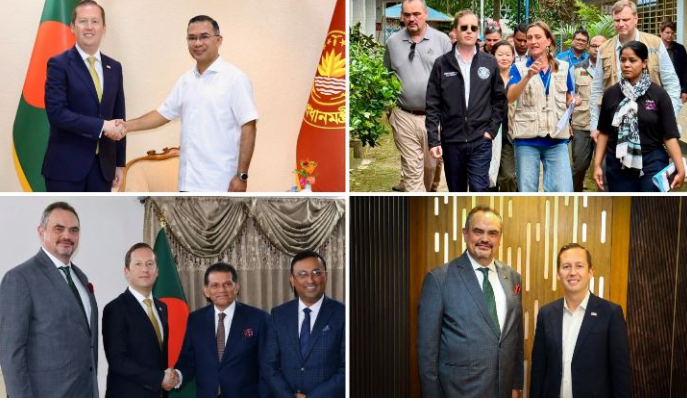
During the visit, Gor met Prime Minister Tarique Rahman and Foreign Minister Dr Khalilur Rahman and travelled to the Rohingya camps in Cox’s Bazar, reflecting the expanding scope of bilateral engagement.
At a meeting with the Prime Minister at the Prime Minister’s Office, the two sides discussed bilateral relations, trade, investment, regional cooperation and other issues of mutual interest.
Following the meeting, Gor, who also serves as the US Ambassador to India, said strengthening economic cooperation and the broader partnership with Bangladesh remains a priority for Washington.
“Today, I had the opportunity to discuss with the Honorable Prime Minister Tarique Rahman the great opportunities between the U.S. and Bangladesh to enhance economic cooperation and strengthen our partnership. This is a priority for the United States, and together we can achieve real success,” he said in a statement released by the US Embassy.
During the meeting, Prime Minister Tarique Rahman sought continued US investment in Bangladesh, particularly in warehousing, soybean, cotton, wheat and the information technology sector, saying such investments would help build a stronger and more competitive supply chain.
The discussions also covered expanding cooperation through the US International Development Finance Corporation (DFC). Gor assured Bangladesh that Washington would work positively to enhance US engagement through the DFC, established in 2019.
The envoy also informed the Prime Minister that US investors were interested in organising a US Investors Summit in Bangladesh in the near future and that he was personally working to facilitate the initiative.
The proposed visit of a delegation from the US-Bangladesh Business Council next month also came up during the talks.
The meeting further discussed expanding cooperation with the US Food and Drug Administration (FDA), with Gor saying the agency would resume inspection activities in Bangladesh.
Praising Prime Minister Tarique Rahman’s leadership, the envoy said stability was returning to Bangladesh and noted that the United States had lowered its travel advisory for Bangladesh from Level 3 to Level 2.
While Level 3 advises travellers to reconsider travel, Level 2 recommends exercising increased caution.
Gor said the revised advisory reflected growing US confidence in Bangladesh’s security environment and would send a positive signal to American investors.
During his visit to Cox’s Bazar, the US envoy commended Bangladesh for hosting more than one million forcibly displaced Myanmar nationals and continuing humanitarian assistance.
“The United States has supported this camp and urges our partners around the world to increase their contributions,” he said.
He also stressed the need for a swift, sustainable and political solution to the Rohingya crisis through coordinated efforts involving ASEAN, neighbouring countries and other stakeholders.
Prime Minister Tarique Rahman expressed gratitude to the United States for providing more than half of the international humanitarian assistance for the Rohingya population.
Earlier, Gor held talks with Foreign Minister Dr Khalilur Rahman, who described Bangladesh-US relations as moving in a “very positive direction” and said both countries were keen to deepen cooperation in trade, investment, energy, migration and regional affairs.
“We had a very productive discussion. Bangladesh and the United States currently enjoy an excellent bilateral relationship, and we discussed how to take it forward,” the Foreign Minister said.
The discussions covered trade, investment, energy cooperation, migration, the Rohingya crisis and Bangladesh’s upcoming presidency of the 81st Session of the United Nations General Assembly.
Responding to questions after the meeting, Khalilur Rahman said there had been no discussion regarding Bangladesh’s relations with China or India and rejected reports suggesting that Washington had proposed a humanitarian corridor into Myanmar.
The US Embassy said the visit underscored the enduring partnership between Bangladesh and the United States and reaffirmed Washington’s commitment to strengthening cooperation across political, economic and regional sectors.
PM Sees Stronger Economy in 4-5 Years Through Govt-Business Partnership
Dhaka: Prime Minister Tarique Rahman has expressed optimism that Bangladesh’s economy could undergo significant positive changes within the next four to five years through close cooperation between the government and the private sector.
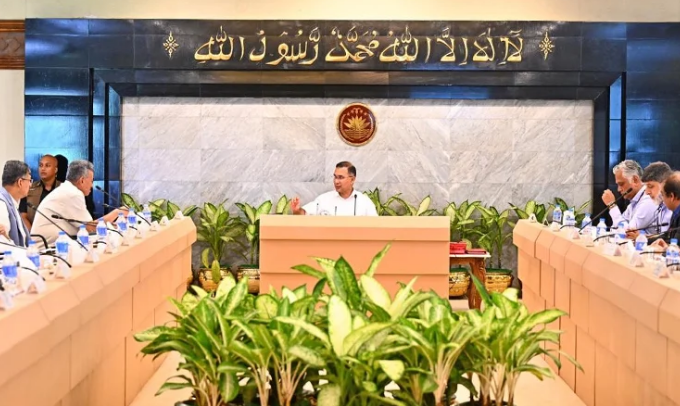
“If the government and the business community work together, it will be possible to bring positive changes to the country’s economy within the next four to five years,” he said after a four-hour views exchange meeting with private sector entrepreneurs at the Prime Minister’s Office in Tejgaon.
The meeting was organised by the Bangladesh Investment Development Authority (BIDA).
According to Prime Minister’s Deputy Press Secretary Hasan Shiplu, the Prime Minister said the government’s objective is to work for the country and its people, acknowledging that while challenges remain, they can be overcome through joint efforts.
“The government understands the existing problems facing the economy, and so do the businesspeople. We are sincerely working to resolve the issues, and discussions between the government and the business community will continue,” he said.
The Prime Minister noted that although the government has not yet completed six months in office, it has already held several meetings with business leaders and is addressing sector-specific issues.
Referring to an earlier meeting, he said many of the concerns raised by entrepreneurs had already been resolved, while new issues identified during the latest discussion would also receive attention.
He announced that another meeting with business leaders would be held within the next two to three months.
“The more frequently we meet, the better we will understand your problems and the more effectively we will be able to solve them,” he said.
Emphasising the importance of regular dialogue, the Prime Minister said sustainable solutions emerge through continuous discussions and cooperation.
The Deputy Press Secretary said the meeting focused on business expansion, attracting greater foreign investment and creating a more favourable environment for industrialisation.
Business leaders called for easier access to credit, stronger policy support and a more business-friendly environment. They also appreciated several government initiatives and expressed satisfaction with the progress made so far.
The meeting was informed that 21 of the 28 issues discussed during the previous meeting had already been resolved, while the remaining seven issues are still under process.
Entrepreneurs also presented a roadmap to increase Bangladesh’s export earnings to US$100 billion by 2030. The government assured them of providing the necessary diplomatic support to help achieve the target.
Among those attending the meeting were Finance and Planning Minister Amir Khosru Mahmud Chowdhury, Home Minister Salahuddin Ahmed, Power, Energy and Mineral Resources Minister Iqbal Hassan Mahmood Tuku, Commerce, Industries, Textiles and Jute Minister Khandakar Abdul Muktadir, Road Transport, Bridges, Railways and Shipping Minister Shaikh Rabiul Alam, Prime Minister’s Adviser on Finance and Planning Rashed Al Mahmud Titumir, Prime Minister’s Office Spokesperson Mahdi Amin, Prime Minister’s Adviser Rehan Asif Asad, State Minister for Power, Energy and Mineral Resources Aninda Islam Amit, BIDA Executive Chairman Chowdhury Ashik Mahmud Bin Harun, Bangladesh Bank Governor Md Mostaqur Rahman, senior government officials and representatives of various industrial groups.
Prominent business leaders including Syed Nasim Manzur of Apex Group, Ahsan Khan Chowdhury of PRAN-RFL Group, Mostafa Kamal of Meghna Group and M A Jabbar of DBL Group also participated in the meeting, along with representatives from Incepta, RANGS, Pacific Jeans, ACI, Bay Footwear, Runner, Walton and Jamuna.
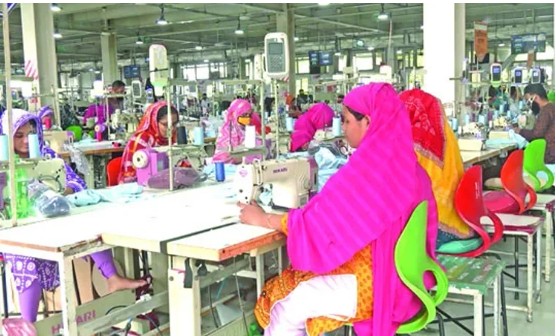
Dhaka: Bangladesh has the potential to capture 12 percent of the projected US$375 billion global man-made fibre (MMF) apparel market by 2030 through policy reforms, investment promotion and industrial upgrading, Bangladesh Foreign Trade Institute (BFTI) Chief Executive Officer (Additional Charge) Dr Saif Uddin Ahammad has said.
Speaking to BSS, Dr Ahammad said the global apparel industry is rapidly shifting from cotton-based products to man-made fibre garments, creating significant opportunities for Bangladesh to diversify its export basket and strengthen its position in international markets.
“Bangladesh cannot afford to miss this transition. Capturing a meaningful share of the global MMF market is essential for sustaining export growth, strengthening competitiveness and securing the future of the country’s apparel industry,” he said.
Referring to a recent study, he said the global MMF apparel market is expected to reach US$375 billion by 2030, and Bangladesh should set an ambitious target to secure a significant share of that market as part of its long-term export growth strategy.
According to Dr Ahammad, the roadmap aims to transform Bangladesh into a regional hub for man-made fibre apparel through phased reforms, including the removal of policy barriers, attraction of domestic and foreign investment, strengthening of backward linkage industries and enhancement of technological capabilities.
He said the government’s priorities include tariff rationalisation on MMF raw materials, faster approval of foreign direct investment (FDI), expansion of domestic polyester staple fibre and synthetic yarn production, access to affordable financing and development of a skilled workforce.
Despite being the world’s second-largest apparel exporter, Bangladesh remains heavily dependent on cotton-based garments, while global demand is increasingly shifting towards synthetic and blended fibre products, he noted.
“Expanding MMF production is no longer simply an opportunity; it is an economic necessity as Bangladesh prepares for the post-LDC trading environment,” Dr Ahammad said.
He stressed that stronger policy support and coordinated implementation would enable Bangladesh to compete more effectively with leading producers of man-made fibre garments.
The BFTI chief also recommended extending bonded warehouse facilities, introducing dedicated credit schemes for MMF manufacturers, encouraging technology transfer and promoting higher-value products such as activewear, sportswear and technical textiles to diversify the country’s apparel exports.
Expressing optimism about the sector’s future, Dr Ahammad said timely implementation of the government’s roadmap, combined with close collaboration between the public and private sectors, would help position Bangladesh as a major global supplier of man-made fibre apparel over the coming decade.
State Minister Warns Against Unplanned Projects, Calls for Efficient Use of Public Funds
State Minister for Power, Energy and Mineral Resources Aninda Islam Amit has directed officials to avoid undertaking poorly planned development projects, saying taxpayers’ money must be spent only on initiatives that are necessary, economically viable and beneficial to the public.
He made the remarks while chairing two separate meetings at the Bangladesh Secretariat on prioritising development projects and improving the efficiency of the country’s power and energy sector.
Addressing a meeting on unapproved projects under the Power Division, the state minister said future development initiatives must be selected based on necessity, feasibility and their contribution to public welfare rather than following past practices.
“Like in the past, we cannot afford to waste taxpayers’ money by undertaking unplanned and unnecessary projects,” he said.
Amit instructed officials to submit complete information and proper justification for every proposed project before it is considered for approval, stressing that priority should be given to projects capable of delivering tangible benefits to the people while strengthening the country’s power sector.
The meeting reviewed several unapproved development proposals, with officials presenting their plans and outlining the expected benefits.
He directed authorities to determine project priorities based on practical necessity, economic viability and long-term national impact.
At another meeting, the state minister discussed measures to improve the efficiency and cost-effectiveness of Bangladesh’s energy demand, production and distribution systems.
Emphasising the importance of long-term planning, he called for preparing a comprehensive and integrated national mapping of the country’s mineral resources.
He said the government needs a reliable, data-driven inventory identifying the location and potential of mineral resources across Bangladesh, replacing the existing fragmented geological maps maintained by different agencies.
A complete picture of the country’s underground resources, he said, would strengthen coordination among government agencies and support more effective planning and implementation of development projects.
The state minister also instructed officials to prepare zone-wise assessments of energy demand and supply across the country so that existing constraints can be identified quickly and appropriate policy measures adopted without delay.
He further emphasised the efficient utilisation of the country’s natural resources and directed authorities to complete the necessary measures to enhance the capacity of the power and energy sector as quickly as possible.
Power Division Secretary Mirana Mahrukh and senior officials from the division and its affiliated organisations attended the meetings.
Doctors’ Cooperation Vital to Building People-Oriented Healthcare System: Fakhrul
Dhaka: LGRD and Cooperatives Minister Mirza Fakhrul Islam Alamgir has said the active cooperation of doctors is essential to building a stronger, modern and people-oriented healthcare system in Bangladesh.
He made the remarks while addressing the First Health Cadre Day 2026 programme as the chief guest. The event was organised by the BCS Health Cadre Association at a hotel in the capital.
Fakhrul said the country still has an inadequate number of doctors compared to its population, while shortages of manpower and infrastructure at government hospitals continue to affect the quality of healthcare services.
He stressed that the government and medical professionals must work together to make the health sector more effective and accessible.
The minister said the government is committed to eliminating long-standing irregularities in the health sector and establishing a modern, efficient and people-friendly healthcare system.
To achieve that goal, he urged doctors serving at upazila and district-level health facilities to remain at their assigned workplaces and provide responsible, dedicated and quality healthcare services to the public.
Highlighting the importance of ensuring a safe working environment for doctors, Fakhrul said the government would give due consideration to the legitimate demands of medical professionals.
He also assured doctors of the government’s continued support in strengthening the healthcare sector and addressing the challenges they face in delivering medical services.
PM Conducts Late-Night Surprise Drive to Inspect Dhaka’s Cleanliness Activities
Dhaka: Prime Minister Tarique Rahman conducted an unannounced late-night drive across several parts of the capital to inspect the routine cleanliness activities carried out by city authorities.
The Prime Minister left the Bangladesh Secretariat at around 9:10 pm after completing his official engagements, according to his Deputy Press Secretary Md Sujauddoula (Sujon Mahmud).
During the inspection, Tarique Rahman drove the vehicle himself, accompanied by Dhaka South City Corporation (DSCC) Administrator Md Shafiqul Islam Khan Milton.
The route covered Farmgate, the National Parliament area, Cantonment, Mohakhali and Banani. After passing through the Chairman Bari area of Banani, the Prime Minister returned to his residence in Gulshan.
Throughout the drive, the Prime Minister observed the city’s cleanliness operations and issued various instructions to the DSCC administrator regarding ongoing maintenance and sanitation activities.
The Prime Minister’s Additional Press Secretary and Personal Assistant accompanied the inspection in separate vehicles that formed part of the convoy.
Govt Reviewing PM’s Invitation to BRICS Summit in India, Says Foreign Minister
Dhaka: Foreign Minister Dr Khalilur Rahman has said the government is reviewing the invitation extended to Prime Minister Tarique Rahman to attend the 18th BRICS Summit in New Delhi as a special guest.
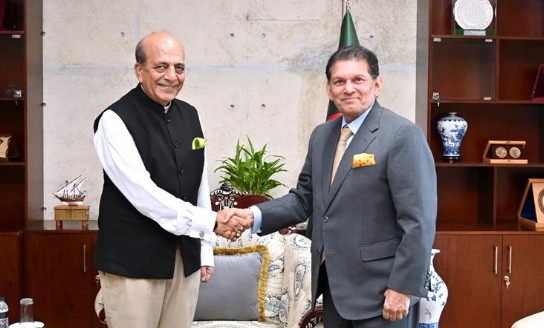
“We’re currently reviewing it. We will take a decision and inform you immediately once that decision is made,” he told journalists at the Ministry of Foreign Affairs after newly appointed Indian High Commissioner to Bangladesh Dinesh Trivedi paid a courtesy call on him.
Prime Minister’s Foreign Affairs Adviser Humayun Kobir was also present during the briefing.
Indian Prime Minister Narendra Modi has invited Prime Minister Tarique Rahman to attend the 18th BRICS Summit, scheduled to be held in New Delhi on September 12-13.
The Foreign Minister said the Prime Minister has received several invitations for overseas visits, while his participation in the United Nations General Assembly in New York also needs to be considered before finalising his foreign engagements.
“There are several invitations. At the same time, the Prime Minister will attend the General Assembly in New York. So, we have to consider all these engagements together,” he said.
Referring to his recent meeting with Indian External Affairs Minister Dr S Jaishankar in Manila, Khalilur Rahman said both sides expressed optimism that Bangladesh and India would continue working to strengthen bilateral relations in the coming days.
Earlier, Indian High Commissioner Dinesh Trivedi said New Delhi was looking forward to welcoming Prime Minister Tarique Rahman to India and hoped the visit would take place soon.
“I think it is the Prime Minister’s prerogative. But from our side, I can say that we are eagerly looking forward to welcoming the head of the Bangladesh government to India. We hope the visit will take place very soon,” the envoy told reporters after separate meetings with Foreign Minister Dr Khalilur Rahman and State Minister for Foreign Affairs Shama Obaed Islam.
Asked about the possible timing of the visit, Trivedi said it would depend on the Prime Minister’s priorities.
The invitation to the BRICS Summit comes amid renewed diplomatic engagement between Dhaka and New Delhi, with both countries expressing their willingness to further strengthen bilateral relations based on mutual interests.