

Three hundred thousand people. That’s the number now attached to a possible first wave of Rohingya repatriation, a figure that would have sounded like fantasy just two years ago. After a decade of talks that went nowhere, something has actually shifted, and it’s worth understanding why before getting too excited about what comes next.
The shift traces back to an unlikely combination: patient Bangladeshi diplomacy that never let the issue drop off the international agenda, and Malaysian Prime Minister Anwar Ibrahim stepping in as a mediator Myanmar was apparently willing to listen to. Myanmar has already agreed in principle to take back around five thousand Rohingya currently sheltering in Malaysia. The larger conversation about Bangladesh’s own million-plus Rohingya population has moved further than it has in years.
To grasp what’s at stake, rewind to August 2017. A military crackdown in Rakhine State sent more than seven hundred thousand Rohingya fleeing into Bangladesh within weeks, on top of earlier waves in 1978 and 1991-92 that had already established the pattern. Today the camps around Ukhiya and Teknaf, plus the relocated population on Bhasan Char, hold well over a million people. None of this originated in Bangladesh. It originated in a 1982 Myanmar law that stripped Rohingya of citizenship, followed by decades of restrictions on where they could go, what they could study, whether they could work. The 2017 violence was the culmination of that system, not a departure from it, a distinction that matters because it’s why Gambia took Myanmar to the International Court of Justice in 2019 over the Genocide Convention, and why the International Criminal Court is still investigating separately.
That legal backdrop is precisely why “repatriation” can’t just mean trucking people back across a border. International law is explicit: nobody gets returned somewhere their safety is in danger. Voluntary, safe, dignified, those aren’t diplomatic pleasantries, they’re the actual bar that has to be cleared, and Myanmar’s Rakhine State still doesn’t clear it easily. Fighting between the military and armed opposition groups continues in parts of the region, which means the question hanging over every returnee is whether citizenship, land, and basic services will actually materialize once they’re home, or whether they’ll be walking back into the same uncertainty they fled. The 2018 and 2019 repatriation pushes collapsed for exactly this reason, Rohingya families simply didn’t trust that going back was safe, and no amount of diplomatic signaling changed that calculus.
There’s also a layer to this that rarely makes the headlines. Rakhine sits on real estate that China and India both care about deeply. Beijing’s Kyaukphyu deep-sea port and the China-Myanmar Economic Corridor give it a Bay of Bengal outlet that bypasses the Malacca Strait entirely. India’s Kaladan transit project runs through the same territory, linking its northeastern states to the sea. Washington and European capitals, meanwhile, have mostly engaged through the human rights track; sanctions, legal backing, statements, which has kept pressure on Myanmar’s military without actually producing a repatriation framework. None of this proves a grand conspiracy behind the crisis; there’s no evidence of that from the UN or any court. But pretending Rakhine’s strategic value has nothing to do with how slowly this has moved would be naive.
Meanwhile, the burden has sat almost entirely on one country. Bangladesh took in refugees on humanitarian grounds and has kept feeding, housing, and protecting them for going on ten years, with agencies like UNHCR, WFP, UNICEF, WHO and IOM running programs that depend on international funding now drying up. Cox’x Bazar has absorbed the cost in ways that don’t always show up in press releases, deforestation, hollowed-out hillsides, strain on jobs and services for the local population, and security problems including trafficking that a small minority exploit while the overwhelming majority of Rohingya remain exactly what they’ve always been: people waiting to go home.
So, what happens now matters more than what’s been announced. If these diplomatic opening holds, it eases pressure that’s been building in Cox’s Bazar for a decade and gives the rest of Bangladesh’s Rohingya population a real path forward, genuinely significant, and a credit to the sustained effort behind it. But announcements alone have burned this process twice before. What makes this attempt different has to be structural: UNHCR embedded at every stage, independent observers on the ground, and a coalition wider than Bangladesh and Myanmar talking bilaterally; the UN, ASEAN, the OIC, the EU, China, India, the US and Japan all need to be pulling in the same direction, because Myanmar has little incentive to follow through on a promise made to Dhaka alone.
Two things need to happen in parallel. Bangladesh has to keep making its case internationally, not just as a humanitarian actor but as a country absorbing genuine long-term economic and environmental costs, because global attention drifts, and funding follows attention. And the communities hosting the camps, in Teknaf, Ukhiya, and Bhasan Char, need investment and support on the same footing as the refugees themselves; border security has to stay firm without punishing an entire population for the actions of a criminal few.
Frame this crisis as regional, because it is one. Rakhine’s location makes it central to Bay of Bengal security, and Bangladesh has an opening to lead more assertively through BIMSTEC and ASEAN rather than treating this purely as a bilateral problem with Myanmar.
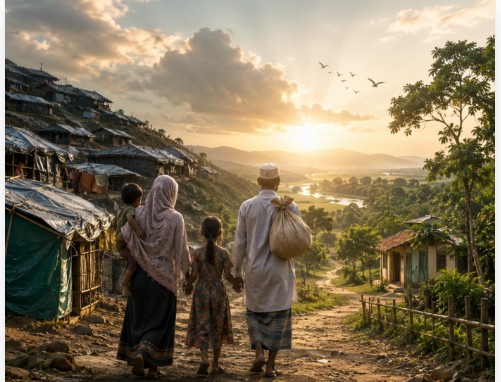
The real measure of success was never going to be a joint statement or a diplomatic photo op. It will be the day a Rohingya family crosses back into Rakhine and finds citizenship where there was statelessness, and a future where there was only waiting. Get there, and it won’t just be a win for Bangladesh’s foreign policy, it will be one of the rare moments international laws actually delivered on its promises.
For a million Rohingya waiting a decade to go home, a fragile diplomatic opening offers the first real hope
38
