

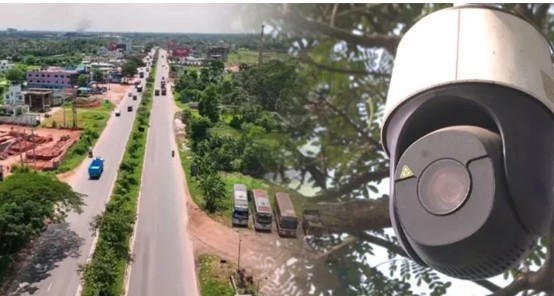
Dhaka: The Dhaka–Chattogram Highway and Dhaka–Mawa Highway have been brought under comprehensive CCTV surveillance with the installation of advanced artificial intelligence (AI)-powered cameras, as part of the government’s zero-tolerance policy against highway crime and narcotics.
Additional Inspector General (IGP) of Highway Police Faruk Ahmed said the entire Dhaka–Chattogram Highway is now under CCTV coverage, while 16 strategic locations have been equipped with AI-powered surveillance cameras.
“We have brought the entire Dhaka–Chattogram Highway under CCTV coverage, while 16 important points of the highway have also been brought under the coverage of AI cameras,” he told Bangladesh Sangbad Sangstha (BSS).
He said the Dhaka–Mawa Highway has also been placed under the same surveillance network to strengthen security along the route.
With the new system in place, the Highway Police is now centrally monitoring both highways through an integrated surveillance network.
According to Ahmed, the AI cameras on the Dhaka–Mawa Highway were installed under a project of the Road Transport and Bridges Ministry.
He said the Highway Police is preparing to sign a memorandum of understanding (MoU) with the ministry that will formally authorize the force to operate the AI-powered surveillance system, although it has already been managing the network on an unofficial basis.
Focus on Crime Prevention
The Highway Police chief said the enhanced surveillance system is expected to significantly improve operational efficiency and strengthen efforts to prevent robberies, drug trafficking and other highway crimes.
He added that although AI cameras have already been installed along the Dhaka–Chattogram Highway, their formal inauguration is expected soon.
The surveillance programme will gradually be expanded to other highways across the country to facilitate prompt action against criminal activities while also helping reduce traffic congestion.
Ahmed said the Highway Police’s two primary responsibilities are preventing highway crimes—including robbery and narcotics trafficking—and ensuring smooth traffic movement.
He noted that the force is increasingly adopting advanced information technology to improve service delivery, operational efficiency, transparency and accountability through data-driven policing.
Authorities are also placing greater emphasis on community-oriented policing by strengthening public trust and encouraging greater citizen participation.
Officials believe that combining modern technology, evidence-based policing and stronger community engagement will contribute to safer highways and more efficient public services.
Drive Against Extortion
Faruk Ahmed, a 17th BCS (Police) officer who assumed office as Additional IGP of Highway Police on July 7, pledged to eliminate extortion and public harassment on the country’s highways.
“I am confident of making the highways extortion- and hassle-free within the next two months,” he said.
He also expressed confidence that allegations of Highway Police personnel collecting illegal payments from vehicles would no longer persist after the next two months.
Expanding Highway Police Capacity
The Additional IGP said the Highway Police currently operates 73 police stations nationwide and plans to establish more stations while strengthening the professional capacity of its personnel to improve public service delivery.
Established on June 11, 2005, the Highway Police is a specialised unit of Bangladesh Police responsible for maintaining law and order, preventing highway crime, investigating road accidents, enforcing traffic laws, conducting highway patrols, ensuring road safety and managing traffic flow across the national highway network.
Operating under the leadership of an Additional Inspector General, the force currently comprises four divisions, eight regional offices, 10 circles, seven camps and 73 highway police stations, with an approved manpower of 2,814 personnel.
Its eight regional headquarters are located in Gazipur, Cumilla, Bogura, Madaripur, Sylhet, Khulna, Rangpur and Mymensingh.
Despite manpower and resource constraints, the Highway Police is responsible for policing approximately 11,806 kilometres of highways across Bangladesh.