

Every country tells a story about itself. The story Bangladesh tells or rather, the story it argues over, cuts to something fundamental: not just who governs, but who belongs.
Ziaur Rahman’s answer to that question was deceptively simple. He called it Bangladeshi nationalism, and four decades on, it remains one of the most consequential and least understood ideas in the country’s political life.
The misunderstanding usually starts in the same place. Critics frame it as a rejection of Bengali identity; a political maneuver designed to distance Bangladesh from its liberation inheritance. But that reading collapses under scrutiny. Ziaur Rahman never disputed that Bangladeshis are Bengali in language and in cultural temperament. What he disputed was the assumption that language alone could bear the full weight of national identity for a sovereign, plural state.
It is worth sitting with that distinction, because it is not a small one.
When Bangladesh emerged in 1971, it inherited not just a flag but a country, a country that included, alongside its Bengali-speaking majority, the Chakma, Marma, Tripura, Mro, Bawm, and dozens of other communities across the Chittagong Hill Tracts, each with languages, histories, and ways of life that Bengali cultural nationalism had no natural vocabulary to accommodate. A national identity that could not speak to them without asking them to dissolve into the majority was not a national identity at all. It was a majority identity with national pretensions.
This is where Bangladeshi nationalism did its most serious philosophical work. Ziaur Rahman proposed a civic identity, rooted not in ethnicity or language but in shared citizenship, shared territory, and a shared stake in the country’s future. His now-famous bouquet metaphor was not decorative. It made a precise argument: that a nation, like a bouquet, draws its strength from the distinctiveness of its parts, not from forcing every flower into the same shape. A Chakma could remain fully Chakma. A Marma would lose nothing of cultural life. A Bengali would surrender no part of linguistic heritage. All would be, and feel, Bangladeshi.
That is harder to build than it sounds and Ziaur Rahman knew it. His pragmatism showed in the way the philosophy extended outward. Rather than tethering Bangladesh to a single regional patron, he opened diplomatic and economic relationships across the Muslim world, China, the United States, and the broader developing world. The early architecture of the remittance economy, the expansion of Bangladesh’s international footprint, the deliberate cultivation of strategic space, all of it was an expression of the same underlying instinct: that a country confident in a secure, composite identity can engage the world on its own terms.
Scholar B K Jahangir, in his rigorous study of Bangladeshi nationalism, argued that in a society of this complexity, single-identity nationalism does not unify, it privileges. Durable cohesion, he contended, requires a political framework expansive enough to hold different communities, regions, and traditions without demanding that any of them disappear. The philosophy Ziaur Rahman articulated was precisely such a framework.
The bouquet, in other words, was not a metaphor for sentimentality. It was a metaphor for statecraft.
That is why the idea keeps returning. In an era of intensifying identity pressure, geopolitical competition, and the constant temptation to define nations by what or whom, they exclude, the question Ziaur Rahman posed remains the right one: how does a diverse society hold together without becoming coercive? His answer was incomplete, as all political philosophies are. But it pointed toward something that many countries, far larger and more powerful than Bangladesh, are still searching for a nationalism that draws its strength not from uniformity, but from the dignity of difference held in common.

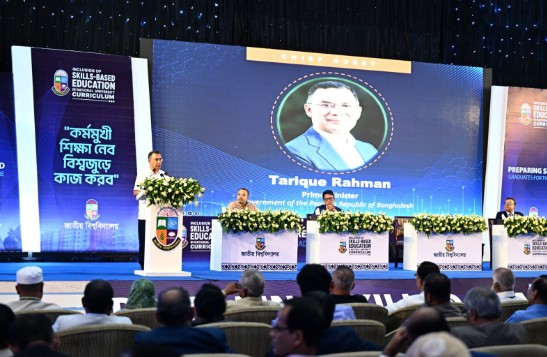
Prime Minister Tarique Rahman today called for developing a skill and technology-based practical and job-oriented education system in the country instead of certificate-based education.
“In this era of the Fourth Industrial Revolution, there is no alternative to modernising and updating the traditional education curriculum to face the challenges of artificial intelligence (AI) and automation,” he said.
The Prime Minister made the remarks while addressing the inaugural session of a training programme on job-oriented and technical education for teachers at the Bangladesh-China Friendship Conference Center in the capital.
The National University (NU) organised the programme under the theme, “We will take job-oriented education, we will work around the world,” with the goal of developing 12,000 college teachers as skilled educators.
Tarique Rahman said more than a decade and a half of authoritarian rule had not only deprived people of their democratic rights but also disrupted the country’s education system.
“It is now our turn to turn around in democratic Bangladesh,” he said.
Emphasising the need to build a knowledge-based state and society, the Prime Minister said Bangladesh must prepare itself in education, science, technology and innovation to remain competitive in the global arena.
Highlighting the role of the National University, he said more than 40 lakh students are currently studying in over 2,000 affiliated colleges across the country.
He noted that former Prime Minister Begum Khaleda Zia established the university in 1992 to address challenges in higher education management and expand access to education.
The Prime Minister said rapid technological change is transforming the global job market, creating new opportunities while making some traditional professions obsolete.
“To cope with this technological revolution, it is essential to include subjects like artificial intelligence, cybersecurity, programming, digital entrepreneurship, quantum computing, nanotechnology and 5G technology in the education curriculum,” he said.
He added that the government has already started efforts to make the education curriculum more practical and technology-oriented at all levels.
Tarique Rahman stressed the need to reduce unemployment among educated youth by strengthening apprenticeships, internships and industry-academia collaboration.
He said these initiatives are initially being implemented in divisional cities so that students can acquire practical skills alongside their academic studies.
Highlighting entrepreneurship development, the Prime Minister said the government has decided to provide seed funding and innovation grants through a competitive process to help commercialise innovative business ideas developed in colleges and universities.
“As a result, young people will be able to create employment themselves instead of chasing jobs,” he said.
The Prime Minister also emphasised the importance of moral education, mental health, social inclusion and environmental awareness alongside technological advancement.
He said learning a third language in addition to Bangla and English could significantly expand employment opportunities both at home and abroad.
Urging teachers to act as agents of social change, Tarique Rahman said a technologically skilled workforce would help build a prosperous and self-reliant Bangladesh.
Describing national development as a collective effort, he called for cooperation from universities, teachers, students, guardians, civil society and the industrial sector in building a knowledge- and merit-based society.
Education Minister ANM Ehsanul Hoque Milon, Prime Minister’s Adviser for Education Mahdi Amin and NU Vice-Chancellor Professor Dr ASM Amanullah also spoke at the programme.

A Dhaka court today sentenced Sohel Rana and his wife Swapna Akter to death in the rape and murder case of schoolgirl Ramisa, in one of the fastest-disposed major rape-murder trials in the country’s judicial history.
Judge Masrur Salekin of the Dhaka Metropolitan Children’s Violence Suppression Tribunal delivered the verdict.
The court began proceedings at 11:00 am and announced the death sentence at 11:37 am. The tribunal also fined Sohel Rana Tk 5 lakh and Swapna Akter Tk 2 lakh.
Security was tightened around the court before the verdict, with three additional platoons of police deployed alongside regular security personnel.
The tribunal framed charges against the two accused on June 1 and completed legal arguments on June 4, allowing the case to be concluded within a week of indictment.
According to the prosecution, Ramisa, a Class-II student of Popular Model High School, was raped and murdered at a flat in the Millat Camp area of Pallabi on May 19. A case was filed by her father the following day.
Police submitted the charge sheet on May 24 against Sohel Rana and his wife Swapna Akter.
The tribunal recorded testimonies from 16 prosecution witnesses on June 2. The witnesses were later cross-examined by the defence on the same day.
On June 3, the two accused made their statements before the court. Sohel Rana sought mercy, while Swapna Akter claimed innocence and requested justice.
During final arguments on June 4, the prosecution sought the highest punishment for both accused.
The tribunal found both accused guilty and handed down the death penalty.

A Chinese delegation visited several locations in Companiganj upazila of Sylhet to inspect potential sites for a proposed 1,000-bed hospital.
The delegation arrived in Sylhet to assess possible locations and examine the feasibility of the project, which is expected to significantly improve healthcare services in the region if implemented.
Expatriates’ Welfare and Overseas Employment Minister Ariful Haque Chowdhury accompanied the delegation during the visit.
The team visited the Sadapathor tourist spot, Sylhet Hi-Tech Park and several other locations to conduct a preliminary assessment of their suitability for the proposed hospital.
Sylhet Deputy Commissioner Md Sarwar Alam and other senior local administration officials were also present.
Speaking to journalists after the visit, the minister said the formal process of selecting a site for the hospital has already begun.
“China will provide full financing for the project and discussions with Chinese investors on site selection and preliminary planning are continuing,” he said.
Ariful Haque Chowdhury expressed optimism that the project would bring major improvements to healthcare services in Sylhet and surrounding areas.
“Once implemented, the project will have a positive impact on healthcare services in this region. People of Sylhet will no longer have to depend on Dhaka for advanced medical treatment,” he said.
Speaking on behalf of the Chinese delegation, Steward Cheung, Chairman of Bai Up Investment Limited, said they were encouraged by the initial site inspections and feasibility assessment.
“Considering Sylhet’s geographical location and the growing demand for quality healthcare services, the project appears highly promising,” he said, adding that efforts would be made to ensure financing for the initiative.
Earlier, the expatriates’ welfare minister held a meeting with the Chinese investors at the Sylhet Circuit House, where both sides discussed the proposed hospital’s location, scope and investment structure.
The two sides agreed to work together to accelerate the implementation process of the project.

Prime Minister Tarique Rahman chaired a meeting to discuss solutions to the long-standing waterlogging problem in the Dhaka-Narayanganj-Demra (DND) Embankment area.
The meeting was held at the Prime Minister’s Cabinet Division office at the Bangladesh Secretariat, according to Prime Minister’s Deputy Press Secretary Md Suzauddhowla (Sujon Mahmud).
Officials discussed the persistent waterlogging situation in the DND embankment area and explored possible measures to address the problem.
Speaking after the meeting, Water Resources Minister Md Shahiduddin Chowdhury Anee said the DND area has suffered from waterlogging for many years and that the problem still remains despite previous efforts.
He said a project to address the issue was launched in 2016 and completed in 2024. However, local residents have not yet received the expected benefits from the project.
The minister said the project implemented by the Ministry of Water Resources would be handed over to the city corporation within the next two weeks.
He also said a new plan is being prepared to further improve the drainage system in the DND area. A proposal to develop an additional 30 kilometres of drainage infrastructure has already been placed before the Prime Minister.
Expressing optimism, Anee said the expected results could be achieved through city corporation management and coordinated efforts by all concerned authorities.
State Minister for Water Resources Forhad Hossain Azad, State Minister for LGRD and Cooperatives Mir Shahe Alam, Dhaka South City Corporation Administrator Abdus Salam and RAJUK Chairman Engineer Md Reazul Islam were present at the meeting.
Every nation eventually confronts the question it has been deferring: not what it has built, but what it believes. Bangladesh is confronting that question now.
The country finds itself at a rare and exposed moment when the old political certainties have crumbled fast enough that the ground beneath them is newly visible. In their place, competing visions are pressing their claims. Some look toward liberal democratic frameworks as the organizing principle of the state. Others seek to draw Islamic identity more explicitly into the center of political life. Still others argue that Bangladesh’s future is best secured through careful alignment with whichever external power can best underwrite its ambitions — whether Washington, Beijing, or New Delhi.
Meanwhile, the tectonic plates of regional geopolitics are shifting. The contest among the United States, China, India, and Russia for strategic influence across South Asia has pulled Bangladesh’s domestic politics into a wider orbit. Internal decisions now carry external weight. The question of who governs, and on what ideological basis, is no longer merely a local matter.
It is against this backdrop that the concept of Bangladeshi nationalism “Bangladeshi jatiyatabad”, has returned to the center of political conversation with a force that surprises those who had pronounced it a relic.
Ziaur Rahman introduced the doctrine at the precise moment when such a framework was most urgently needed: the early years after independence, when a new state had yet to determine what it was independent for. The Liberation War had answered the question of sovereignty. It had not answered the question of identity.
What Zia proposed was not ethnic nationalism in the European mold, nor Islamic nationalism in the Pakistani tradition, nor secular nationalism in the Bengali cultural sense. It was something more eclectic and perhaps more honest; a synthesis. Language, history, geography, religious reality, and the state’s sovereign interest were all folded into a single framework. The result was a political philosophy that resisted easy categorization, which is precisely what made it durable.
Critics have long called it vague. But vagueness can be a virtue in nation-building. A doctrine capacious enough to contain the diversity of a deltaic country, its coastal fishing communities and hill-tract peoples, its madrasa students and garment workers, its diaspora remitting from the Gulf and from Manchester is not formless. It is federal in spirit, even if not in structure.
After Zia’s death, the burden of continuity fell to Khaleda Zia, and it was a different kind of burden. Translating a founding vision into governing practice is always harder than articulating it. The rhetorical architecture had to become institutional.
Her governments, first in 1991, then from 2001 to 2006, made serious attempts to embed Bangladeshi nationalism into policy rather than merely into party platforms. Sovereignty, multiparty democracy, economic liberalization, and popular political participation were treated not as abstract values but as operational commitments. Rural infrastructure, agricultural expansion, the early development of an IT sector, the integration of diaspora remittances into the national development framework, these were not simply administrative decisions. They were applications of a philosophy that held national self-reliance and broad-based development as inseparable.
The religious and cultural texture of Bangladeshi society was treated, during this period, not as a problem to be managed but as a reality to be incorporated, honestly and without embarrassment into the nation’s self-understanding.
Tarique Rahman now leads the Bangladesh Nationalist Party from a distance, from exile, and at a moment of significantly greater complexity than either of his predecessors faced.
The world that Ziaur Rahman navigated was bipolar and relatively legible. The world Khaleda Zia governed was unipolar and briefly optimistic. The world Tarique Rahman is addressing is something else entirely: multipolar, information-saturated, algorithmically fractured, and governed increasingly by the logic of technological power and supply-chain dependency.
His public positions – national unity, participatory democracy, youth empowerment, technology-driven economic growth, accountable governance, decentralized administration reflect a recognition that the core philosophical inheritance must be re-expressed in a contemporary idiom if it is to remain credible rather than nostalgic.
Most notably, he has argued for a foreign policy grounded in national interest rather than bloc alignment, a diplomatic posture of balance rather than dependency, and a development model that routes benefits to ordinary citizens rather than accumulating in patronage networks. Whether one supports BNP or not, these are not trivial positions. They engage seriously with the structural failures that have defined Bangladesh’s political economy for a generation.
There is a deeper argument embedded in all of this, and it deserves to be stated plainly.
The most important long-term question facing Bangladesh is not economic growth, though growth matters. It is not even democratic governance, though governance is foundational. It is the question of national cohesion whether the country can maintain sufficient shared identity to navigate the pressures that are bearing down on it from outside and the tensions that are pulling at it from within.
Political polarization. Ideological conflict. The soft-power competition of external actors who have their own preferences about how Bangladesh should be governed and with whom it should align. These are not hypothetical threats. They are active conditions.

Dhaka North City Corporation (DNCC) and Dhaka South City Corporation (DSCC) have taken extensive preparations to ensure quick removal of sacrificial animal waste during Eid-ul-Azha, with around 29,500 personnel set to work across the capital.
Authorities said waste removal operations will begin from the afternoon of Eid day. Around 700,000 sacrificial animals are expected to be slaughtered in Dhaka this year, producing nearly 55,000 tonnes of waste.
To ensure uninterrupted cleaning operations, Eid holidays of sanitation workers and officials of both city corporations have been cancelled. Around 1.77 million plastic, poly and biodegradable bags are also being distributed among residents for waste collection and disposal.
DSCC Administrator Freedom Fighter Md Abdus Salam said a special monitoring council has been formed to supervise cattle markets and waste management activities.
He said the main cleaning drive will start at 12 noon on Eid day and authorities aim to remove the first day’s sacrificial waste within eight hours.
The DSCC administrator urged residents not to throw waste into drains or sewers, warning that it could cause disease outbreaks and severe waterlogging during rainfall.
According to DSCC officials, around 33,942 tonnes of waste will be removed over three days. Of this, 15,935 tonnes will be cleared on the first day, 11,776 tonnes on the second day and 6,231 tonnes on the third day.
About 174,000 animals are expected to be sacrificed within DSCC areas this year. A total of 2,117 vehicles and equipment including compactors, dump trucks, container carriers, excavators, bulldozers and water tankers will be used for waste removal.
To support sanitation activities, DSCC will distribute 46 tonnes of bleaching powder, 210 gallons of Savlon and 140,000 biodegradable bags.
A central control room at Nagar Bhaban will monitor operations round-the-clock, while separate control rooms will remain active at cattle markets.
Two hotline numbers — 01709900888 and 02223386014 — have been opened for citizens to report complaints.
Meanwhile, DNCC Administrator Md Shafiqul Islam Khan said awareness campaigns on waste management are being carried out through loudspeaker announcements in every ward. Imams are also encouraging people to maintain cleanliness during Eid.
DNCC officials said around 16,000 personnel including sanitation workers, waste collectors and volunteers will remain deployed in the field.
The corporation has distributed 1.63 million poly bags and 3,600 sacks of bleaching powder for cleaning and disinfection.
A total of 752 vehicles and equipment including trucks, dumpers, water tankers, compactor trucks and road sweepers have been kept ready.
DNCC officials also said around 1,000 meat processors across 54 wards are being trained to ensure proper slaughtering and waste management practices.
Officials from both city corporations expressed hope that with public cooperation, sacrificial waste across the capital could be removed within the targeted timeframe
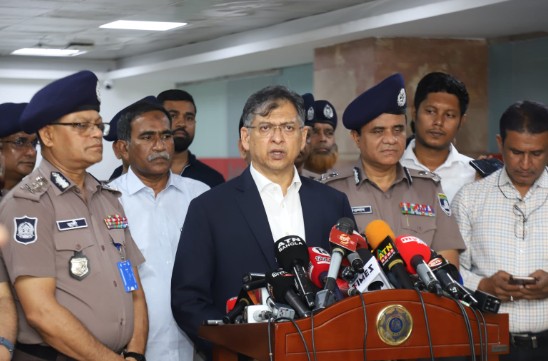
Home Minister Salahuddin Ahmed said the government is maintaining a zero tolerance policy against terrorism, drugs, extortion and all forms of criminal activities to ensure public safety and law and order ahead of Eid-ul-Azha.
“The government will continue its zero tolerance stance against terrorism, drugs and extortion. After years of disorder and criminalization, we are determined to restore discipline and the rule of law in the country,” he said.
The minister made the remarks while speaking to journalists after visiting the National Operation Monitoring Center at Bangladesh Police Headquarters in Dhaka.
He said law enforcement agencies remain fully prepared and alert to maintain peace and stability across the country during the Eid holidays.
During the visit, the minister inspected monitoring activities and provided directives to on-duty police officials.
He said the Central Monitoring Cell, which operates throughout the year, has been strengthened from seven days before Eid until seven days after Eid to ensure uninterrupted surveillance and quick response.
According to the minister, all major highways, cattle markets, the Jamuna Bridge, the Padma Bridge and expressways are now under round-the-clock monitoring.
He said police personnel in areas without CCTV coverage are being equipped with body-worn cameras to improve surveillance and accountability.
Referring to recent road accidents, the minister said the number of accidents this year is lower compared to previous years. However, he blamed carelessness and risky travel practices for the incidents that occurred.
He urged people to remain careful and responsible while travelling during Eid.
On illegal cattle markets, the minister said the government is taking strict measures to stop unauthorized markets from operating.
He mentioned that an illegal cattle market under the metro rail line in Mirpur was shut down immediately.
The minister also said counterfeit currency detection machines have been installed at cattle markets with support from Bangladesh Bank, commercial banks and police to prevent fake notes.
Commenting on recent attacks on police and RAB members in Narayanganj and Jangal Salimpur in Chattogram, he warned that the government would take firm action against terrorists and criminal groups.
He said a coordinated operation in Jangal Salimpur led to the arrest of several notorious criminals and the recovery of a large number of weapons.
The minister also announced plans to establish a security and administrative hub in the area, including a police academy, RAB academy, police sports complex and prison facilities.
Replying to questions about traffic congestion at the Jamuna Bridge toll plaza, he said the problem is mainly caused by the manual toll collection system. He added that the government would recommend digital automation and card-based toll payments to improve traffic flow.
Regarding allegations involving drug trafficking operations and attacks on journalists in Savar, the minister said three police members had already been closed over the incident.
He assured that strict legal action would be taken against those involved based on information provided by journalists.
Senior Secretary of the Ministry of Home Affairs Manzur Morshed Chowdhury, Inspector General of Police Md Ali Hossain Fakir and other senior police officials were present.

The Bangladesh Power Development Board (BPDB) said electricity demand during Eid holidays is expected to remain around 12,000-13,000 megawatts.
Some power plant units are currently under scheduled maintenance, while fuel-based plants are also being operated to meet peak demand.
BPDB officials said online coordination meetings are being held regularly with distribution companies. Field engineers have also been deployed in four BPDB zones to ensure quick response in case of storms or technical problems.
The BPDB said industrial and commercial electricity demand usually decreases during Eid holidays, making it easier to maintain stable power supply in residential areas.
Authorities have already inspected and carried out maintenance work on vulnerable transmission lines and substations.
Special control rooms will remain active before and after Eid, while engineers, linemen and technical teams will stay on standby for emergency response.
The Power Division has instructed senior officials of all agencies to monitor electricity conditions in their respective areas during the holiday period and submit reports to the ministry.
Distribution companies including Dhaka Power Distribution Company (DPDC), Dhaka Electric Supply Company (DESCO), Bangladesh Rural Electrification Board (BREB) and Northern Electricity Supply Company (NESCO) have formed special monitoring teams.
The Power Division also urged consumers to avoid unnecessary electricity use and advised prepaid meter users to complete their recharges in advance.

UNICEF has expressed deep shock and concern over recent incidents of brutal violence against children in Bangladesh, including the rape and killing of girls and boys in places where they were expected to be safe.
“Brutality against children must stop,” UNICEF Representative in Bangladesh Rana Flowers said in a statement.
She said the growing number of reports of sexual and brutal violence against women and children across the country in 2026 highlights the urgent need to strengthen child protection and gender-based violence prevention systems.
Rana Flowers said the culture of impunity for perpetrators must end and gaps in prevention, reporting, institutional safety, child-friendly policing, justice and social services must be addressed.
She also stressed the importance of psychosocial support for women and children and called for stronger accountability in schools, madrasas, workplaces, neighbourhoods and care centres.
“Violence spreads when communities stay silent,” she said, urging people to report abuse and exploitation through available protection services including Child Helpline 1098.
UNICEF also urged the public, media outlets and social media users not to share photos, videos or personal details of victims, saying such actions increase the trauma of survivors and their families.
The organisation called on everyone to raise their voices for stronger protection systems and an end to impunity for offenders.
“Every child has the right to protection everywhere, in communities, schools, at home and even in how their stories and images are treated in public spaces,” Rana Flowers added.