

Every nation eventually confronts the question it has been deferring: not what it has built, but what it believes. Bangladesh is confronting that question now.
The country finds itself at a rare and exposed moment when the old political certainties have crumbled fast enough that the ground beneath them is newly visible. In their place, competing visions are pressing their claims. Some look toward liberal democratic frameworks as the organizing principle of the state. Others seek to draw Islamic identity more explicitly into the center of political life. Still others argue that Bangladesh’s future is best secured through careful alignment with whichever external power can best underwrite its ambitions — whether Washington, Beijing, or New Delhi.
Meanwhile, the tectonic plates of regional geopolitics are shifting. The contest among the United States, China, India, and Russia for strategic influence across South Asia has pulled Bangladesh’s domestic politics into a wider orbit. Internal decisions now carry external weight. The question of who governs, and on what ideological basis, is no longer merely a local matter.
It is against this backdrop that the concept of Bangladeshi nationalism “Bangladeshi jatiyatabad”, has returned to the center of political conversation with a force that surprises those who had pronounced it a relic.
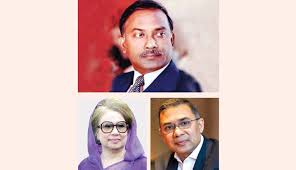
Ziaur Rahman introduced the doctrine at the precise moment when such a framework was most urgently needed: the early years after independence, when a new state had yet to determine what it was independent for. The Liberation War had answered the question of sovereignty. It had not answered the question of identity.
What Zia proposed was not ethnic nationalism in the European mold, nor Islamic nationalism in the Pakistani tradition, nor secular nationalism in the Bengali cultural sense. It was something more eclectic and perhaps more honest; a synthesis. Language, history, geography, religious reality, and the state’s sovereign interest were all folded into a single framework. The result was a political philosophy that resisted easy categorization, which is precisely what made it durable.
Critics have long called it vague. But vagueness can be a virtue in nation-building. A doctrine capacious enough to contain the diversity of a deltaic country, its coastal fishing communities and hill-tract peoples, its madrasa students and garment workers, its diaspora remitting from the Gulf and from Manchester is not formless. It is federal in spirit, even if not in structure.
After Zia’s death, the burden of continuity fell to Khaleda Zia, and it was a different kind of burden. Translating a founding vision into governing practice is always harder than articulating it. The rhetorical architecture had to become institutional.
Her governments, first in 1991, then from 2001 to 2006, made serious attempts to embed Bangladeshi nationalism into policy rather than merely into party platforms. Sovereignty, multiparty democracy, economic liberalization, and popular political participation were treated not as abstract values but as operational commitments. Rural infrastructure, agricultural expansion, the early development of an IT sector, the integration of diaspora remittances into the national development framework, these were not simply administrative decisions. They were applications of a philosophy that held national self-reliance and broad-based development as inseparable.
The religious and cultural texture of Bangladeshi society was treated, during this period, not as a problem to be managed but as a reality to be incorporated, honestly and without embarrassment into the nation’s self-understanding.
Tarique Rahman now leads the Bangladesh Nationalist Party from a distance, from exile, and at a moment of significantly greater complexity than either of his predecessors faced.
The world that Ziaur Rahman navigated was bipolar and relatively legible. The world Khaleda Zia governed was unipolar and briefly optimistic. The world Tarique Rahman is addressing is something else entirely: multipolar, information-saturated, algorithmically fractured, and governed increasingly by the logic of technological power and supply-chain dependency.
His public positions – national unity, participatory democracy, youth empowerment, technology-driven economic growth, accountable governance, decentralized administration reflect a recognition that the core philosophical inheritance must be re-expressed in a contemporary idiom if it is to remain credible rather than nostalgic.
Most notably, he has argued for a foreign policy grounded in national interest rather than bloc alignment, a diplomatic posture of balance rather than dependency, and a development model that routes benefits to ordinary citizens rather than accumulating in patronage networks. Whether one supports BNP or not, these are not trivial positions. They engage seriously with the structural failures that have defined Bangladesh’s political economy for a generation.
There is a deeper argument embedded in all of this, and it deserves to be stated plainly.
The most important long-term question facing Bangladesh is not economic growth, though growth matters. It is not even democratic governance, though governance is foundational. It is the question of national cohesion whether the country can maintain sufficient shared identity to navigate the pressures that are bearing down on it from outside and the tensions that are pulling at it from within.
Political polarization. Ideological conflict. The soft-power competition of external actors who have their own preferences about how Bangladesh should be governed and with whom it should align. These are not hypothetical threats. They are active conditions.
