

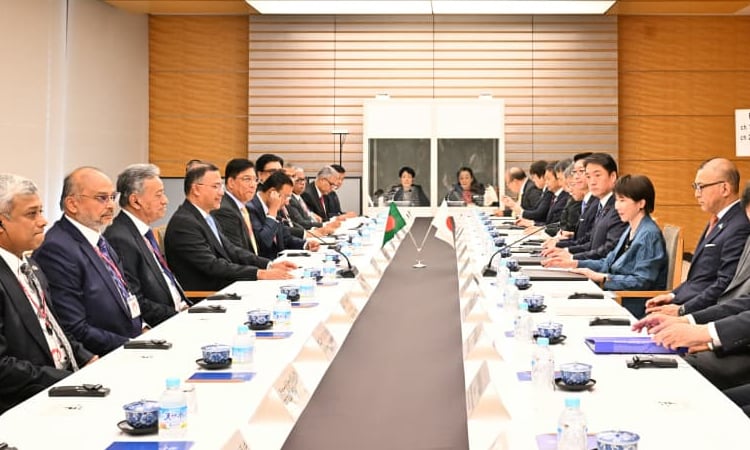
Prime Minister Tarique Rahman and his Japanese counterpart Sanae Takaichi have agreed to strengthen bilateral cooperation in energy security, advanced technology, infrastructure, trade and investment, as the Bangladesh premier proposed forming a joint ministerial commission to accelerate cooperation in priority sectors.
At a bilateral summit at the Japanese Prime Minister’s Office in Tokyo, Tarique Rahman called on the Japanese government and private sector to play a more active role in Bangladesh’s economic development, technological advancement and industrialisation.
He said Bangladesh was working to establish itself as a regional hub for economic activity, technology and manufacturing, highlighting its growth potential.
“By 2030, Bangladesh could become the world’s ninth-largest consumer economy, and by 2034, our GDP could exceed US$1 trillion,” he said.
On energy security, the prime minister stressed that reliable and affordable energy supplies were essential to sustaining economic growth. He thanked Japan for its long-standing support, particularly an emergency loan of 50 billion Japanese yen under the Partnership for Power Asia initiative.
He also called for greater Japanese investment in Bangladesh’s liquefied natural gas (LNG) infrastructure, efficient power generation and renewable energy sectors.
To promote a technology-driven economy, Tarique Rahman proposed establishing a Bangladesh-Japan Tech Park that would connect Japanese companies, universities and investors with Bangladesh’s young talent, entrepreneurs and skilled technology professionals.
The proposed facility could focus on artificial intelligence, cloud computing, robotics and electronics manufacturing, creating opportunities for technology transfer, innovation and skilled employment.
He also expressed interest in expanding cooperation in space science, satellite engineering and related technologies, drawing on Japan’s advanced capabilities in these fields.
Highlighting the need for modern transport infrastructure, the prime minister outlined plans to develop a high-speed railway network connecting Bangladesh’s six major divisional cities and a nationwide elevated-road network.
He sought Japanese technical assistance, investment and financing for the projects, noting that Japan’s experience in infrastructure development and modern transport systems could help Bangladesh achieve its development goals.
Welcoming fresh investment from Japanese businesses, Tarique Rahman said his government was committed to improving the investment climate through greater transparency, predictability and efficiency in regulatory systems, tax policies, customs clearance and fund transfers.
He also called for the prompt implementation of the Bangladesh-Japan Economic Partnership Agreement (EPA), saying both countries should work together to ensure that its benefits reach their people.
Recalling the longstanding friendship between the two countries, he said Japan held a special place in the hearts of Bangladeshis. Japan was among the earliest countries to recognise Bangladesh after its independence in 1971 and has remained one of its most valued development partners, contributing significantly to socioeconomic progress and infrastructure development.
The prime minister also recalled his father, Shaheed President Ziaur Rahman’s, two visits to Japan and his mother, former prime minister Begum Khaleda Zia’s, contributions to strengthening bilateral relations. He pledged to take the partnership to new heights.
On regional and international issues, Tarique Rahman reaffirmed the two countries’ shared commitment to multilateralism, international peace and respect for international law.
He thanked Japan for supporting Bangladesh Foreign Minister Dr Khalilur Rahman’s election as president of the 81st session of the United Nations General Assembly and expressed hope for closer cooperation with Tokyo in addressing global challenges.
Reiterating their shared vision of a free, open, peaceful and inclusive Indo-Pacific, he stressed the importance of stronger regional connectivity, free trade and sustained economic growth.
The prime minister also expressed deep concern over the worsening situation in Myanmar and the resulting Rohingya displacement crisis. He called for an end to all forms of violence, unhindered humanitarian assistance and dialogue among the parties concerned.
Appreciating Japan’s support for Bangladesh’s humanitarian efforts to shelter Rohingyas forcibly displaced from Myanmar’s Rakhine State, he urged Tokyo to remain actively engaged in promoting regional peace and stability.
“A lasting solution to the Rohingya crisis lies in Myanmar,” he said, stressing the need for the early repatriation of displaced people to their homeland in a voluntary, safe and dignified manner.
In his concluding remarks, Tarique Rahman expressed optimism that the summit would open a new chapter in Bangladesh-Japan relations through deeper trust, broader economic cooperation, stronger investment ties and a shared commitment to peace, stability and prosperity.
He proposed establishing a joint ministerial commission to identify priority areas, accelerate implementation and turn cooperation opportunities into concrete initiatives. He also emphasised the importance of closer engagement between the business communities of the two countries.
The prime minister invited Takaichi to visit Bangladesh at a mutually convenient time, expressing confidence that the longstanding friendship would continue to grow through mutual trust, cooperation and shared prosperity.
Following the summit, the two leaders made a joint press announcement on the outcomes of their discussions and exchanged several memorandums of understanding covering key areas of cooperation. Takaichi also hosted an official luncheon in honour of Tarique Rahman at the Kantei, the Japanese prime minister’s office.
Tarique Rahman arrived in Tokyo on Monday for a four-day official visit at Takaichi’s invitation. During the visit, he is also scheduled to deliver the keynote address at the Bangladesh-Japan Economic Forum and meet Japanese business leaders.
