

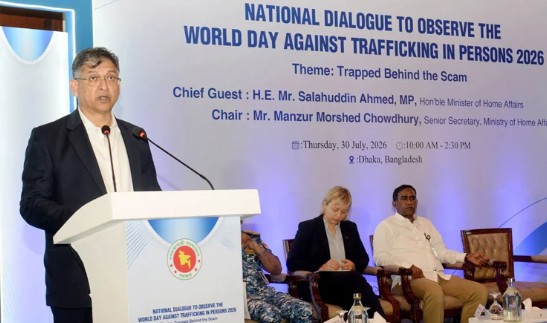
Home Minister Salahuddin Ahmed has said the government has adopted a zero-tolerance policy against human trafficking and technology-enabled transnational scam networks, reaffirming its commitment to protecting citizens from trafficking and cyber-enabled exploitation.
He made the remarks while addressing a high-level national dialogue titled “Trapped behind the Scam: Ending Human Trafficking for Forced Criminality” at Pan Pacific Sonargaon Hotel in the capital, marking the World Day Against Trafficking in Persons 2026.
The Home Minister said trafficking syndicates are increasingly using fake online recruitment platforms and social media to lure job seekers, particularly young people, with false promises of overseas employment.
Many victims are subsequently confined in cyber scam centres abroad, where they face torture, intimidation and are forced into criminal activities, he said.
Salahuddin Ahmed noted that conventional law enforcement alone is no longer sufficient to address the evolving nature of human trafficking and called for stronger cooperation among technology companies, financial institutions, the private sector and civil society.
Highlighting recent government initiatives, he said Bangladesh has enacted the Human Trafficking and Migrant Smuggling (Prevention and Suppression) Act, 2026, aligning the country’s legal framework with the United Nations Convention against Transnational Organized Crime (UNTOC) and its protocols.
According to the minister, the new law introduces stricter legal measures against online scam-related trafficking, technology-enabled deception and forced criminality.
He also said the government is updating the Human Trafficking Prevention and Suppression Rules, 2017, while finalising the National Action Plan (2026–2030) focusing on prevention, protection, prosecution and partnership.
To strengthen support for victims, the government is enhancing the National Referral Mechanism (NRM) to ensure timely rescue and provide legal, medical, psychological and rehabilitation services.
A digital trafficking information management platform is also being developed to improve case tracking and support evidence-based policymaking, he added.
The minister urged the media and civil society to raise awareness among young people, women and prospective migrant workers about safe migration and the risks posed by fraudulent recruitment networks.
The dialogue was chaired by Home Ministry Senior Secretary Manzur Morshed Chowdhury and attended by senior government officials, diplomats, law enforcement representatives and international development partners, including the European Union, the International Organization for Migration (IOM) and the United Nations Office on Drugs and Crime (UNODC).
Special guests included Law and Justice Division Secretary Liaquet Ali Molla, Inspector General of Police Md Ali Hossain Fakir, Chargé d’Affaires of the European Union Baiba Zarina and IOM Bangladesh Chief of Mission Dr Laura Tomm-Bonde, who also serves as Coordinator of the UN Migration Network.
Among those present were Bangladesh Coast Guard Director General Rear Admiral Md Ziaul Hoque and Border Guard Bangladesh Additional Director General Brigadier General Md Sohrab Hossain Bhuiyan.
The programme began with a welcome address by Additional Secretary of the Ministry of Home Affairs Dr Ziauddin Ahmed, while UNODC Bangladesh Head of Programme Office Shah Mohammad Naheeaan presented this year’s World Day Against Trafficking in Persons theme. A panel discussion on trafficking for forced criminality, deceptive recruitment and online exploitation was also held.
