

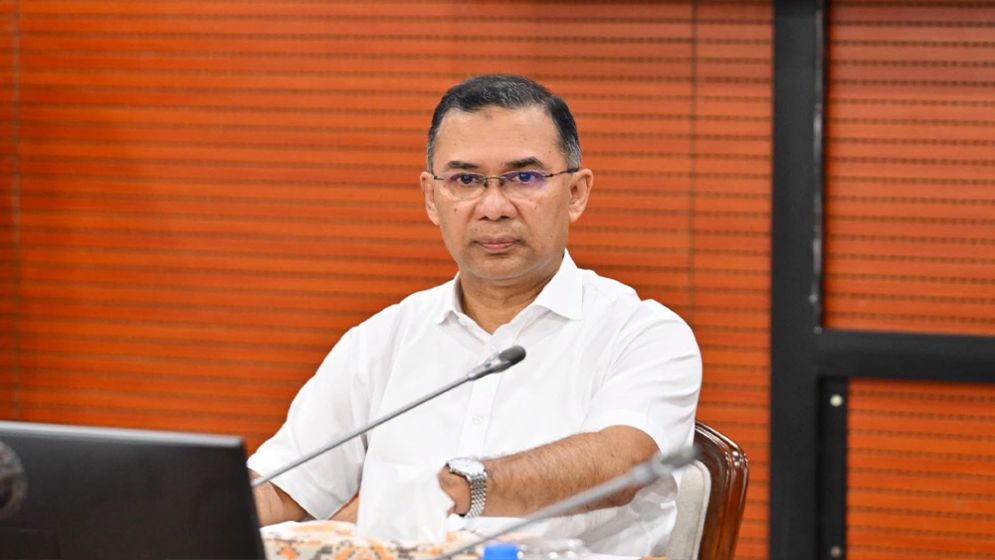
Prime Minister Tarique Rahman has called for national unity against domestic and foreign conspiracies, warning that no one has ever been able to suppress the people of Bangladesh and that no one will be able to do so in the future.
Speaking as the chief guest at a rally ahead of a colourful procession marking National Revolution and Solidarity Day on November 7, the prime minister said the nation would collectively respond to any conspiracy, whether originating at home or abroad.
His remarks came amid growing political tensions, labour unrest in the readymade garment (RMG) sector and opposition demonstrations. These developments have raised concerns about political stability, economic security and the future of the country’s democratic process.
The BNP-led government, headed by Tarique Rahman, assumed office amid significant economic and administrative challenges. The war in Iran and rising tensions in the Middle East have contributed to global fuel shortages and price increases, placing additional pressure on Bangladesh’s economy.
The government has been working to meet the country’s energy needs and maintain economic activity amid these challenges. In such circumstances, political cooperation and national unity are widely regarded as important for addressing the country’s difficulties.
However, allegations of political interference in labour unrest and attempts to destabilise the country have added to the tensions.
Government ministers, advisers and political leaders have accused former Awami League leaders, former ministers and MPs, as well as affiliated organisations such as the Chhatra League and Sramik League, of exploiting workers’ grievances to create instability. Some government officials have alleged that individuals associated with the banned party are attempting to use labour unrest to disrupt government activities ahead of December.
These allegations have prompted questions about whether the recent labour demonstrations are primarily driven by workers’ demands or are being influenced by political interests. Reports have also alleged that members of the banned Awami League and its affiliated organisations have joined garment workers in protests.
According to the Ministry of Home Affairs and intelligence reports cited in the allegations, former Prime Minister Sheikh Hasina, who fled to India, and former ministers and lawmakers associated with her party have been accused of instigating unrest.
The reports further allege that members of the banned Awami League, Sramik League and Chhatra League have infiltrated labour movements in Mirpur, Ashulia and Gazipur, provoking violence, arson and vandalism. These allegations have intensified calls for political parties to unite against sabotage and violence.
Meanwhile, an 11-party alliance led by Jamaat-e-Islami has been conducting long marches from Dhaka towards different divisional headquarters as part of a seven-point demand charter. The demands include implementation of the public mandate of the referendum, justice for the July genocide, and solutions to shortages of electricity, oil, gas and fertiliser.
The programme began on September 5 with a march towards Chattogram. The second phase was held on September 19 towards Rangpur, followed by a third march along the Dhaka-Khulna-Kushtia route on October 31.
At rallies along the routes, alliance leaders, including opposition leader and Jamaat chief Dr Shafiqur Rahman, delivered strong anti-government speeches and called for political change. Similar programmes have been announced for Barishal, Rajshahi, Sylhet and Mymensingh.
The opposition’s street programmes have sparked debate over their timing and political objectives, with the government having been in office for around eight months. Questions have also emerged over whether such demonstrations could intensify political instability or weaken parliamentary democracy.
Political analysts have expressed concern that prolonged political confrontation could create opportunities for forces seeking to exploit instability. Recent incidents of crude bomb explosions, arson and sabotage in different parts of Dhaka have further heightened public anxiety.
On Saturday, miscreants reportedly attempted to set fire to a passenger bus in Mirpur-12. Bus staff and local residents managed to extinguish the flames before the fire spread.
At least eight crude bomb explosions and one bus arson incident were reported in the capital during a single night.
The explosions occurred on Friday evening, November 6, and continued into the late night in Adabor, Shahbagh, Airport, Khilgaon and Kalshi in Mirpur.
On the same evening, a passenger bus belonging to Baishakhi Paribahan was set on fire on Pragati Sarani in Baridhara. A day earlier, a crude bomb exploded near a courier service covered van in front of Krishi Market in Rayerbazar, triggering a fire that injured the vehicle’s driver.
Such incidents have raised serious concerns about public safety and the potential consequences of political violence. Maintaining peace and stability is essential to protecting citizens, safeguarding economic activity and preserving democratic institutions.
The unity forged during the July movement remains an important national consideration. Political divisions and violence could undermine efforts to build a more inclusive and discrimination-free Bangladesh.
Against this backdrop, Prime Minister Tarique Rahman’s call for unity on National Revolution and Solidarity Day carries renewed significance.
The country needs collective efforts to prevent violence, address grievances through dialogue and protect democratic institutions. Political parties, workers, employers and citizens all have a role to play in ensuring peace, stability and national progress.
National unity, respect for democratic processes and a firm stand against violence remain essential to safeguarding Bangladesh’s future.
