

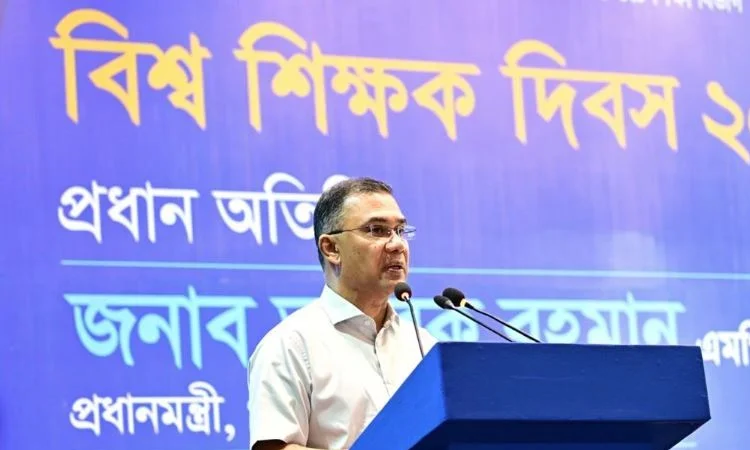
Prime Minister Tarique Rahman has said the government is working to make teaching a first-choice profession for meritorious people by reforming teacher recruitment and the education system.
“Teaching can never be a profession of last resort or merely another job. Rather, we are reshaping teacher recruitment and the education system to ensure that the most meritorious people choose teaching as their first choice of profession,” he said.
The Prime Minister was speaking as the chief guest at a ceremony at Osmani Memorial Auditorium marking World Teachers’ Day 2026 and honouring selected teachers from primary to higher education levels with the national “Eminent Teacher Award”.
Tarique Rahman said the dignity of the state was linked to the honour and dignity of teachers in society. He expressed respect to teachers across primary and secondary schools, colleges, madrasas, technical institutions and universities and congratulated the award recipients.
He said teachers should become trusted role models for their students so that they could help young people face global challenges and grow into responsible citizens.
In the era of rapid development of social media and artificial intelligence (AI), the Prime Minister said there was no alternative to technical and practical education alongside conventional teaching methods.
He said the government had formulated a new curriculum based on contemporary needs and that students would receive textbooks based on the new curriculum within this year.
“Instead of mere memorisation, we have to raise the questions of ‘why’ and ‘how’ in the minds of students. If curiosity is created, a student can become his or her own teacher,” he said.
Tarique Rahman said “joyful learning” had gained popularity around the world. For the first time in Bangladesh, the Ministry of Education is providing sixth-grade students with a book titled “Learning with Happiness”, with similar books to be introduced for other grades in phases.
He said artificial intelligence had created vast opportunities for learning, while technical and practical knowledge had become increasingly important.
Referring to challenges created by rapid advances in information technology, the Prime Minister said teachers’ training colleges needed further modernisation.
“We do not want to see technology as a substitute for teachers. Rather, technology will be the strength of teachers,” he said, mentioning the government’s “One Teacher, One Tab” programme.
He said teachers would be able to use digital lesson plans, question banks, students’ learning progress data and teaching materials through the tablets. Multimedia classrooms were also being expanded and free Wi-Fi facilities increased at educational institutions, he added.
The Prime Minister said the government wanted to build an education system where no child was deprived of education and where students who dropped out at any stage would not remain unemployed.
Describing education as the government’s top priority, he said the highest-ever allocation for education had been made in the national budget and that the allocation would be increased gradually.
Referring to secondary education, he said there were around 21,000 institutions at this level, with more than 300,000 teachers providing education to millions of students. He noted that much of secondary education depended on private and MPO-listed institutions.
Tarique Rahman said disparities remained between urban and rural areas in educational opportunities and that the government had plans to ensure access to skilled teachers and modern technology in both areas.
He said the core foundations of education reform were equal opportunities, quality education and non-discriminatory access.
The Prime Minister stressed that employment-oriented education was necessary but was not the sole purpose of education. Moral and character development were also key objectives, he said, urging teachers to instil truthfulness, responsibility, empathy, patriotism, humanity, discipline and respect for others.
Highlighting measures to strengthen teachers’ financial security and make teaching a more dignified and competitive profession, he said the government was giving particular attention to teachers at the primary, secondary and higher-secondary levels.
He said the authorities had been instructed to make it mandatory from this year to invite at least one teacher each from primary and secondary schools to state functions on national occasions such as Independence Day and Victory Day.
Tarique Rahman said teachers, whether serving or retired, remained worthy of the state’s respect throughout their lives.
He also said instructions had been issued to end harassment of teachers in receiving salaries and retirement benefits. “The money due to a teacher must reach their bank account on time and in accordance with the rules,” he said.
The Prime Minister said teachers were among the key instruments for building a knowledge-based state and society.
World Teachers’ Day is observed globally on October 5 to highlight teachers’ dignity, rights, professional development and the importance of quality education.
Education Minister Dr A N M Ehsanul Hoque Milon chaired the programme. National Professor Dr Mahbub Ullah, Prime Minister’s Office Spokesperson Mahdi Amin, State Minister for Primary and Mass Education Bobby Hajjaj and Chairman of the Parliamentary Standing Committee on the Ministry of Education Md Selim Bhuiyan also addressed the event.
