

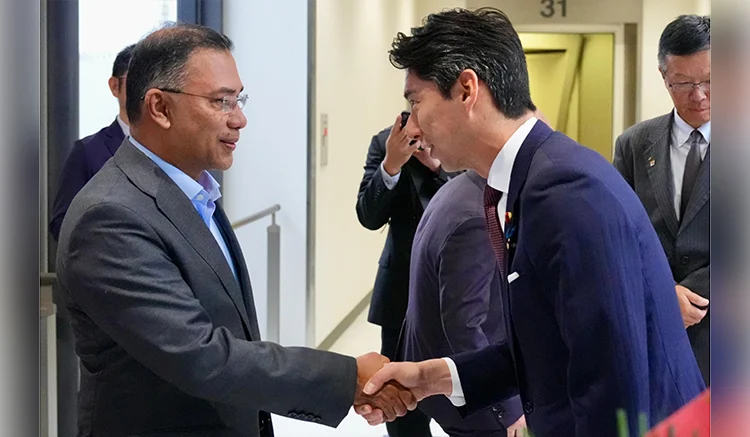
Prime Minister Tarique Rahman arrived in Tokyo on Monday morning for a four-day official visit aimed at strengthening Bangladesh-Japan relations, attracting Japanese investment and expanding trade and development cooperation.
A Biman Bangladesh Airlines flight carrying the Prime Minister, his wife Dr Zubaida Rahman, and members of his entourage landed at Narita International Airport at 9:07am local time.
Japanese State Minister for Foreign Affairs Yasutaka Nakasone received the Prime Minister at the airport. A motorcade subsequently escorted him to Tokyo’s Imperial Hotel, where he will stay during the visit.
Prime Minister’s Adviser for Posts, Telecommunications and Information Technology and Science and Technology Rehan Asif Asad, Special Assistant to the Prime Minister for Foreign Employment in the Asia-Pacific region Dr Md Shakirul Islam Khan, and senior officials of the Bangladesh Embassy in Tokyo were also present.
Tarique Rahman departed Hazrat Shahjalal International Airport in Dhaka early Monday with a small delegation.
According to the Prime Minister’s press wing, he is scheduled to hold high-level bilateral talks with Japanese Prime Minister Sanae Takaichi at her office on October 27. The meeting will be followed by a joint press announcement and a luncheon hosted by the Japanese premier.
During the four-day visit, the Prime Minister will meet Japanese government officials, development institutions and business leaders, visit industrial and energy facilities, and deliver the keynote address at the Bangladesh-Japan Economic Forum.
Trade, Investment and Development Cooperation
The visit is expected to strengthen the existing strategic partnership, attract new Japanese investment, expand bilateral trade and accelerate ongoing development projects, Foreign Secretary Asad Alam Siam said at a media briefing at the Foreign Ministry on October 20.
A key focus will be the effective implementation of the Bangladesh-Japan Economic Partnership Agreement (EPA), signed in February 2026. The agreement is expected to create opportunities for Bangladeshi products to access the Japanese market and encourage stronger business engagement between the two countries.
Both sides will also explore cooperation in renewable energy, agriculture, science and technology, digital transformation, skills development and human resource development.
The Prime Minister’s tentative programme includes meetings with representatives of the Japan-Bangladesh Parliamentary Friendship League and the Japan-Bangladesh Committee for Commercial and Economic Cooperation.
He is also scheduled to meet the heads of the Japan International Cooperation Agency (JICA), the Japan Bank for International Cooperation (JBIC) and the Japan External Trade Organization (JETRO), as well as the chairman of the Sasakawa Peace Foundation.
The proposed itinerary includes visits to an LNG terminal and power plant in Futtsu, Chiba Prefecture, the headquarters of Japanese apparel company UNIQLO and a Toyota factory in Nagoya.
MoUs and New Investment Opportunities
Bangladesh and Japan are discussing draft memorandums of understanding and cooperation agreements covering agriculture, fisheries, human resource development, skills enhancement, civil aviation, trade, environmental protection and local government modernisation.
Foreign Secretary Asad Alam Siam said around eight MoUs were under discussion, with three to four potentially being signed during the visit. Separate agreements are also being pursued in education and human resource development.
Detailed discussions are expected on Japanese support for establishing factories in Bangladesh, creating employment opportunities and developing a skilled workforce in line with the Prime Minister’s priorities.
The two sides are also expected to discuss regional and international peace and stability, a sustainable and peaceful solution to the Rohingya crisis, cooperation in addressing energy challenges and efforts to resolve international conflicts.
The visit follows Tarique Rahman’s participation in an online meeting in April at the invitation of the Japanese premier. During that meeting, Bangladesh welcomed a Japan-led initiative to address energy challenges across Asia.
Building on a Longstanding Partnership
Japan has been a major development partner of Bangladesh since the establishment of diplomatic relations in 1972. Japanese assistance has supported major infrastructure projects, including Dhaka metro rail, the third terminal of Hazrat Shahjalal International Airport and infrastructure development in Matarbari.
Shaheed President Ziaur Rahman visited Japan in 1978 and 1980, while former Prime Minister Khaleda Zia visited the country in 1994 and 2005.
The current visit offers both countries an opportunity to build on decades of cooperation while exploring new avenues for investment, technology transfer, employment generation and sustainable economic development.
