

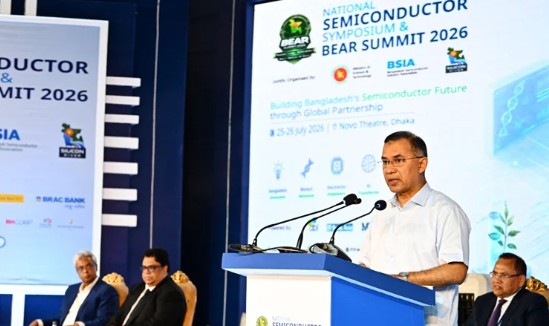
Dhaka: Prime Minister Tarique Rahman today announced a comprehensive national strategy to develop Bangladesh’s semiconductor industry, describing it as the country’s next major engine of economic growth after the ready-made garment (RMG) sector.
“The semiconductor industry could emerge as Bangladesh’s next promising economic sector after the RMG industry. The government has already started implementing comprehensive plans, including creating a business-friendly environment, to transform this next major driver of economic prosperity into reality,” he said.
The Prime Minister was addressing the inaugural ceremony of the National Semiconductor Symposium and BEAR (Bangladesh Electronics, AI and Robotics) Summit-2026 at the Bangabandhu Sheikh Mujibur Rahman Novo Theatre in Dhaka.
Semiconductor Industry a National Priority
Describing the event as more than an ordinary conference, Tarique Rahman said it had brought together the people who would shape Bangladesh’s technology-driven future.
He praised the participation of Bangladeshi professionals working abroad, saying their expertise would play an important role in building a self-reliant, prosperous and innovation-driven Bangladesh.
Calling semiconductors the foundation of modern civilisation in the era of the Fourth and Fifth Industrial Revolutions, the Prime Minister said semiconductor chips are indispensable across industries ranging from artificial intelligence, robotics and data centres to renewable energy, medical devices, smartphones and satellites.
Highlighting the industry’s global potential, he noted that the worldwide semiconductor market is expected to approach US$1 trillion by 2026, creating significant opportunities for Bangladesh.
“Bangladesh has immense opportunities in this vast market, and I believe the country will be able to achieve its targeted export earnings from this sector by 2030,” he said.
Whole-of-Nation Approach
The Prime Minister said the government has designated semiconductors as a national priority sector, but stressed that its development requires a coordinated national effort.
“We consider the semiconductor industry a national priority sector. However, developing this industry is not the responsibility of any single ministry or institution; it is a collective national mission,” he said.
He called for close collaboration among the government, universities, research institutions, industrialists, entrepreneurs and Bangladeshi experts living abroad to build a globally competitive semiconductor ecosystem.
Incentives for Investment and Innovation
Outlining the government’s policy support, Tarique Rahman said the current national budget has removed all taxes and duties on raw materials required by the semiconductor industry.
He also announced plans to introduce cash incentives for export earnings from semiconductor design services to encourage high-value technology exports.
To support innovation, the Prime Minister said the government has, for the first time, allocated Tk 5 crore annually as startup grants for technology entrepreneurs, with the distribution process already underway.
He further said the government is working to introduce tax-free bonded facilities, develop specialised industrial infrastructure and attract both domestic and foreign investment into the sector.
Alongside upgrading existing high-tech parks, the government also plans to establish a new biotechnology park to strengthen Bangladesh’s advanced technology ecosystem.
Investing in Talent and Research
Acknowledging challenges such as skills shortages and intense global competition, the Prime Minister expressed confidence in Bangladesh’s human capital.
“Despite various limitations, we have an indomitable determination to move forward. We will achieve this goal by relying on our talent, skilled youth and innovative capacity,” he said.
“The government will stand by you with all its capabilities to help turn your dreams and determination into reality.”
Expressing optimism about the summit’s outcomes, he said he hoped it would generate new partnerships, research collaborations and investment opportunities that would accelerate the country’s technological transformation.
Summit Showcases Emerging Technologies
Following his address, the Prime Minister formally inaugurated the National Semiconductor Symposium and BEAR Summit-2026.
He later joined a photo session with local and international delegates before visiting exhibition booths showcasing innovations by students and startup entrepreneurs in semiconductors, artificial intelligence, robotics, healthcare technology, intelligent systems and other deep-tech sectors.
The two-day summit is jointly organised by the Bangladesh Semiconductor Industry Association (BSIA), the Ministry of Science and Technology, and the Silicon River Bangladesh programme under the theme: “Building Bangladesh’s Semiconductor Future through Global Partnerships.”
The inaugural session was also addressed by Minister for Posts, Telecommunications, ICT, and Science and Technology Faqir Mahbub Anam, Prime Minister’s Adviser on Science and Technology Rehan Asif Asad, BSIA President M. A. Jabbar, Science and Technology Secretary Md Anwar Hossain, and Professor Muhammad Mustafa Hussain, Chief Architect of the Silicon River Initiative and a professor at Purdue University.
The summit will conclude tomorrow with the Christie Fellowship Research Symposium, where emerging Bangladeshi researchers will present their latest findings in semiconductor research.
