

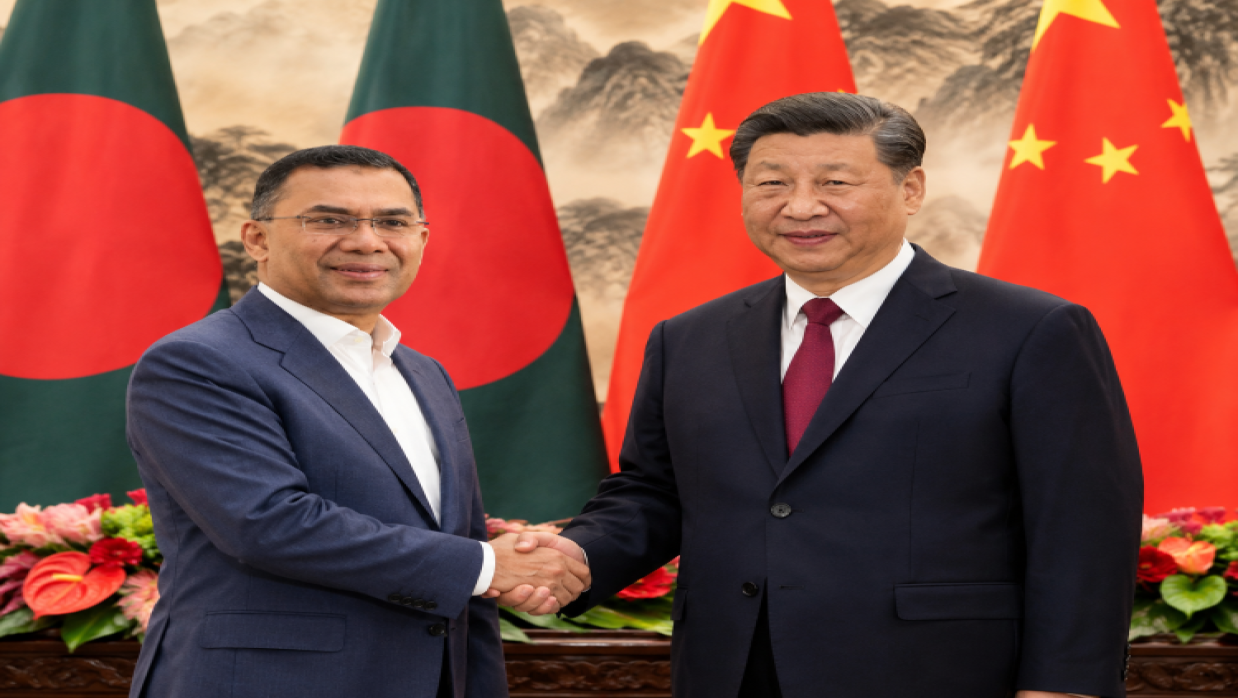
Prime Minister Tarique Rahman’s ongoing visit to China comes at a time when the global economy, regional security environment, and international diplomacy are undergoing significant transformation. Amid growing economic uncertainty, energy challenges, geopolitical competition, and disruptions in global supply chains, the visit is widely viewed as an important opportunity for Bangladesh to strengthen one of its most valuable international partnerships.
Over the past several decades, Bangladesh and China have developed a deep and multifaceted relationship. China has become one of Bangladesh’s most important development partners, contributing significantly to infrastructure development, energy projects, transportation networks, trade, investment, and technological cooperation. As a result, Prime Minister Tarique Rahman’s visit is being seen not merely as a routine state visit but as an opportunity to elevate bilateral relations to a new level.
One of the primary objectives of the visit is to expand investment and economic cooperation. Bangladesh is currently pursuing industrialization, employment generation, and export diversification as key drivers of economic growth. In this context, increased Chinese investment could play a vital role in developing industrial zones, manufacturing industries, technology sectors, and special economic zones across the country.
Trade cooperation is also expected to be a major focus of discussions. Although bilateral trade has grown substantially over the years, Bangladesh continues to face a significant trade imbalance with China. Therefore, expanding access for Bangladeshi products to the Chinese market, creating new export opportunities, and improving trade balance are likely to receive considerable attention during the visit.
Energy security remains another important area of cooperation. Given the volatility of global energy markets, Bangladesh is actively exploring long-term solutions to meet its growing energy demands. Cooperation with China in power generation, renewable energy, energy infrastructure, and advanced technologies could contribute significantly to Bangladesh’s sustainable development goals.
The visit also reflects the broader vision of Bangladesh’s “Bangladesh First” policy. This policy emphasizes pursuing national interests through balanced and diversified partnerships with countries around the world. Strengthening cooperation with China aligns with this strategic approach and demonstrates Bangladesh’s commitment to maintaining constructive relations with all major global partners.
Bangladesh’s strategic importance continues to grow due to its location in the Bay of Bengal. Positioned at the intersection of major regional initiatives—including China’s Belt and Road Initiative (BRI), the United States’ Indo-Pacific Strategy, and emerging regional connectivity frameworks—Bangladesh has become an increasingly important player in regional geopolitics. Consequently, the visit carries significance not only for bilateral relations but also for the broader strategic landscape of the region.
Business leaders, investors, and policymakers in Bangladesh are hopeful that the visit will result in concrete progress in investment, trade, technology transfer, and development cooperation. New agreements and initiatives in infrastructure, manufacturing, renewable energy, and industrial development could provide additional momentum to Bangladesh’s economic transformation.
Prime Minister Tarique Rahman’s visit to China is therefore more than a diplomatic engagement. It represents an important opportunity to strengthen economic cooperation, deepen strategic trust, and create new pathways for sustainable development. If the visit delivers tangible outcomes, it could mark the beginning of a new chapter in Bangladesh-China relations and contribute significantly to Bangladesh’s long-term prosperity and global engagement.
