

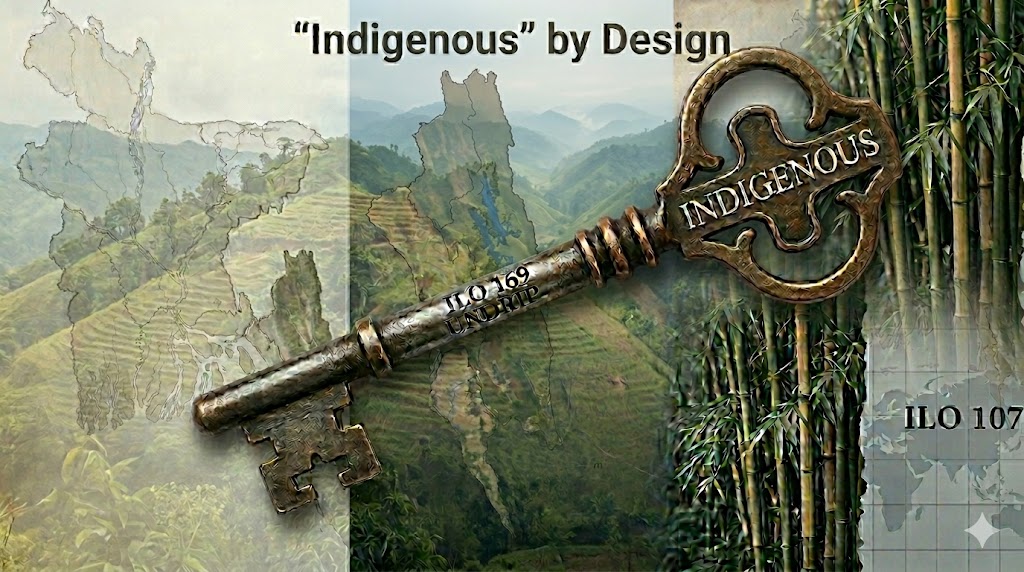
Words, in the right legal context, function less like language and more like keys. They open doors that argument alone cannot. In the Chittagong Hill Tracts of Bangladesh, one such word has been quietly inserted into a decades-long political contest: indigenous. Its substitution for the less freighted tribal is not semantic housekeeping. It is strategy.
To understand why, one must first appreciate what the distinction actually means in international law not rhetorically, but structurally. The ILO’s Convention 169 draws a careful line between two categories of peoples. Tribal communities are defined by cultural distinctiveness: separate social organization, separate economic life, governance through custom rather than national statute. Indigenous peoples carry an additional and far more consequential qualification prior occupancy. They are those who inhabited a territory before the imposition of colonial boundaries or the formation of the modern state, and who have maintained their own political and social institutions across that rupture. The anthropologist Lewis Morgan framed it even more starkly: indigenous peoples are those whose origins and migrations leave no recoverable historical trace. They did not arrive. They were already there.
This is precisely where the Hill Tracts claim grows complicated. The historical record imperfect as all such records are places the arrival of the region’s various hill communities between the sixteenth and eighteenth centuries, in successive and traceable movements. Different groups, different routes, different centuries, but a chronology nonetheless. A people with a chronology have, by definition, an origin elsewhere. And a people with an origin elsewhere do not meet the threshold that international law has set for indigeneity. They meet the threshold for something equally legitimate, equally worthy of protection but categorically different.
None of this would carry particular urgency were it merely an academic disagreement. It became politically charged on September 13, 2007, when the United Nations General Assembly adopted the Declaration on the Rights of Indigenous Peoples. UNDRIP is not a treaty with binding enforcement mechanisms, but its moral and legal weight is considerable. Recognition under its framework confers international legitimacy on land claims, creates obligations for signatory states, and critically provides a platform from which sub-national groups may address international bodies directly, partially bypassing the state itself. The declaration turned a classification question into a question of sovereign consequence.
That the advocacy for indigenous status in Bangladesh intensified markedly after 2007 is a matter of observable record. The sequence matters. It suggests that what appears to be a grassroots assertion of cultural identity is, at least in part, a calibrated legal maneuver one in which the vocabulary of human rights is deployed to achieve ends that human rights language alone cannot fully account for.
Bangladesh’s response has been characteristically understated but firm. The government ratified ILO Convention 107, the older and less expansive instrument. It has not ratified Convention 169. It has not endorsed UNDRIP. Critics read this as evasion. A more defensible reading is that Dhaka recognizes something that the advocates prefer to leave unexamined: that the reclassification they seek would not merely update a label. It would restructure, in law and in precedent, the relationship between a sovereign state and a portion of its own territory.
The hill communities of the Chittagong Hill Tracts possess cultures of genuine distinction languages, traditions, and social arrangements that have survived pressures most societies could not withstand. Their claim to recognition, to protection, to full participation in the political life of the country, is neither trivial nor easily dismissed. But recognition of cultural distinctiveness and recognition as an indigenous people are different instruments with different consequences. Conflating them, whether through carelessness or calculation, does no service to the communities whose interests are supposedly at stake and considerable service to those whose interests lie elsewhere.
In the end, the argument is not about a word. It never is. It is about what the word unlocks.
