

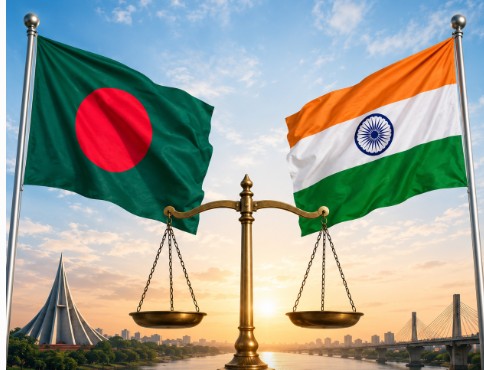
There is a category error at the heart of how Bangladesh-India relations have been conducted for much of the past two decades, one that mistakes proximity for partnership, and deference for diplomacy. The relationship has worn the vocabulary of friendship while operating, in substance, as something closer to supervision. The question Bangladesh confronts now is not whether warmth toward India is desirable. It plainly is. The harder question is whether that warmth can be sustained without a fundamental recalibration of the terms on which it has historically rested.
To be clear about what this argument is not: it is not a brief for antagonism. Bangladeshis, by overwhelming disposition, harbor no animus toward a neighbor with whom they share river systems, trade corridors, and an interwoven history stretching back generations. The grievance is more precise than hostility, it is the accumulated fatigue of having been cast, structurally, as the junior party in a relationship that geography alone does not justify treating as hierarchical.
For much of the post-2000 period, India’s engagement with Bangladesh was conducted almost exclusively through a single political conduit: the Awami League under Sheikh Hasina. The interests of that government were treated, with a kind of unexamined diplomatic convenience, as coextensive with the interests of the Bangladeshi state itself. This was always an analytically unsound premise, the conflation of a ruling party with a nation of 170 million people and the mass uprising of August 2024 demonstrated precisely how unsound. What is notable is how incompletely that lesson appears to have been absorbed in Delhi. A foreign policy architecture premised on one party’s permanence was never a stable one; it merely took a popular movement to reveal its fragility.
What follows from this is less a demand than a description. Bangladesh is asking to be recognized, in practice and not merely in protocol, as a sovereign state whose government is determined by its own electorate rather than by the comfort level of any neighboring capital. This is not a radical proposition. It is the baseline expectation of inter-state relations among nominal equals, cooperation absent coercion, neighborliness absent hierarchy.
It is in this light that the Prime Minister’s recent state visits; to Malaysia, and separately to China, are best understood. They are not gestures of realignment so much as the unremarkable exercise of options that should have been available all along. Malaysia offers access to labor markets, educational partnerships, and deeper integration with the broader Muslim world. China offers capital for infrastructure, industrial capacity, and technical cooperation spanning river management to manufacturing. Neither engagement is constituted in opposition to India. Both are constituted in pursuit of Bangladeshi interest, which is, in fact, the entire substance of the matter.
This is the underlying logic of what has come to be called “Bangladesh First”: not a rhetorical flourish but an operating principle of statecraft. Sustained relations with India. Deepened development cooperation with China. Trade and technological exchange with Washington. High-grade investment from Tokyo and Seoul. Defense-industrial cooperation with Ankara. Energy and labor access across the Gulf states. Export and human-capital partnerships with Europe. Regional integration through ASEAN. None of these relationships is designed to displace the others. Their cumulative effect, rather, is to ensure that no single relationship is positioned to displace Bangladesh’s own capacity for independent judgment.
This is the structural argument worth dwelling on. A state too tightly bound to a single patron forfeits the one asset that makes genuine negotiation possible: a credible alternative. A state with a diversified portfolio of partnerships retains that alternative and what diplomats term leverage is, ultimately, the only durable currency of respect between states of unequal size.
Were Delhi inclined toward a more constructive footing with Dhaka, the path would not be obscure, however politically inconvenient it may prove. It runs through the cessation of border killings that have persisted years past any defensible justification, the resolution of water-sharing disputes left unaddressed for a generation, the correction of trade terms structurally weighted toward one party, and a reconsideration of the sanctuary extended to a fugitive former head of government. None of these constitute extraordinary demands. They are the ordinary maintenance required of any relationship between sovereign equals and their continued absence is precisely what sustains the present deficit of trust.
What emerges from all this is not a nationalism defined by its adversaries, but one defined by what it seeks to preserve: sovereignty, dignity, economic self-determination, and the prerogative of a nation to reach its own conclusions. Bangladesh has no need of enemies. It has, equally, outgrown the role of understudy.
Friendship remains available to all. The final word belongs to Dhaka alone.
On the Asymmetry of Friendship: Reframing Dhaka’s Relationship with Delhi
53
