

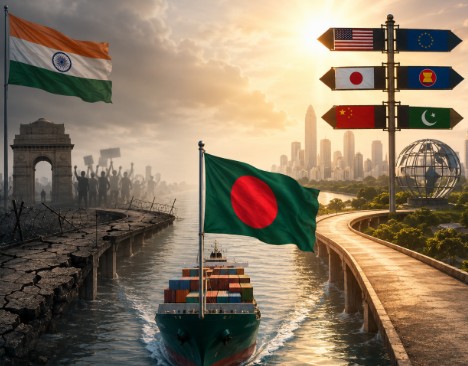
The era of India’s uncontested influence in Bangladesh has reached its logical conclusion, paving the way for a more sophisticated, multi-aligned foreign policy in Dhaka. For over a decade, New Delhi enjoyed unparalleled sway over its eastern neighbor, but the landscape has fundamentally shifted following the major political transition of August 2024 and the subsequent February election. While both governments have signaled a desire to reset their fractured relationship, the path forward is heavily obstructed by unresolved baggage and powerful undercurrents of public opinion.
Chief among these obstacles is the diplomatic standoff surrounding former Prime Minister Sheikh Hasina. Now a convicted criminal sentenced to death for crimes against humanity, her continued asylum in India serves as a direct impediment to normal relations. Dhaka has formally requested her extradition, and New Delhi’s reluctance to comply leaves a gaping wound in bilateral trust. This issue is not merely a legal or bureaucratic hurdle; it is a lightning rod for Bangladeshi public opinion, which soured dramatically during the Hasina period and the post-uprising transition. Across the border, Indian public perception has been similarly warped by a wave of disinformation unleashed during recent state elections. Neither government can afford to ignore these domestic sentiments as they attempt to redefine their ties.
Consequently, Bangladesh’s approach to its regional heavyweight is transitioning to a “slow and steady” calibration, managed deliberately by figures like Foreign Minister Dr. Khalilur Rahman. Rather than reverting to the lopsided alignments of the past, Dhaka is aggressively diversifying its international portfolio. The days of Indian primacy have given way to a calculated balancing act, wherein Bangladesh is actively expanding its economic and security cooperation with the United States; which has paid significant attention to the country’s democratic shift, while simultaneously courting investments from European partners.
This diversification extends deeply into regional and multilateral spheres. By pursuing stronger ties with ASEAN and the D-8 grouping, and by steering negotiations toward an independent trade agreement with Washington, Dhaka is asserting its agency on the global stage. Even potential economic entanglements, such as regional connectivity corridors involving China and Myanmar, are being explored as pragmatic avenues for job creation and export growth. Evolving diplomatically, Bangladesh is proving that engaging with Beijing for economic infrastructure does not have to result in friction with Washington, provided the strategy is managed adeptly.
Ultimately, the changing dynamics between Dhaka and New Delhi signal a healthier, more mature phase of South Asian diplomacy. Bangladesh is no longer content to be viewed through the narrow lens of a single patron’s sphere of influence. By championing a balanced foreign policy and reclaiming its historic role as a proponent of regional multilateralism, Dhaka is charting a sovereign path forward, one defined by independent national interest rather than inherited geopolitical compliance.
Bangladesh charts an independent course as the era of Indian primacy fades
5
