

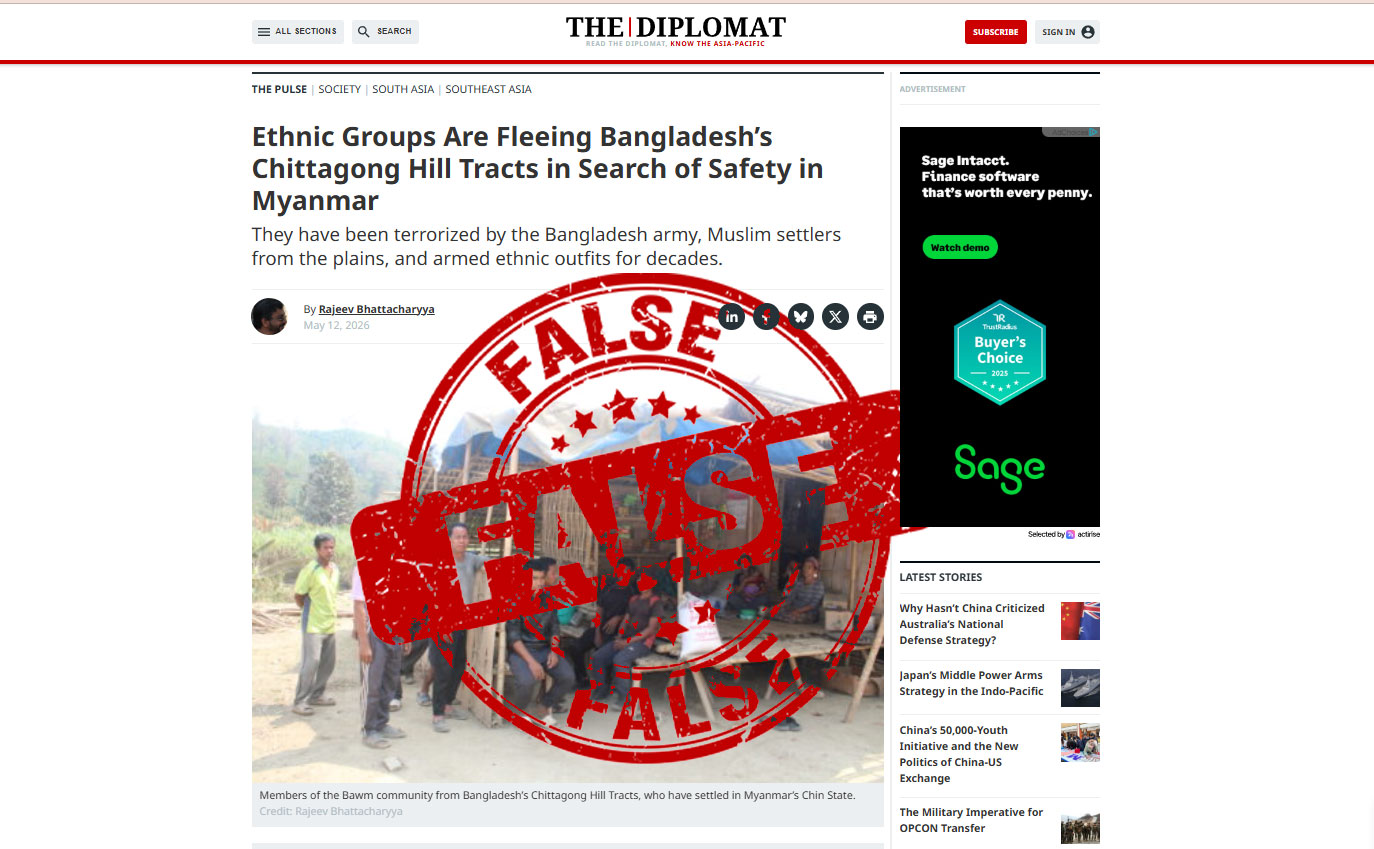
Foreign media reports and commentary on Bangladesh’s Chittagong Hill Tracts (CHT) often present the situation in a one-sided and exaggerated manner. In many cases, the issue is framed as if the Bangladeshi state is systematically oppressing tribal or hill communities, forcing them to flee to Myanmar for safety. However, the reality is far more complex. The CHT is a sensitive region shaped by political tensions, armed groups, border security concerns, historical grievances, and regional instability. Any serious analysis must consider all of these factors instead of reducing the issue to a simple “state versus minorities” narrative.
A Region with Longstanding Security and Political Challenges
For many years, the CHT has faced problems related to land disputes, ethnic tensions, armed conflict, and cross-border criminal activities. These challenges cannot be blamed solely on the state or the military.
Several armed groups, including the Parbatya Chattagram Jana Samhati Samiti (JSS), United People’s Democratic Front (UPDF), and, more recently, the Kuki-Chin National Front (KNF), have been active in the region. Rivalries among these groups have led to violence, extortion, kidnappings, killings, and illegal arms activities. Ordinary people living in the hills- especially tribal communities- have often suffered because of these conflicts.
Many families in the hills have experienced fear and insecurity not only because of state actions, but also because of pressure and violence from armed groups. Therefore, presenting migration or displacement only as a result of “state oppression” creates a misleading and incomplete picture.
Questions About the “Safe Haven” Narrative in Myanmar
Some foreign reports have suggested that hill people are fleeing Bangladesh and going to Myanmar for safety. This claim raises important questions.
Myanmar itself has been facing severe internal conflict, ethnic violence, civil war, and military operations for years. The world has widely criticized Myanmar over the Rohingya crisis and other human rights abuses. Many parts of Myanmar remain dangerous due to fighting between the military and armed ethnic groups.
In this context, portraying Myanmar as a safe refuge appears questionable. In border areas, people sometimes temporarily cross the frontier for family connections, ethnic ties, trade, or local mobility patterns that have existed for generations. Such movement should not automatically be described as large-scale political exile or evidence of systematic persecution by Bangladesh.
The CHT border area is also linked to wider regional security concerns, including smuggling, armed movements, and cross-border militant activities.
Security Operations and the Role of the Bangladesh Army
Another issue often overlooked in international reporting is the role of armed groups and criminal networks operating in the hills.
The KNF, for example, has been accused by Bangladeshi authorities of involvement in bank robberies, armed training, kidnappings, extortion, and links with militant organizations. These are serious security concerns for any country.
Like every sovereign state, Bangladesh has the responsibility to maintain law and order, protect civilians, and secure its borders. The Bangladesh Army has largely been deployed in the CHT with a pacification and stabilization mandate aimed at maintaining peace, preventing armed violence, supporting civil administration, and protecting local communities from insecurity created by armed groups and criminal networks.
The Army has also played important non-combat roles in the hills, including medical support, disaster response, road construction, educational assistance, and humanitarian activities in remote areas where state services are limited.
Although various allegations are sometimes raised in foreign reports or advocacy campaigns, there are no widely established or independently proven findings showing a systematic policy of atrocities by the Bangladesh Army against tribal communities in the CHT. Individual complaints or allegations, if any, should be investigated properly through legal and institutional mechanisms. However, portraying the entire military presence as an occupying or oppressive force without clear evidence distorts the understanding of the situation.
At the same time, it is also important to recognize that ordinary civilians- including both tribal residents and Bengali settlers- have frequently been victims of violence carried out by armed groups operating in the region.
Development and State Presence in the Hills
Over the last two decades, Bangladesh has invested heavily in development projects in the CHT. Roads, bridges, schools, hospitals, electricity, and communication systems have expanded significantly in many remote hill areas.
Critics may argue that development alone cannot solve political grievances, and that is a fair point. But it is also inaccurate to describe the state only through a security lens while ignoring ongoing development and welfare efforts.
At the same time, issues related to land rights, political representation, and implementation of the 1997 CHT Peace Accord remain important challenges. These concerns should be addressed through dialogue, trust-building, and institutional reforms.
The Need for Balanced International Reporting
International media and analysts should approach the CHT issue with greater balance and caution. Selective reporting or emotional narratives can create misunderstandings and increase tensions rather than help foster peaceful solutions.
Both tribal communities and Bengali residents in the hills have experienced violence and insecurity over the years. A balanced analysis should recognize the suffering and concerns of all sides instead of presenting only one group as victims and the other as aggressors.
The CHT is also strategically important because of its location near the Bangladesh-Myanmar border. Therefore, the situation cannot be separated from broader regional security and geopolitical realities.
Conclusion
The situation in the Chittagong Hill Tracts is complex and sensitive. It involves historical grievances, security concerns, political disputes, armed groups, development challenges, and regional instability. Simplistic narratives that blame only one side do not help in understanding the real situation.
The long-term solution lies in peaceful dialogue, fair development, protection of rights, stronger trust between communities, and the rule of law. Human rights concerns should be examined responsibly, but security threats and armed violence must also be addressed realistically.
A balanced and fact-based approach is essential- not narratives that portray Bangladesh as an inherently oppressive or unstable state while ignoring the broader realities on the ground.
