

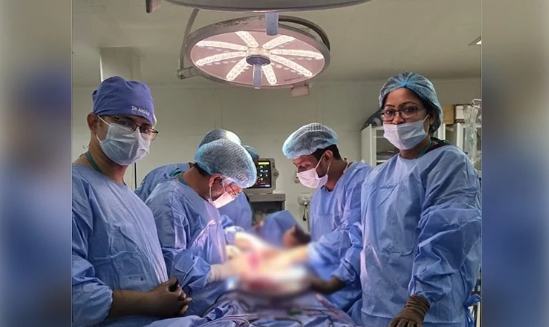
Bangladesh Medical University (BMU) plans to double its monthly liver transplantation rate to four procedures by the end of 2027, aiming to expand access to specialised treatment and reduce the need for patients to seek care abroad.
“We currently perform two transplants every month as the transplantation became a regular procedure,” Associate Professor Dr Mohammad Saief Uddin of the university’s concerned department told BSS.
He said the facility at Shahbagh in Dhaka planned to increase the number to four a month, equivalent to one transplant a week, by the end of next year.
A multidisciplinary team involving 19 departments conducts the procedures under the leadership of BMU’s Department of Hepatobiliary, Pancreatic and Liver Transplantation Surgery.
Department Chairman Professor Bidhan C Das said end-stage liver cirrhosis, hepatocellular carcinoma or liver cancer, and acute liver failure were the three major conditions that could require transplantation. Successful procedures can help patients return to normal life, he added.
Bangladesh’s liver transplant journey
Bangladesh has performed 13 liver transplants since 2010, including eight at BMU, three at BIRDEM and two at Labaid Hospital.
BIRDEM conducted the country’s first liver transplant on June 3, 2010, followed by procedures on August 6, 2011, and February 13, 2020. A BMU team performed the two procedures at Labaid Hospital in January and May 2011.
BMU launched its own transplantation programme in 2019 and has since performed eight procedures, including six under its regular programme in 2025 and 2026.
The latest six procedures were conducted free of charge with government funding and technical support from a specialist transplant team at the Asian Institute of Gastroenterology Hospital in Hyderabad, India.
BMU is scheduled to perform two more transplants on October 30 and 31.
Family members donate organs to save loved ones
Among the recent beneficiaries, Ismat Ity, a 12th-grade student from Sharankhola in Bagerhat, was diagnosed with liver cirrhosis in February and received a free transplant at BMU Super Specialized Hospital on July 4. Her elder sister, Ayesha Siddiqua, donated part of her liver.
Ayesha told BSS that both sisters were doing well. After three months of close follow-up care, they returned home on October 19.
In another case, 23-year-old Sumaiya Kabir from Bandar in Narayanganj donated part of her liver to her 62-year-old father, Haji Kabir Hossain, who was diagnosed with cirrhosis in January 2025. The transplant was performed at BMU Super Specialized Hospital on July 3.
Sumaiya said she had recovered while her father was gradually improving. Both remain under medical follow-up.
Promising outcomes encourage expansion
Of the six most recent transplant recipients at BMU, five survived while one died from an infection. All four patients treated before that group survived, according to the report.
Dr Saief said liver transplantation success rates at leading specialised centres worldwide stood at around 90 to 95 percent, while BMU’s reported success rate was 90 percent. He said the results encouraged the university to expand the programme.
However, recipients require lifelong follow-up care and medication to prevent their bodies from rejecting the transplanted organ. Monthly medicine costs may initially range from Tk 10,000 to Tk 15,000 before falling to around Tk 4,000 to Tk 5,000 after the critical period, he said.
Domestic treatment could reduce costs
Hepatology experts cited World Health Organization data indicating that around 50 million people in Bangladesh suffer from liver diseases, which account for an estimated 22,000 to 25,000 deaths annually. Cirrhosis and liver cancer are among the major causes.
Experts estimate that Bangladesh needs more than 1,000 liver transplants each year.
A transplant in a neighbouring country can cost around Tk 40 lakh to Tk 50 lakh under a package, potentially rising to Tk 1 crore if complications require prolonged intensive care. Costs in Thailand and Singapore may reach Tk 1 crore to Tk 2 crore, with even higher expenses in Western countries.
Professor Bidhan said BMU initially received Tk 5 crore in government funding for 10 procedures, equivalent to around Tk 50 lakh per transplant, as the university developed its infrastructure and institutional capacity.
As the programme becomes more established, costs are expected to decline. A transplant at BMU could eventually cost Tk 10 lakh to Tk 15 lakh with government subsidies, while the corporate rate at its Super Specialized Hospital could be around Tk 20 lakh to Tk 25 lakh, according to the report.
Donor safety remains a priority
BMU currently performs living-donor liver transplants. Deceased-donor transplantation, also known as cadaveric transplantation, has yet to begin in Bangladesh, although it is permitted under the current legal framework.
Close relatives can donate part of their liver to eligible recipients. A recent legal amendment has also opened the possibility of donations by “emotional donors”, subject to approval by the relevant authorities.
Dr Saief said the medical team carefully examines donor-recipient relationships to rule out financial transactions or commercial motives. Donors undergo extensive medical assessments to ensure that the procedure does not put their health at undue risk.
Donors are generally selected from the 18–55 age group, with younger eligible adults often preferred. People with serious uncontrolled conditions, including diabetes, hypertension or significant heart disease, may be excluded. BMU has recorded no donor deaths in its programme so far.
A liver transplant typically takes six to eight hours. Donors may spend one to three days in intensive care and usually leave hospital within about a week, depending on their condition. Recipients generally remain in intensive care for around seven days and may require two to three weeks of hospitalisation.
In living-donor transplantation, surgeons may remove around 60 percent of the donor’s liver, leaving roughly 35 to 40 percent to regenerate over time.
