

As Bangladesh nears a decade since the 2017 displacement and marks the 75th anniversary of the global refugee framework, it is an opportune moment to evaluate the evolution of our humanitarian landscape. For nearly 50 years, since the initial 1978 influx, Bangladesh has stood as a beacon of humanitarian duty, shouldering the immense burden of hosting 1.2 million refugees. This response, while born from an urgent need for shelter, has transitioned into a complex, deep-rooted demographic and economic reality that shapes the life of Cox’s Bazar today.
While the fundamental goal remains the safe, voluntary, and dignified return of the Rohingya to Myanmar, the current climate requires us to look beyond the static “temporary” model. The reality on the ground has shifted; the camps have expanded into complex, semi-urban spaces. This transformation demands a recalibration of our national strategy—one that balances our unwavering commitment to human rights with the practical necessities of national security, social stability, and economic management.
A refreshed approach does not abandon the call for repatriation; rather, it acknowledges that until Myanmar establishes the necessary conditions of citizenship and safety, we must manage the situation with greater foresight. By integrating these settlements into a more structured planning framework, we can better address the rising internal security challenges, such as criminal networks and the risks posed by local instability. This is not about granting permanent citizenship, but about ensuring that while these populations remain, they are governed in a way that minimizes the burden on local infrastructure and safeguards the environment and social fabric of our communities.
On the diplomatic front, the state’s balanced stance remains our greatest strength. Engaging with the complex, fragmented power dynamics across our border is a delicate task that demands nuance over rhetoric. By diversifying our diplomatic efforts—utilizing China’s influence, deepening ties with ASEAN, and coordinating with global partners—we can effectively transform this from a localized crisis into a shared regional responsibility.
The way forward is to transition from a cycle of crisis management to a cycle of strategic governance. By prioritizing pragmatic diplomacy and evolving our local management framework, Bangladesh can uphold its reputation as a responsible global actor while shielding its borders and citizens from the pressures of a protracted crisis. Humanitarian aid is and will remain a pillar of this process, but a durable future can only be secured through a political and strategic vision that recognizes the reality of the present while steadfastly working toward the stability of tomorrow.

The contemporary trajectory of Bangladesh-China relations represents a sophisticated recalibration of bilateral diplomacy, shifting from traditional transactional cooperation to a more integrated, long-term strategic alignment. The recent elevation of this relationship to a “community with a shared future” is not merely a diplomatic platitude; it signifies a deliberate move to synchronize Bangladesh’s national development objectives with China’s advanced industrial and technological ecosystems.
From an analytical perspective, this partnership is fundamentally grounded in the pragmatism of the current administration. By securing significant capital inflows, most notably the $9.2 billion in fresh investments, Bangladesh is effectively leveraging the comparative advantages of its partner to address critical structural bottlenecks in energy, connectivity, and maritime infrastructure. This capital infusion is particularly strategic; it serves as a catalyst for industrial diversification, allowing the nation to move beyond the constraints of a single-sector export economy toward a more nuanced, technology-integrated framework.
The intellectual merit of this engagement lies in its emphasis on “qualitative upgrading.” The transition toward collaborative efforts in artificial intelligence, the digital economy, and green energy indicates a sophisticated understanding of the shifting global economic order. Rather than merely importing finished goods, Bangladesh is positioning itself to absorb knowledge, foster technological capacity, and cultivate a highly skilled workforce. This approach is instrumental in insulating our national economy against the volatility of global supply chains and the unpredictable fluctuations of external market demand.
Furthermore, this alignment underscores a refined foreign policy that prioritizes national sovereignty. By diversifying strategic partnerships and engaging with a global power that emphasizes non-interference, Bangladesh is expanding its geopolitical maneuverability. This is not about passive alignment; it is a proactive strategy to optimize our national interests within a multipolar global landscape.
Ultimately, this partnership provides a stable, secure, and technologically supported foundation for Bangladesh to actualize its long-term development milestones. By fostering deep, systemic integration with a stable and rapidly innovating economy, Bangladesh is effectively constructing a hedge against external shocks while creating the necessary space for internal socioeconomic maturation. It is a calculated, strategic evolution that prioritizes systemic resilience and sustainable, high-value growth for our nation’s future.
Floods Mark Third Major Crisis Facing Government Since Taking Office
The flooding now stranding more than 150,000 people across greater Chattogram, with conditions deteriorating in Sylhet, Rangpur and beyond, ought to be assessed not in isolation but as the third in a sequence of structural shocks this government has absorbed since taking office. Those sequencing matters. It changes the analytical question from “can this government manage a flood” to “how has this government performed under compounding pressure,” which is a more honest frame given the timeline involved.
The starting conditions were themselves adverse. The BNP government inherited an economy substantially degraded by the fascist Hasina regime’s final years, a period marked by politically motivated prosecutions of private entrepreneurs, arson and looting targeting industrial facilities, and chronic gas and electricity shortages that suppressed private investment. The resulting figures are stark: an estimated 15 million people unemployed, 20 million below the poverty line, and, according to World Bank Vice-President Martin Raiser, only 8.7 million jobs created against 14 million new labor market entrants over the preceding decade. This was the baseline the incoming administration inherited, not a condition it produced.
Superimposed on this domestic legacy was an exogenous geopolitical shock. The eruption of conflict involving Iran, the United States and Israel disrupted global energy markets and closed the Strait of Hormuz to normal trade flows, with direct transmission effects into Bangladesh’s fuel prices, transport costs and export competitiveness. The government’s response, two successive domestic fuel price increases, should be read as an accommodation to an external constraint rather than a discretionary policy failure. The macroeconomic data bears this out: export earnings fell 1.5% to $35.57 billion in FY2025-26, RMG earnings declined nearly 2% to $32.64 billion, and private sector credit growth fell to 4.75%, its lowest level in two decades. Government borrowing rose 30.37% to compensate. These are the signatures of an economy absorbing external shock, not of policy mismanagement.
Against this backdrop, the government’s first national budget, structured around anti-corruption measures, curbs on money laundering and reduced wasteful expenditure, represents a coherent attempt to address the institutional weaknesses left by the previous regime while operating under active external constraint. That two objectives, structural reform and crisis management, were pursued simultaneously is itself analytically significant; it suggests policy continuity rather than reactive improvisation.
The floods now compound this picture as a third, largely exogenous shock, arriving at the start of the new fiscal year and disproportionately affecting already vulnerable populations, women, children, the elderly and persons with disabilities, in a country whose position on the Global Food Security Index was already weak. Whether this test is met successfully will depend less on any single government intervention than on the coordination of state capacity, opposition restraint and civil society mobilization, precisely the conditions under which post-disaster recovery has historically succeeded in Bangladesh.
The relevant conclusion is not that this government has avoided difficulty. It is that a government inheriting a degraded economic base has, in five months, absorbed a geopolitical energy shock and produced a first budget with a discernible reform logic, before the floods even arrived. That sequencing is worth holding in mind before rendering judgment on how the current crisis is handled.
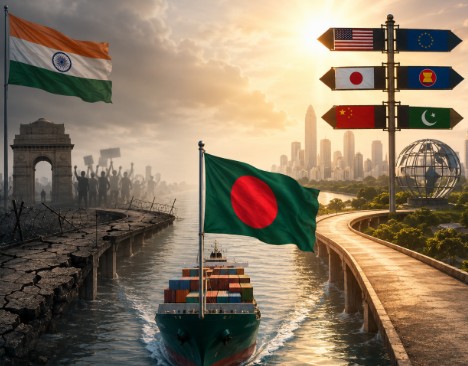
The era of India’s uncontested influence in Bangladesh has reached its logical conclusion, paving the way for a more sophisticated, multi-aligned foreign policy in Dhaka. For over a decade, New Delhi enjoyed unparalleled sway over its eastern neighbor, but the landscape has fundamentally shifted following the major political transition of August 2024 and the subsequent February election. While both governments have signaled a desire to reset their fractured relationship, the path forward is heavily obstructed by unresolved baggage and powerful undercurrents of public opinion.
Chief among these obstacles is the diplomatic standoff surrounding former Prime Minister Sheikh Hasina. Now a convicted criminal sentenced to death for crimes against humanity, her continued asylum in India serves as a direct impediment to normal relations. Dhaka has formally requested her extradition, and New Delhi’s reluctance to comply leaves a gaping wound in bilateral trust. This issue is not merely a legal or bureaucratic hurdle; it is a lightning rod for Bangladeshi public opinion, which soured dramatically during the Hasina period and the post-uprising transition. Across the border, Indian public perception has been similarly warped by a wave of disinformation unleashed during recent state elections. Neither government can afford to ignore these domestic sentiments as they attempt to redefine their ties.
Consequently, Bangladesh’s approach to its regional heavyweight is transitioning to a “slow and steady” calibration, managed deliberately by figures like Foreign Minister Dr. Khalilur Rahman. Rather than reverting to the lopsided alignments of the past, Dhaka is aggressively diversifying its international portfolio. The days of Indian primacy have given way to a calculated balancing act, wherein Bangladesh is actively expanding its economic and security cooperation with the United States; which has paid significant attention to the country’s democratic shift, while simultaneously courting investments from European partners.
This diversification extends deeply into regional and multilateral spheres. By pursuing stronger ties with ASEAN and the D-8 grouping, and by steering negotiations toward an independent trade agreement with Washington, Dhaka is asserting its agency on the global stage. Even potential economic entanglements, such as regional connectivity corridors involving China and Myanmar, are being explored as pragmatic avenues for job creation and export growth. Evolving diplomatically, Bangladesh is proving that engaging with Beijing for economic infrastructure does not have to result in friction with Washington, provided the strategy is managed adeptly.
Ultimately, the changing dynamics between Dhaka and New Delhi signal a healthier, more mature phase of South Asian diplomacy. Bangladesh is no longer content to be viewed through the narrow lens of a single patron’s sphere of influence. By championing a balanced foreign policy and reclaiming its historic role as a proponent of regional multilateralism, Dhaka is charting a sovereign path forward, one defined by independent national interest rather than inherited geopolitical compliance.
Few port cities occupy as advantageous a position as Chittagong: situated where the Bay of Bengal narrows toward Myanmar, at the confluence of overland trade routes across South Asia and maritime corridors extending toward China and Southeast Asia. This geographic endowment has long outpaced the infrastructure built to exploit it. This year’s national budget signals Dhaka’s intent to finally close that gap.
Finance Minister Amir Khosru Mahmud Chowdhury outlined the framework during a visit to Chittagong: a 600-acre economic zone on the Karnaphuli’s southern bank, a substantially expanded airport designed for serious cargo capacity, a dedicated Chinese economic zone, and a rail corridor intended to materially reduce Dhaka-Chittagong transit time. Taken alongside the Matarbari deep-sea port, already the most consequential coastal infrastructure undertaking in the country’s history, these initiatives are designed to reposition Chittagong from a transit point for goods into a logistics hub in its own right.
Matarbari’s depth capacity is the linchpin. It can accommodate vessels too large for Chittagong’s existing port, precisely the class of ships that render a Bay of Bengal stopover commercially viable on China-Indian Ocean shipping lanes, rather than a theoretical proposition.
This is what lends substance to discussions of a China-Myanmar-Bangladesh economic corridor. Lieutenant General Mohammad Mahfuzur Rahman (Retd) characterizes it as a form of strategic leverage previously unavailable to Bangladesh, a route linking China’s Yunnan province through Myanmar to Chittagong Port that could substantially compress the roughly two-week sea transit currently required to reach Chinese markets. Given that China already ranks among Bangladesh’s principal trading partners, the underlying commercial logic is far from speculative.
Economists frame the opportunity in structural terms. Dr Mohammad Lutfor Rahman of Jahangirnagar University observes that efficient transport infrastructure and streamlined customs procedures are decisive factors in how multinational manufacturers select a production base, positioning Bangladesh as an increasingly competitive option for firms serving both South and Southeast Asian markets. His colleague, Md Rashidul Islam Rusel, extends the argument further: corridor access could open ASEAN markets to Bangladeshi exporters, with tariff advantages and more effective deployment of the country’s labor capacity.
The minister was candid that this is not a near-term transformation, with measurable economic momentum unlikely before the third or fourth year of implementation, a timeline consistent with the scale of the undertaking rather than a deficiency in planning.
What remains constant is the geography itself. Chittagong has always occupied precisely the position a regional trade hub requires. Bangladesh is now constructing the port capacity, rail infrastructure, and economic zones necessary to convert that positional advantage into realized economic weight, ensuring the country features in this decade’s corridor discussions as an active architect of the route, not merely a location it happens to pass through.
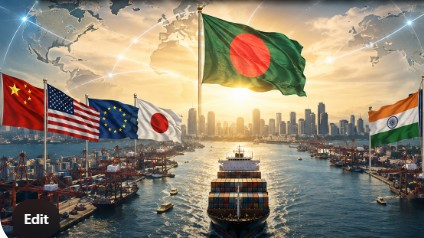
The global order is undergoing a structural realignment, and as the Indo-Pacific emerges as the focal point of this transformation, Bangladesh finds itself at a critical strategic junction. Positioned at the apex of the Bay of Bengal, our nation is transitioning from a peripheral observer into a pivotal nexus between the dense markets of South Asia and the expansive trade corridors of Southeast Asia. For the administration of Prime Minister Tarique Rahman, the imperative is to synthesize our geographic endowment with a sophisticated diplomatic architecture, one that fosters national prosperity while consciously resisting the reductive pull of binary geopolitical alignments.
Our foundational foreign policy doctrine of “Friendship to all, malice toward none” is frequently misinterpreted as a vestige of defensive passivity. In practice, however, it represents a highly calibrated paradigm of strategic autonomy. In an era where competing superpowers demand zero-sum loyalty, our capacity to maintain constructive, independent relationships with diverse global capitals is not a diplomatic weakness; it is our most potent strategic asset. Choosing sides would be an act of structural self-sabotage. To jeopardize our industrial supply lines with China, the essential consumer markets of the West, or the logistical synergy with India would be to forfeit the very stability required to uplift our 170 million citizens.
Our trajectory must therefore be defined by the transformation of our territory into an indispensable hub for peaceful commerce. By ensuring that our ports and transit routes remain open, transparent, and geared toward regional integration rather than containment, we create a vested, tangible interest for all global powers in our continued stability. This approach allows us to leverage Japan’s “Big-B” industrial development initiatives, China’s infrastructural capital, and India’s regional logistical frameworks as complementary forces for growth. We are not merely a participant in the global economy; we are an essential bridge.
The path forward demands a rigorous institutional upgrade. To maximize our leverage, we must enhance our domestic regulatory and logistical frameworks, ensuring that our nation possesses the requisite capacity to absorb and optimize complex international investments. By embedding our bilateral relationships within multilateral frameworks, we can collectively negotiate for regional stability and dilute the external pressure of any single dominant power. The message from Dhaka must remain unwavering: we are a land of vast economic opportunity, a bridge between civilizations, and a steadfast proponent of sovereign equality. Our destiny is defined not by the frictions of global power, but by our commitment to sustainable development and a vision of the Bay of Bengal as a space for shared prosperity.
There is a legal vocabulary for what happens along the India-Bangladesh frontier, and it is worth using precisely, because precision is what the debate keeps losing. When a state’s agents kill unarmed civilians outside a recognized theatre of conflict, the applicable standard under international human rights law is not self-defense as commonly understood in domestic criminal codes, but necessity and proportionality — force must be the last available option, and even then, calibrated to the threat actually posed. Nine Bangladeshis shot dead by India’s Border Security Force since January do not fit comfortably inside that standard, whatever language the BSF’s after-action reports use. Two died in Brahmanbaria’s Kasba upazila on May 8, one near Coachbehar on May 15, one more in Moulvibazar’s Kulaura upazila on June 12, a death that arrived one day after the two countries’ border forces had concluded four days of talks in New Delhi ostensibly aimed at preventing exactly this outcome.
What makes the pattern analytically significant, rather than merely tragic, is its persistence across changes in government on both sides of the border. Ain o Salish Kendra’s figures; 34 killed in 2025, 30 in 2024, 31 in 2023; span an interim technocratic administration in Dhaka and an elected one, a period in which Bangladesh’s foreign policy establishment shifted from unelected caretakers to a BNP government that campaigned explicitly on ending border killings. The continuity of the underlying practice, indifferent to who occupies Ganabhaban, suggests something closer to institutional doctrine on the Indian side than incidental excess. That doctrine found unusually candid articulation this year in a reported internal BSF communique, dated March 26, instructing field units to assess deploying snakes and crocodiles into riverine gaps where physical fencing has proven impractical, a proposal a former BSF director general himself dismissed as unable to distinguish nationality from intent, but one whose existence in writing indicates a security apparatus contemplating lethality as an engineering problem rather than a legal one.
The push-in question sits adjacent to this but is doctrinally distinct: it is a matter of state responsibility for the treatment of persons within a state’s jurisdiction, and of the customary prohibition on the forcible transfer of individuals across an international boundary absent due process. Home Minister Salahuddin Ahmed’s disclosure to parliament on June 17, 2,369 people pushed across since August 2024, the overwhelming majority processed through Bangladeshi police stations rather than returned through any bilateral mechanism, describes a practice that treats an international border less as a demarcation of sovereignty than as a discretionary outlet for a domestic policy problem, namely West Bengal’s post-election “detect, delete, deport” campaign against alleged undocumented residents. That Rohingya and Myanmar nationals have been included among those pushed only sharpens the point: the border is being used to externalize a burden that international law generally assigns to the state where displaced persons are found, not to whichever neighbor happens to share a fence line. Bangladesh, notably, has continued to accept and process every individual verified as its own national through established channels, even as the volume of unverified transfers has grown.
The diplomatic record shows Bangladesh availing itself of every available instrument, the 57th BGB-BSF director general conference, parliamentary statements, a formal summons of India’s deputy high commissioner over a separate incident involving a prime ministerial adviser detained at Delhi airport, without yet securing the one outcome that would indicate the relationship is being taken seriously on both sides: a compensation mechanism for victims’ families, which Ahmed confirmed does not exist, and a verifiable reduction in fatalities, which the data does not show. The absence of the customary joint press conference at the June conference’s conclusion was a minor procedural detail, but diplomatic minutiae of that kind tend to register the actual temperature of a relationship more honestly than its communiqués do.
None of this is incidental to a bilateral friendship the size and history of the one Dhaka and New Delhi claim to share. A shared border exceeding four thousand kilometers, nearly a fifth of it still unfenced by necessity rather than choice, is either governed by mutual restraint or it is governed by whichever side holds the greater capacity for unilateral action and for the residents of Kurigram, Chapainawabganj, and Brahmanbaria, the answer to that question is being decided empirically, one border pillar at a time, rather than in any conference room.
The Palashbari controversy invites us to confront a fundamental distinction that holds pluralistic societies together: the difference between a constitutional right to practice religion today and an empirical claim to historical continuity yesterday. North Bengal is not a blank slate waiting for a singular identity to be etched upon it; it is a complex, deeply layered palimpsest where every epoch has left a distinct material footprint. To understand this region’s religious evolution, one must look to the soil; to epigraphy, numismatics, and stratigraphy rather than the volatile arena of social media or contemporary polemics. When we subject North Bengal to rigorous historical and archaeological audit, a clear, chronological pattern emerges that directly challenges the premise of retrofitting modern architectural ambitions with ancient lineage.
The earliest, most physically imposing layer of North Bengal’s identity is unassailably Buddhist. The sheer scale of excavated complexes; the massive urban fortifications of Mahasthangarh, the sprawling monasteries of Bhasu Vihara, Sitakot Vihara, Gokul Medh, and Bihar Dhap, reveals an ancient landscape that was once a premier global powerhouse of Buddhist education and philosophy. This material reality, heavily documented by medieval travelers like Xuanzang and embodied by intellectual giants like Atish Dipankar during the Pala Dynasty, forms the bedrock of the region’s historical consciousness. When Hindu traditions later expanded following the gradual decline of Buddhism, they did not manifest as a monolith. The archaeological and documentary record demonstrates that the sacred geography of North Bengal became predominantly defined by Shakta, Shaiva, and Krishna-Vaishnava traditions.
The major regional pilgrimage sites tell this specific story. The Bhabanipur Shaktipeeth stands as a monumental testament to Goddess Bhavani, while the architectural marvel of the Kantajew Temple and the venerable Govinda Bhita site represent high-water marks of Vaishnava and Krishna worship. Conspicuously absent from this dense archaeological grid is any evidence characterizing the Gaibandha-Bogura-Rangpur corridor as a historically significant epicenter of Ram worship. While individual devotion or household practice undoubtedly existed across various communities over the centuries, it never formed a defining, institutionalized feature of North Bengal’s public heritage. To assert otherwise in the present day is to conflate personal devotion with regional history.
This complex landscape shifted again from the thirteenth century onward with the gradual, structural arrival of Islam. Facilitated by the expansion of the Bengal Sultanate and the Mughal Empire, the influence of Sufi saints, and agrarian transformations, Islam became the faith of the region’s majority. Critically, North Bengal’s Islamic heritag, exemplified by the architectural brilliance of the Sura, Chihilghazi, and Nayabad mosques in Dinajpur, the Mithapukur Mosque in Rangpur, and the Jamalpur Shahi Mosque in Gaibandha, functions differently than its Buddhist predecessor. While the Buddhist monasteries survive as excavated ruins, the region’s Islamic monuments exist as a living, breathing cultural continuum seamlessly integrated into the daily social and spiritual life of the populace. A final, distinct layer was added much later during the colonial era with the late eighteenth-century arrival of Christian missions, marked by the founding of the Dinajpur Baptist Mission Church in 1796.
Acknowledging this multi-layered history does not diminish the constitutional liberties of present-day communities. Under the laws of Bangladesh, every religious group enjoys the undeniable legal right to establish places of worship. If a community wishes to construct a modern monument or a statue in Palashbari, it may do so, provided it navigates the transparent, secular mechanisms of the state, including clear land title, zoning compliance, public safety protocols, and funding transparency. However, problems arise when modern construction seeks validation by misrepresenting local history. A mosque built today does not prove that Islam stood on that exact acre for a millennium; a statue erected tomorrow does not transform a historically Shakta or Buddhist landscape into an ancient center of Ram worship. When we allow unverified narratives to masquerade as historical continuity, we invite social polarization and erode the integrity of our shared past.
To prevent controversies like Palashbari from fracturing into communal tension, the state and its academic institutions must transition from a reactive posture to a proactive strategy of cultural preservation and public education. The Department of Archaeology, in tandem with research universities, should construct a digital regional heritage atlas to catalog every verified site, detailing its exact construction period and archaeological findings. Furthermore, field research must be expanded into insufficiently explored pockets of Gaibandha and Palashbari to fully map their cultural evolution. Living assets and excavated ruins alike require enhanced conservation, and our educational frameworks must evolve to teach the history of Bengal not as a series of sudden, fractured disruptions, but as a rich, unbroken process of civilizational evolution. Ultimately, the Palashbari controversy should be resolved through the rule of law and the clarity of evidence, preserving both public harmony and historical integrity.
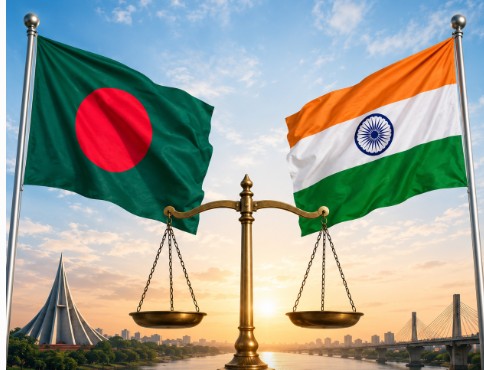
There is a category error at the heart of how Bangladesh-India relations have been conducted for much of the past two decades, one that mistakes proximity for partnership, and deference for diplomacy. The relationship has worn the vocabulary of friendship while operating, in substance, as something closer to supervision. The question Bangladesh confronts now is not whether warmth toward India is desirable. It plainly is. The harder question is whether that warmth can be sustained without a fundamental recalibration of the terms on which it has historically rested.
To be clear about what this argument is not: it is not a brief for antagonism. Bangladeshis, by overwhelming disposition, harbor no animus toward a neighbor with whom they share river systems, trade corridors, and an interwoven history stretching back generations. The grievance is more precise than hostility, it is the accumulated fatigue of having been cast, structurally, as the junior party in a relationship that geography alone does not justify treating as hierarchical.
For much of the post-2000 period, India’s engagement with Bangladesh was conducted almost exclusively through a single political conduit: the Awami League under Sheikh Hasina. The interests of that government were treated, with a kind of unexamined diplomatic convenience, as coextensive with the interests of the Bangladeshi state itself. This was always an analytically unsound premise, the conflation of a ruling party with a nation of 170 million people and the mass uprising of August 2024 demonstrated precisely how unsound. What is notable is how incompletely that lesson appears to have been absorbed in Delhi. A foreign policy architecture premised on one party’s permanence was never a stable one; it merely took a popular movement to reveal its fragility.
What follows from this is less a demand than a description. Bangladesh is asking to be recognized, in practice and not merely in protocol, as a sovereign state whose government is determined by its own electorate rather than by the comfort level of any neighboring capital. This is not a radical proposition. It is the baseline expectation of inter-state relations among nominal equals, cooperation absent coercion, neighborliness absent hierarchy.
It is in this light that the Prime Minister’s recent state visits; to Malaysia, and separately to China, are best understood. They are not gestures of realignment so much as the unremarkable exercise of options that should have been available all along. Malaysia offers access to labor markets, educational partnerships, and deeper integration with the broader Muslim world. China offers capital for infrastructure, industrial capacity, and technical cooperation spanning river management to manufacturing. Neither engagement is constituted in opposition to India. Both are constituted in pursuit of Bangladeshi interest, which is, in fact, the entire substance of the matter.
This is the underlying logic of what has come to be called “Bangladesh First”: not a rhetorical flourish but an operating principle of statecraft. Sustained relations with India. Deepened development cooperation with China. Trade and technological exchange with Washington. High-grade investment from Tokyo and Seoul. Defense-industrial cooperation with Ankara. Energy and labor access across the Gulf states. Export and human-capital partnerships with Europe. Regional integration through ASEAN. None of these relationships is designed to displace the others. Their cumulative effect, rather, is to ensure that no single relationship is positioned to displace Bangladesh’s own capacity for independent judgment.
This is the structural argument worth dwelling on. A state too tightly bound to a single patron forfeits the one asset that makes genuine negotiation possible: a credible alternative. A state with a diversified portfolio of partnerships retains that alternative and what diplomats term leverage is, ultimately, the only durable currency of respect between states of unequal size.
Were Delhi inclined toward a more constructive footing with Dhaka, the path would not be obscure, however politically inconvenient it may prove. It runs through the cessation of border killings that have persisted years past any defensible justification, the resolution of water-sharing disputes left unaddressed for a generation, the correction of trade terms structurally weighted toward one party, and a reconsideration of the sanctuary extended to a fugitive former head of government. None of these constitute extraordinary demands. They are the ordinary maintenance required of any relationship between sovereign equals and their continued absence is precisely what sustains the present deficit of trust.
What emerges from all this is not a nationalism defined by its adversaries, but one defined by what it seeks to preserve: sovereignty, dignity, economic self-determination, and the prerogative of a nation to reach its own conclusions. Bangladesh has no need of enemies. It has, equally, outgrown the role of understudy.
Friendship remains available to all. The final word belongs to Dhaka alone.
There are moments in diplomacy when the destination itself becomes the message. When a newly elected prime minister chooses Beijing for one of his earliest official visits, the significance extends well beyond protocol or ceremony. The itinerary, the meetings, the agreements under negotiation and the level of reception together communicate a broader strategic intent.
Prime Minister Tarique Rahman’s visit to China represents such a moment. It reflects a government seeking to deepen economic partnerships while pursuing a foreign policy shaped increasingly by Bangladesh’s own national interests. More than a routine bilateral engagement, the visit suggests that Dhaka is positioning itself to engage major powers with greater confidence and strategic flexibility.
International observers have focused on the practical outcomes expected from the visit. Reuters highlighted Bangladesh’s efforts to attract investment, create employment and diversify its external economic partnerships. Reports indicate that between 15 and 17 bilateral instruments—including memorandums of understanding, agreements, action plans and protocols—are expected to be signed, covering sectors such as infrastructure, energy, industrial development and river management, including the long-discussed Teesta project.
Yet the broader significance of the visit extends beyond the number of agreements. It reflects Bangladesh’s effort to strengthen ties with China while maintaining constructive relations with other regional and global partners. Rather than signaling alignment with any single power, the visit points to a more balanced and interest-driven foreign policy.
Chinese media have also attached considerable importance to the visit. Commentaries in the Global Times argued that Bangladesh should continue pursuing a “Bangladesh First” approach based on its own national priorities. The publication also noted that Bangladesh-China relations have been elevated to a Comprehensive Strategic Cooperative Partnership, underscoring Beijing’s intention to deepen long-term cooperation.
The same publication rejected suggestions that closer Bangladesh-China relations should be viewed through the lens of regional rivalry, arguing that bilateral cooperation is intended to serve mutual development rather than target any third country. Regardless of how such commentary is interpreted, it illustrates the broader geopolitical attention surrounding the visit.
The ceremonial aspects of the visit also reflected its importance. Prime Minister Tarique Rahman received a formal state welcome in Beijing, including an official reception, guard of honour and meetings with China’s highest political leadership. His schedule includes separate meetings with Premier Li Qiang and President Xi Jinping—an indication of the importance Beijing attaches to relations with Bangladesh.
Economically, the visit comes at a time when both countries are seeking to expand cooperation. Bangladesh hopes to attract greater Chinese investment in manufacturing, industrial zones, infrastructure, renewable energy and technology. The Chinese Economic and Industrial Zone in Chattogram, along with discussions on trade expansion and regional connectivity, reflects this broader agenda.
Defence cooperation has also emerged as an area of discussion. For Bangladesh, diversifying partnerships in defence, technology and industrial capability aligns with a broader objective of strengthening national capacity while maintaining strategic autonomy.
Importantly, the visit should not be viewed as a departure from Bangladesh’s relationships with India, the United States, the Gulf states or other international partners. Rather, it reflects an effort to engage all major partners based on mutual benefit and national priorities.
An interest-based foreign policy requires balancing multiple relationships while preserving policy independence. Such an approach demands institutional capacity, consistent diplomacy and the ability to manage competing expectations from larger powers.
In that context, Tarique Rahman’s visit to Beijing may represent an early indication of a foreign policy framework that seeks broader partnerships without exclusive alignment. Whether that approach succeeds will depend not only on the agreements signed during this visit but also on how effectively Bangladesh translates diplomatic engagement into long-term economic growth, technological advancement and strategic resilience.
Ultimately, the importance of the visit lies not only in its immediate outcomes but in the direction it suggests: a Bangladesh seeking to engage the world with greater confidence, pursuing partnerships that advance its own development priorities while maintaining constructive relations across an increasingly complex international landscape.