

Geography is not a choice. Bangladesh and India will share a border long after every current government has passed into history. The question, therefore, has never been whether relations will exist, it is what kind of relations they will be. Built on mutual respect and sovereign equality, or sustained through asymmetry, political favoritism, and the slow accumulation of distrust? That is the question the current crisis forces both countries to answer honestly.
The origins of this crisis are not difficult to trace. Between 2009 and 2024, Bangladesh-India relations reached their warmest point since independence. Security cooperation deepened, trade expanded, connectivity improved, and India secured strategic access to its northeastern states through Bangladeshi territory. On paper, the relationship looked like a regional model. Beneath the surface, it was something more complicated.
Throughout those fifteen years, Bangladesh experienced serious democratic deterioration. Elections were contested, political opponents were silenced, enforced disappearances became a documented pattern, and press freedom eroded systematically. Western governments and international human rights organizations raised consistent objections. India, with equal consistency, either stayed silent or continued its warm engagement regardless. The message this sent to ordinary Bangladeshis was not ambiguous: New Delhi valued a friendly government in Dhaka more than it valued the democratic rights of the Bangladeshi people. Whether or not that reading fully captures India’s calculations, it became a political reality. When the mass uprising of August 2024 removed Sheikh Hasina from power, that accumulated perception did not dissolve. It hardened.
In diplomacy, perception is rarely a secondary concern. It is often the only one that matters.
No single-issue captures India’s dilemma more sharply than the continued presence of Sheikh Hasina on Indian soil. A state retains the sovereign right to grant shelter to foreign political figures, that principle is not in dispute. What is in dispute is the line between humanitarian shelter and implicit political endorsement, a line India has conspicuously refused to draw. The Bangladeshi people, through a popular uprising whose scale cannot be credibly dismissed, rejected a government. When the principal figure of that government was permitted to remain in India while continuing to make political statements, a significant portion of the Bangladeshi public reached a logical conclusion: that India had not accepted the new political reality, and that the Awami League remained its preferred interlocutor in Dhaka. India could have adopted a clearer, more transparent posture on this question. It chose not to. That choice carries consequences.
India is, by every meaningful measure, the dominant power in South Asia. Its economy, military capacity, and regional influence dwarf those of its neighbors. But disproportionate power generates disproportionate responsibility. When tensions arise between a stronger and a weaker state, the expectation of greater restraint and diplomatic maturity falls naturally on the more powerful party. This is not sentiment; it is the foundation of any sustainable regional order. A regional power that uses its weight to pressure rather than reassure its neighbors does not produce stability. It produces resentment.
The political transition of August 2024 gave India a clear opportunity: to demonstrate, convincingly, that its relationship was with Bangladesh as a nation and not with any particular political party. India did not take that opportunity. Influential sections of Indian media and political commentary produced a sustained narrative portraying Bangladesh as unstable, hostile to minorities, and approaching state failure. Many of these claims were later shown to be exaggerated or factually false. Yet they shaped public opinion in both countries, and the damage to Bangladeshi trust was real. Simultaneously, social media discourse in India filled with references to military operations and aggressive scenarios directed at Bangladesh. These were not official government positions. But states are judged not only by what their governments formally declare, they are also judged by what their political culture tolerates and amplifies.
Border conduct has added another layer of tension. Bangladesh has formally raised complaints about push-in operations, instances where individuals were transferred across the frontier outside established diplomatic and verification procedures. Both countries possess functioning bilateral mechanisms for handling such matters. When those mechanisms are bypassed in favor of unilateral, informal action, it does not read as routine border management. It reads as political pressure. Many Bangladeshis have drawn precisely that conclusion.
Then there is the question of military signaling. Every state has the right to develop its defense capabilities, India’s sovereign right in this regard is unquestioned. But military posture also functions as a political language, and context determines meaning. Bangladesh has never made a territorial claim against India. It has never adopted an aggressive military stance. It has not joined any alliance directed against Indian interests. On the contrary, it has cooperated with India on security matters across successive governments. When security framing and military messaging intensify specifically toward a neighbor that poses no military threat, during a period of political strain, the message being communicated is not reassurance. A mature regional power should make its neighbors feel secure, not anxious.
Bangladesh today is pursuing a diversified foreign policy, strengthening relations with China, Malaysia, Türkiye, the Gulf states, Japan, and Europe. This is not anti-India policy. It is sovereignty in practice. India itself maintains concurrent relationships with the United States, Russia, and France without treating this as a contradiction. Bangladesh deserves the same latitude. A confident Bangladesh pursuing its interests through multiple partnerships is ultimately a more stable and reliable neighbor than one kept dependent and resentful.
India’s deepest strategic error, however, may be simpler than any of this. It treated the Awami League and Bangladesh as if they were the same thing. No political party, however long in power, is coterminous with a nation. Bangladesh existed before the Awami League and will continue long after it. By investing its political capital so completely in one electoral force, India created distance between itself and a large, diverse, and politically conscious society. That is the distance it is now struggling to close, from a position of diminished trust.
Bangladesh is not without its own responsibilities. Minority communities must be protected, not as a concession to external pressure, but as a constitutional and moral obligation. The rule of law must be upheld without exception. Foreign policy must be grounded in realistic national interest rather than reactive emotion. Political sentiment is not a substitute for strategic thinking. These obligations belong to Bangladesh regardless of what India does or does not do.
But responsibility in this relationship is not equally distributed. India’s sustained alignment with the previous government, its handling of the Hasina question, its border conduct, its tolerance of hostile narratives, and its position as the dominant regional power. all of this places the heavier burden of repair at New Delhi’s door.
What Bangladesh asks of India is not charity. It is recognition. Recognition that the Bangladesh of 2026 is not the Bangladesh of 2023. That its people made a sovereign political choice which deserves respect. That a relationship worth having must be founded on equality rather than managed through leverage.
Geography cannot be renegotiated. Diplomatic behavior can. And in the present moment, the first meaningful step toward rebuilding trust must come from India, not because Bangladesh is without fault, but because the country with the greater power and the longer record of consequential choices carries the greater obligation to move first.
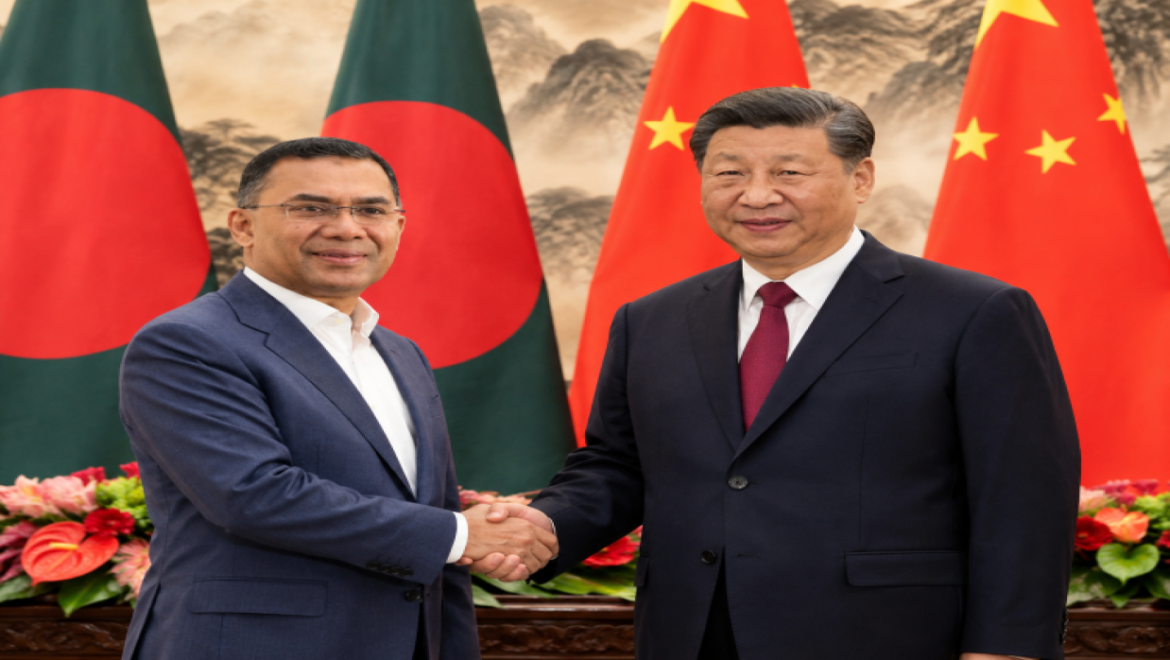
Prime Minister Tarique Rahman’s ongoing visit to China comes at a time when the global economy, regional security environment, and international diplomacy are undergoing significant transformation. Amid growing economic uncertainty, energy challenges, geopolitical competition, and disruptions in global supply chains, the visit is widely viewed as an important opportunity for Bangladesh to strengthen one of its most valuable international partnerships.
Over the past several decades, Bangladesh and China have developed a deep and multifaceted relationship. China has become one of Bangladesh’s most important development partners, contributing significantly to infrastructure development, energy projects, transportation networks, trade, investment, and technological cooperation. As a result, Prime Minister Tarique Rahman’s visit is being seen not merely as a routine state visit but as an opportunity to elevate bilateral relations to a new level.
One of the primary objectives of the visit is to expand investment and economic cooperation. Bangladesh is currently pursuing industrialization, employment generation, and export diversification as key drivers of economic growth. In this context, increased Chinese investment could play a vital role in developing industrial zones, manufacturing industries, technology sectors, and special economic zones across the country.
Trade cooperation is also expected to be a major focus of discussions. Although bilateral trade has grown substantially over the years, Bangladesh continues to face a significant trade imbalance with China. Therefore, expanding access for Bangladeshi products to the Chinese market, creating new export opportunities, and improving trade balance are likely to receive considerable attention during the visit.
Energy security remains another important area of cooperation. Given the volatility of global energy markets, Bangladesh is actively exploring long-term solutions to meet its growing energy demands. Cooperation with China in power generation, renewable energy, energy infrastructure, and advanced technologies could contribute significantly to Bangladesh’s sustainable development goals.
The visit also reflects the broader vision of Bangladesh’s “Bangladesh First” policy. This policy emphasizes pursuing national interests through balanced and diversified partnerships with countries around the world. Strengthening cooperation with China aligns with this strategic approach and demonstrates Bangladesh’s commitment to maintaining constructive relations with all major global partners.
Bangladesh’s strategic importance continues to grow due to its location in the Bay of Bengal. Positioned at the intersection of major regional initiatives—including China’s Belt and Road Initiative (BRI), the United States’ Indo-Pacific Strategy, and emerging regional connectivity frameworks—Bangladesh has become an increasingly important player in regional geopolitics. Consequently, the visit carries significance not only for bilateral relations but also for the broader strategic landscape of the region.
Business leaders, investors, and policymakers in Bangladesh are hopeful that the visit will result in concrete progress in investment, trade, technology transfer, and development cooperation. New agreements and initiatives in infrastructure, manufacturing, renewable energy, and industrial development could provide additional momentum to Bangladesh’s economic transformation.
Prime Minister Tarique Rahman’s visit to China is therefore more than a diplomatic engagement. It represents an important opportunity to strengthen economic cooperation, deepen strategic trust, and create new pathways for sustainable development. If the visit delivers tangible outcomes, it could mark the beginning of a new chapter in Bangladesh-China relations and contribute significantly to Bangladesh’s long-term prosperity and global engagement.
Relations between neighboring countries work best when they are built on restraint, not assertion. For Bangladesh, the real issue is not whether India calls it a friend, but whether India’s behavior matches the standards of friendship. That question matters because trust in diplomacy is shaped far more by conduct than by vocabulary.
Bangladesh has consistently avoided hostility toward India. It has not claimed Indian territory, nor has it sought to project power across the border. Its position has been straightforward: peaceful coexistence, practical cooperation, and respect for sovereignty. In that context, any perception of pressure, asymmetry, or political interference naturally draws scrutiny.
A sovereign state has every right to defend itself. If India expands its military capacity or deepens its strategic partnerships, that is its prerogative. Bangladesh is no different. It may strengthen its own defense systems, choose its own suppliers, and build security ties according to its own national interests. Sovereignty is not a favor granted by neighbors; it is a constitutional reality.
The same applies to foreign policy. Bangladesh is not obliged to seek validation for its choices, whether in defense, diplomacy, trade, or technology. Its relationships with China, the United States, Türkiye, Japan, Pakistan, the European Union, Gulf states, or any other partner should be guided by one principle alone: Bangladesh’s national interest.
What troubles many Bangladeshis is not engagement itself, but the appearance of hierarchy. When a larger state expects deference while treating its own strategic moves as normal, the result is not confidence but resentment. Friendship cannot survive if one side assumes the role of instructor and the other is expected to remain compliant.
Border management has also become a sensitive issue. Allegations of push-ins, if true, are not minor administrative concerns. They carry human consequences and diplomatic weight. Such matters require transparent legal and diplomatic procedure, not actions that create the impression of unilateral control.
There is also growing discomfort over the use of Bangladesh’s internal issues, especially minority concerns, as a lever in external politics. The protection of minorities in Bangladesh is an internal responsibility of the Bangladeshi state. Raising such issues in good faith is one thing; using them to influence domestic politics is another.
Bangladesh today is not a country without leverage. Its economy has expanded, its strategic location matters, and its regional importance is increasing. That reality should encourage confidence, not dependence. A mature foreign policy must reflect that confidence by remaining independent, balanced, and firmly anchored in national interest.
Bangladesh is open to friendship with India. It is open to friendship with everyone. But friendship, to be meaningful, must be mutual. It cannot rest on pressure, imbalance, or assumptions of entitlement. If India wants to be seen as a genuine partner, it will need to demonstrate that it understands a simple truth: sovereign nations do not seek approval for being sovereign.
In contemporary geopolitical commentary, the specter of a large-scale military conflict between India and Bangladesh occasionally resurfaces, sometimes as a product of genuine security anxiety, and other times as inflammatory political rhetoric. Yet, while absolute certainty is a luxury foreign to international politics, a cold calculus of South Asian strategic realities reveals that a large-scale Indian invasion of Bangladesh remains highly improbable. Modern warfare has repeatedly demonstrated that raw firepower does not automatically translate into a successful occupation, nor does occupation guarantee strategic gain. For any decision-maker in New Delhi, regardless of bilateral tensions, a military campaign across the border represents one of the least rational options available.
The primary obstacle to any hostile outside force is Bangladesh’s underappreciated, defender-biased geography. The nation sits atop the world’s largest river delta, a labyrinthine network of thousands of rivers, floodplains, and wetlands that severely restricts the mobility of heavy armor and mechanized supply convoys. During the monsoon season, this terrain transitions from challenging to treacherous; flooding washes out infrastructure, degrades lines of communication, and transforms the landscape into an operational nightmare for an army unfamiliar with its fluid dynamics. Compounding this is the topography of the Chittagong Hill Tracts, which provides an ideal environment for protracted defensive and asymmetric operations.
Furthermore, military planners must account for the human element: population density and national consciousness. Housing over 170 million people within a highly compact territory, Bangladesh presents a recipe for unsustainable urban and guerrilla resistance. For Bangladeshis, sovereignty is not an abstract legal concept but a visceral component of national identity forged in the crucible of the 1971 Liberation War. Any foreign encroachment would inevitably trigger a massive mobilization of civil networks, ensuring that an invading force would face a hostile population capable of disrupting intelligence and logistics indefinitely. This resistance would be anchored by the Bangladesh Armed Forces, which have undergone two decades of steady modernization, enhancing their defensive, maritime, and airspace capabilities to impose severe, compounding costs on an adversary from day one.
From a defensive standpoint, India’s own geopolitical environment strongly discourages the opening of a new theater. New Delhi is already burdened with a complex, multi-front security matrix. To the west lies a volatile relationship with Pakistan, characterized by persistent cross-border friction and the long-standing dispute over Kashmir. To the north, a heavily militarized, unresolved border dispute with China across Ladakh and Arunachal Pradesh demands continuous strategic focus and resource allocation. For India to entangle its forces in Bangladesh would be to court catastrophic strategic overextension, a vulnerability that Beijing and Islamabad would be highly likely to exploit through synchronized pressure on India’s existing fronts.
Crucially, India faces a severe internal chokepoint: the Siliguri Corridor. This narrow strip of land, colloquially known as the “Chicken’s Neck,” serves as the solitary overland artery connecting mainland India to its northeastern “Seven Sisters” states. The vulnerability of this corridor means that maintaining a stable, predictable relationship with Bangladesh is a structural necessity for Indian territorial integrity. Any major conflict in the delta would instantly reverberate across the Northeast, exacerbating localized ethnic tensions, threatening vital supply lines, and destabilizing a region that already requires delicate federal management.
Beyond regional dynamics, Bangladesh’s rising economic and maritime weight has integrated it deeply into the global architecture. Situated at the northern apex of the Bay of Bengal, the country sits at the geopolitical crossroads of South and Southeast Asia, a critical junction in the broader Indo-Pacific strategy. Major global actors, including the United States, China, Japan, and the European Union, hold expanding commercial and strategic stakes in Bangladesh. Any unilateral military action by India would immediately spark a high-level international political crisis, inviting severe global backlash, diplomatic isolation, and a rapid flight of foreign capital that would derail India’s aspirations of being recognized as a responsible global leader.
Ultimately, the most damning argument against an invasion is the total absence of a strategic prize. India holds no territorial claims over Bangladesh, nor are there resources or geographic assets that New Delhi cannot more efficiently access through trade and diplomacy. History offers no parallel here; the unique humanitarian and geopolitical variables of 1971 bear no resemblance to the realities of a modern, sovereign Bangladeshi state fully integrated into international economic systems.
For Dhaka, the strategic mandate remains clear: continue to fortify its national position by diversifying global partnerships, modernizing its defense architecture, and maintaining a fiercely independent, balanced foreign policy. An invasion of Bangladesh would not be a victory for an aggressor; it would be a costly, self-inflicted trap, a strategic reality that ensures it remains highly unlikely.
There is a particular sleight of hand that recurs in subcontinental political discourse whenever minority rights are raised across the India-Bangladesh axis. The moment temple attacks in Bangladesh enter the conversation, they are deployed not as a humanitarian concern demanding accountability but as a rhetorical instrument a way of deflecting scrutiny from what Muslims in India have been living through. Equivalence is asserted. The conversation is neutralized. And both minorities are quietly abandoned in the process.
The equivalence does not survive contact with evidence.
The most elementary problem is one of scale, and it is so large that it should give any serious analyst pause before the comparison is even attempted. India’s Muslim population exceeds 220 million, a figure larger than Bangladesh’s entire population. The Hindu community in Bangladesh numbers somewhere between 14 and 15 million, constituting roughly 7% of the country. To invoke these two communities as symmetrical minorities, equally persecuted, equally deserving of parallel condemnation, is not comparative analysis. It is arithmetic evasion.
But the more consequential asymmetry is not numerical. It is structural.
Hindus in Bangladesh occupy a position within the state’s institutional architecture that is, by most available measures, stronger than their demographic share would predict. Estimates of their representation across the civil service, judiciary, and learned professions place them significantly above that 7% baseline, in some sectors, between 20 and 25%. Durga Puja is not a quietly tolerated observance; it is a nationally visible celebration, covered extensively by state and private media alike, supported by administrative security arrangements. More tellingly, no legislative or judicial process in Bangladesh has ever placed a Hindu citizen’s right to belong, their fundamental claim to nationality, under formal contestation. Whatever vulnerabilities the community faces, and they are real, they exist within a framework that does not interrogate their citizenship.
In India, that framework has itself become the problem.
The Citizenship Amendment Act and the proposed National Register of Citizens did not emerge from a vacuum. They arrived in a political climate already shaped by years of documented hostility toward Muslim identity in public space, harassment over dietary practice, coercion around religious expression, the long shadow of Babri Masjid’s demolition and the judicial and political treatment that followed. What the CAA-NRC framework added was something categorically more serious: the legislative possibility that Muslim citizenship could be made conditional in ways that the citizenship of no other community could. The scale of the response; Shaheen Bagh, mass mobilizations across every major Indian city, was not disproportionate. It was a rational reaction to a structural threat.
The institutional data reinforces what the political record suggests. Muslim representation in India’s elite administrative and police services has remained stubbornly between 3 and 5%, against a population share of 15%. This disproportion has persisted across decades and across governments of varying ideological orientations. It is not an anomaly or an oversight. It is a pattern and patterns of this duration reflect something embedded in the architecture of the state itself.
To raise these facts is not to argue that Hindus in Bangladesh face no hardship. Attacks on temples have occurred and been documented. Land appropriation, social intimidation, and episodes of communal violence are part of the community’s lived experience, and the Bangladeshi state’s obligation to protect its minority citizens is a serious one that admits no equivocation. Acknowledging this is not a concession to the deflection argument, it is what intellectual honesty requires.
What intellectual honesty equally requires is the refusal to treat these two situations as morally or structurally equivalent. One community confronts vulnerability of a social and physical kind, within a constitutional order that does not dispute its belonging. The other confronts that vulnerability and, increasingly, the more corrosive anxiety of wondering whether the state itself regards it as fully, unambiguously a part of the nation it inhabits.
That is not the same predicament. Insisting that it is does not protect either minority. It produces a symmetry of rhetoric that serves only those who prefer that neither question be answered.
Population Reality
Muslims in India constitute one of the largest Muslim populations in the world. According to India’s 2011 official census, Muslims made up 15% of the country’s population, which today is estimated at more than 220-230 million people.
In contrast, Hindus in Bangladesh make up around 7% of the population, numbering approximately 14-15 million people.
In other words, the Muslim population of India is larger than the entire population of Bangladesh. Therefore, their social, political, and cultural presence would naturally be expected to be much greater.
Religious Freedom and Religious Practice
In Bangladesh, Hindus openly celebrate Durga Puja, Janmashtami, Rath Yatra, Kali Puja, Saraswati Puja and other religious festivals. These events receive security support from the state and administration and are widely covered at the national level.
Muslims in India also freely perform prayers, celebrate Eid, undertake Hajj, and operate madrasa education and religious activities. However, in recent years, controversies over the hijab, mosque-temple disputes, objections to the call to prayer (Azan), cow-related issues, and debates centered around religious identity have created concerns within the Muslim community.
Representation and Participation in the Mainstream
One important indicator of the actual condition of a minority community is its participation in the mainstream institutions of the state and society.
Although Hindus constitute around 7-8% of Bangladesh’s population, they have a significant presence in education, medicine, engineering, law, business, universities, the civil service, judiciary, and police. Various studies suggest that minority representation in some levels of the civil service, judiciary, and police ranges between 12-15%, which is nearly double their share of the population. In some professions, their participation is estimated to be as high as 20-25%.
Many secretaries, judges, police officers, doctors, teachers, industrialists, and cultural figures in Bangladesh come from the Hindu community.
On the other hand, although Muslims constitute about 15% of India’s population, their representation in the administration, police, judiciary, and other policy-making institutions has long been lower than their population share. Various studies have found that Muslim representation in the IAS, IPS, and higher government services remains around 3-5%, which is significantly lower than their population proportion—roughly one-fifth of what it would be if representation matched population size.
As a result, Hindus in Bangladesh appear to be comparatively overrepresented in many state and professional sectors relative to their population share, while Muslims in India remain underrepresented in several key state institutions despite being a much larger community.
Security of Places of Worship and Religious Sites
The demolition of the Babri Mosque in India was not merely the destruction of a building; it was a historic turning point that had a long-term impact on the sense of security among Indian Muslims. Since then, legal and political disputes surrounding several mosques, along with cases of mosque demolition or eviction, have attracted international attention.
In Bangladesh, incidents of attacks, vandalism, and arson targeting temples have occurred and are certainly concerning. However, there is no comparable example of a major historic temple being removed or demolished with direct state or court backing. In most cases, the authorities have stated that action would be taken against those responsible.
Citizenship and the State’s Approach
This is perhaps the most significant difference between the two situations.
The controversy surrounding the CAA and NRC in India emerged largely because many Muslims feared that citizenship verification processes could place them at greater risk. Many analysts viewed this as a form of structural pressure on Muslims. The nationwide protests, including the famous Shaheen Bagh movement, were fundamentally driven by concerns over citizenship and equal rights.
In Bangladesh, there has been no comparable state-level debate regarding the citizenship or constitutional status of Hindus. A Hindu citizen does not face the prospect of losing recognition as a Bangladeshi because of his or her religious identity.
Social Behavior and Public Space
Over the last decade, international media have documented numerous incidents in India involving Muslims being forced to chant “Jai Shri Ram,” being harassed over allegations of possessing or consuming beef, or being targeted because of their religious identity. These incidents do not represent the behavior of all Indians, but they are real and documented occurrences.
In Bangladesh, incidents of attacks, intimidation, and harassment against Hindus have occurred. However, there is no widespread, organized national pattern of forcing Hindus to recite Islamic declarations of faith, compelling religious conversion, or systematically forcing religious slogans upon them.
Protests, Assemblies, and Political Activism
In Bangladesh, Hindu groups have organized public rallies, human chains, demonstrations, and protests on issues related to minority rights, security, representation, and specific incidents. Such events generally take place openly.
Muslims in India also organize protests. However, the experience of the anti-CAA and anti-NRC movements demonstrated that large-scale Muslim-centered political protests often face greater political controversy, security scrutiny, and state response.
Media, Rumors, and Narrative Warfare
When attacks against Hindus occur in Bangladesh, a section of the Indian media often presents them as representative of the overall situation in Bangladesh.
Conversely, incidents involving discrimination or actions against Muslims in India are frequently explained as matters of law enforcement, removal of illegal structures, or local disputes, with less attention given to broader patterns and trends.
As a result, both countries experience not only real incidents but also competing narratives and information battles.
New Delhi wants the world to believe what happened to Dr Zahed Ur Rahman at Indira Gandhi International Airport was a paperwork issue. Nearly two and a half hours held at immigration, while the rest of his delegation walked through without incident, was apparently just routine screening. Nobody outside South Block actually believes that, and nobody should pretend to.
Dr Zahed is not a private citizen. He is the Adviser to Bangladesh’s Prime Minister on Policy and Strategy Affairs, and on Information and Broadcasting, leading his country’s official delegation to a meeting convened by India’s own Ministry of External Affairs. His visit was formally communicated in advance through a diplomatic note verbale. His government had done everything right. India still chose to make him wait.
The “computer glitch” defense does not survive contact with the facts. A flagged name, a routine check, an unfortunate coincidence, these are the excuses of an establishment that has been caught being petty and is now looking for cover. If this were truly administrative, the rest of the Bangladeshi delegation would not have cleared the same checkpoint without a hitch while their delegation leader was left standing for hours. Bureaucratic errors do not selectively target the one official whose government no longer takes orders from Delhi.
That is the real story here, and Delhi knows it. This is the same establishment that spent over a decade comfortable with a Dhaka that asked few questions and caused fewer problems. That arrangement ended last year. Bangladesh removed a government that had outsourced its spine, and what followed was not chaos, it was clarity. A country of 170 million people reasserted that its foreign policy answers to its own citizens, not to its largest neighbor’s preferences. Delhi has not metabolized that yet, and an immigration desk became the venue for its sulking.
To his credit, Dr Zahed did not swallow it quietly. When Indian officials offered, belatedly, to let him through, he declined and flew home through Colombo rather than accept an entry stamp on those terms. That is exactly the posture Dhaka has been missing for years. For too long, Bangladesh’s instinct was to absorb every slight quietly and call it diplomacy. Those days are over, and Delhi will need to get used to dealing with a neighbor that no longer performs gratitude for basic respect.
Dhaka’s response so far, summoning the Deputy High Commissioner and registering “deep disappointment,” is the correct first step and nothing more. A diplomatic note is not a deterrent. If Delhi believes a polite protest is the ceiling of Bangladesh’s response, it has learned nothing from the last year. The government should demand a direct, unconditional apology, not a quiet clarification buried in a press briefing.
The lesson here is not really about one airport or one official. It is about how long this government intends to let “routine screening” function as a euphemism every time Delhi wants to remind Bangladesh of the old order of things. The uprising settled that question domestically. It is past time it got settled at the border too.
There is a reason these expulsions happen at night. Light makes witnesses, and witnesses make accountability, which is precisely what India’s Border Security Force has spent the past month trying to avoid along its frontier with Bangladesh. According to Human Rights Watch, that effort has failed. Comprehensively.
Since 1 June, Bangladesh’s border guards have foiled 21 separate attempts by the BSF to force more than 200 people, among them children, through breaches in the barbed-wire fence and into Bangladeshi territory. This is not an aberration. Twenty-one incidents in a matter of weeks describes a system, not a mistake and systems require sign-off, infrastructure, personnel briefed and dispatched with intent.
The testimony assembled by HRW is difficult to read as anything other than what it is: state-enabled cruelty dressed in the bureaucratic language of migration control. In Panchagarh, ten people including children were stranded on an embankment in no man’s land for 75 hours, exposed to lightning and heavy rain, sustained by what witnesses called minimal food from the very force that had put them there. In Thakurgaon, a pregnant woman and her child were among those left stranded for nearly two days at the zero line before being taken back. These are not the conditions of a managed deportation process. They are the conditions of abandonment.
What makes the pattern harder to defend, not easier, is the documentation now sitting behind it. A union council member in Panchagarh recalls meeting a family from Siliguri carrying Aadhaar cards, India’s own proof of citizenship, whose eldest member had voted in four previous elections. Their names had simply vanished from a revised electoral roll, one of more than nine million removed in West Bengal ahead of March’s state elections and within months they were being walked toward a border that was never theirs to be walked toward. In Assam, a citizenship verification drive in 2019 left close to two million people stateless; Human Rights Watch reports that exclusion from voter rolls has since become, in one activist’s words, a trigger for arrest, detention and expulsion in itself.
West Bengal’s newly installed chief minister, Suvendu Adhikari, has been candid about the intent behind this machinery, describing a “detect, delete and deport” policy that he says has already forced nearly 5,000 people back across the border. Assam’s chief minister, Himanta Biswa Sarma, has been equally direct, telling Human Rights Watch that authorities “take them to a convenient location near the border” and “literally push them across”, an admission, in his own words, of exactly the practice his government’s diplomats might otherwise call unsubstantiated.
None of this withstands the standards India has signed up to. Arbitrary deprivation of citizenship, expulsion without due process, detention without access to legal representation these are violations of international human rights law, not policy choices a government gets to make unilaterally because the people affected happen to speak Bengali. The expulsion of children compounds the breach: the Convention on the Rights of the Child guarantees protection from arbitrary detention and a right to nationality that does not evaporate because an electoral roll was redrawn.
Bangladesh’s response throughout has been the position any sovereign state is entitled to take: no entry outside legal channels, no acceptance of anyone without verification, and no willingness to absorb the human cost of another country’s domestic political project. That is not intransigence. It is the baseline of how borders are meant to work between neighbors operating in good faith a standard India’s own conduct, documented now in granular and repeated detail, has failed to meet.
The Indian government has the means to dispute findings it considers unfair. What it does not have, after this month, is deniability. Twenty-one foiled attempts, nine witness accounts, and statements from its own state leadership describing the practice in plain terms have closed that door. The only question remaining is whether Delhi corrects course, or simply waits for the next moonless night.
A manufactured humanitarian crisis is unfolding at Bangladesh’s border with India, and the world must pay attention. What began as BJP campaign rhetoric has metastasized into a systematic, state-sponsored program of forced expulsions, unilateral “push-ins” that violate diplomatic norms and inflict human suffering on hundreds of innocent people.
The numbers tell a stark story. Between May 2025 and January 2026, approximately 2,400 to 2,500 individuals were targeted in forced push-in maneuvers. In recent weeks, Border Guard Bangladesh intercepted 21 coordinated eviction attempts, preventing the forced entry of more than 200 men, women, and children. Since June 3 alone, 186 people were stopped across 18 separate incidents.
This is not accidental border tension. This is deliberate policy.
Following the BJP’s electoral victory in West Bengal, the new state government pivoted instantly from the previous administration’s resistance. Within a month, nearly 5,000 alleged irregular migrants were deported, triggering aggressive sweeps at Benapole and Hakimpur. In Assam, now the policy laboratory for exclusion—30,000 people have been declared “foreigners” through the National Register of Citizens, with hundreds systematically pushed toward the Bangladesh border since mid-2025. Tripura, under nearly a decade of BJP rule, has maintained persistent border raids throughout 2025 and 2026.
The mechanism is what India calls “double-engine governance”: seamless coordination between New Delhi and state capitals, armed with the sweeping Immigration and Foreigners Act of 2025, bypassing traditional verification protocols entirely. Border enforcement has become a domestic political weapon.
The humanitarian consequences are severe. When BSF fails to force people into Bangladesh, they are often taken back but most are not allowed to re-enter India. These individuals now live in inhumane conditions in open areas, stranded between two nations, denied basic rights, and abandoned by the state that expelled them.
Bangladesh’s response has been measured and diplomatic. The government raised the issue through formal channels, convened the 57th DG-level BGB-BSF conference in New Delhi, and prepared BGB to resist illegal push-ins across 26 vulnerable districts along the 4,156-kilometer border. Foreign Affairs Minister Shama Obaed correctly noted that formal repatriation procedures exist, India should follow them.
But diplomatic discussions alone cannot stop a strategy driven by domestic political gain. The BJP’s electoral expansion has transformed border enforcement into a political tool, creating a profound geopolitical crisis that threatens regional stability.
The international community must ask: when does border enforcement cross into human rights violations? When does political strategy become a humanitarian catastrophe? The answer is clear: when unilateral expulsions bypass diplomatic protocols, when people are treated as political problems to be “deleted,” and when hundreds of innocent men, women, and children are left stranded in open areas without protection.
Bangladesh stands on principles of sovereignty, respect, and diplomatic dignity. But the world must recognize this crisis. This is not merely a bilateral dispute. This is about how nations treat human beings at their borders. And currently, India’s eastern borderlands are failing that test.
The crisis has risen to the top of India-Bangladesh bilateral agenda. It threatens regional stability. And unless India respects diplomatic protocols and formal repatriation procedures, it will continue to strain relations with its neighbor.
Borders should protect nations. They should not be weaponized to force people out without reason, without process, and without humanity. The world must hold India accountable.
There is a particular kind of diplomatic cynicism that does not announce itself. It arrives quietly, at the border, in the dead of night, dressed not as hostility but as bureaucratic necessity. What India is doing along its frontier with Bangladesh right now fits that description precisely.
The Border Security Force has been attempting to push undocumented individuals into Bangladeshi territory across more than ten locations at once. From Jhenaidah in the south to Sylhet in the east to Panchagarh in the north, the pattern is too coordinated, too simultaneous, to be dismissed as isolated incidents of poor judgment by personnel on the ground. This is policy. The only question worth asking is whose.
West Bengal’s chief minister has provided part of the answer, publicly confirming that thousands excluded under the Citizenship Amendment Act have already been forced across, with hundreds more in holding facilities awaiting the same fate. India’s own officials, in other words, are not even pretending this is anything other than what it is, a deliberate transfer of unwanted populations across an international border without documentation, without consent, without legal basis.
Bangladesh has responded with restraint that, frankly, India does not deserve. Over a dozen formal protests have been filed. The Home Minister has asked, with considerable diplomatic patience, that India simply follow the procedures that already exist. The Border Guard has turned back every attempt. A bilateral meeting of senior border officials has already taken place. None of it has made any difference. The push-ins continue.
This matters beyond the immediate humanitarian concern, though that alone should be sufficient. It matters because it is happening at precisely the moment when both governments were publicly committed to a reset. The collapse of Sheikh Hasina’s government in 2024 left relations in a difficult place. The BNP’s election victory earlier this year created an opening. Ministerial visits followed. Water-sharing talks, long frozen were back under discussion. The language from both capitals was, for once, conciliatory.
Against that backdrop, the border incidents are not a coincidence. They are a message. Analysts who have described the push-ins as leverage ahead of high-stakes negotiations are not being uncharitable toward India. They are simply reading the situation as it is. The timing, the scale, and the continuation of push-ins even after diplomatic engagement has taken place all point in the same direction.
Some have suggested this reflects a division within the Indian state rather than a unified strategy that West Bengal’s newly elected BJP government and the BSF are operating with a degree of autonomy that New Delhi’s central government does not fully endorse. That interpretation, while possible, offers cold comfort. If India cannot control what its own border force does, that is a governance failure of the first order. If it can but chooses not to, that is something worse.
What is not in doubt is the effect. Every push-in attempt that Bangladesh repels is another data point in an emerging portrait of a neighbor that speaks the language of partnership while acting on entirely different instincts. Bangladesh has extended goodwill. It has opened channels. It has shown, repeatedly, that it is willing to work within established frameworks to manage a relationship that carries enormous consequence for both countries.
India’s response has been to keep crossing the line.
A new chapter, both governments said. But a new chapter requires both parties to turn the page. Right now, only one of them is trying.