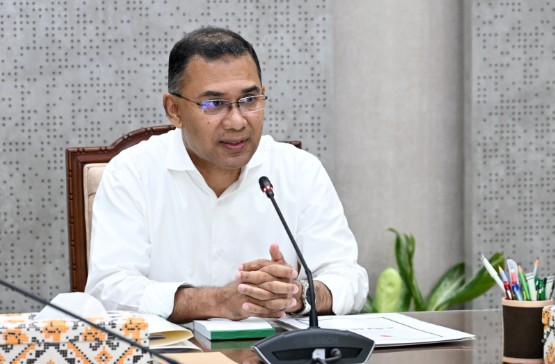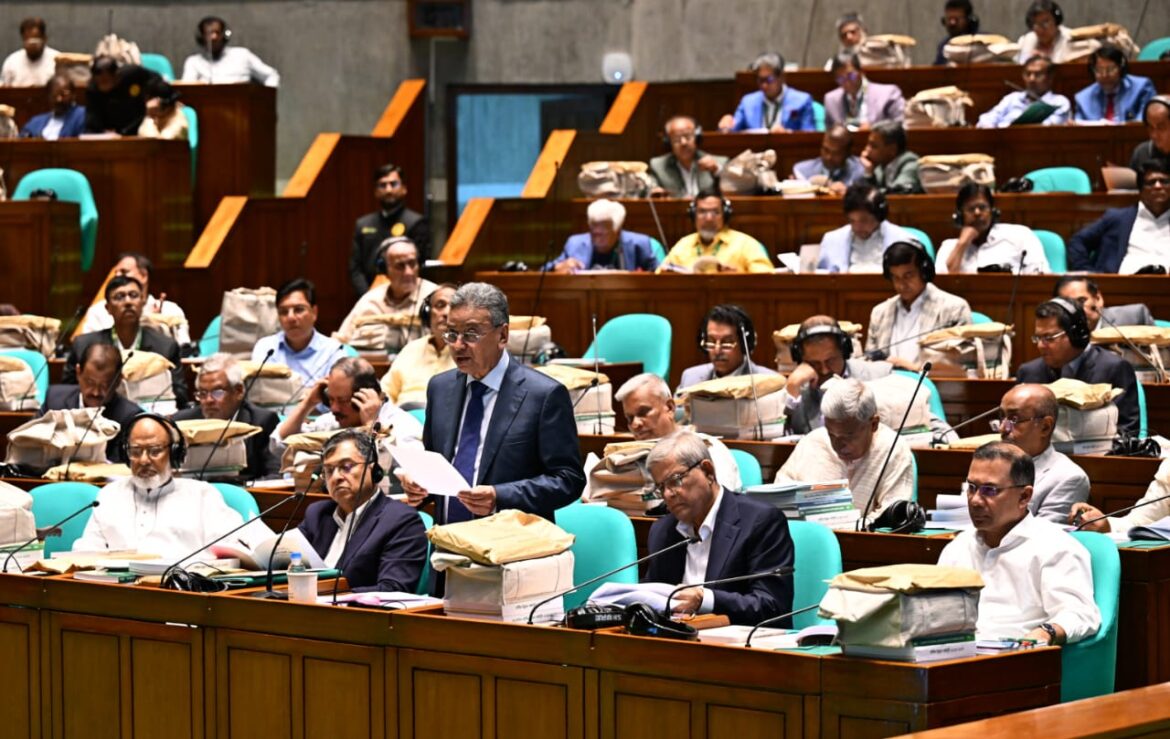

Finance Minister Amir Khosru Mahmud Chowdhury unveiled a record Tk 9.38 lakh crore national budget for FY2026-27, outlining the government’s roadmap for economic recovery, investment growth and social development.
Presenting the budget in the Jatiya Sangsad during the second session of the 13th Parliament, the finance minister said the proposed budget aims to restore macroeconomic stability, accelerate investment and employment, expand social protection and move Bangladesh towards becoming a one-trillion-dollar economy by 2034.
The budget speech, titled “Journey Towards a Democratic, Humane and Inclusive Economy”, was delivered in the presence of Prime Minister Tarique Rahman, while Speaker Hafiz Uddin Ahmad Bir Bikram chaired the session.
“This budget has been formulated with a focus on economic stability, investment, production, employment generation and the establishment of an equitable society,” the finance minister told parliament.
The government has projected the country’s GDP at Tk 68.30 lakh crore for FY27 and set a growth target of 6.5 percent, while aiming to reduce inflation to 7.5 percent.
The proposed budget includes a revenue collection target of Tk 6.95 lakh crore, with the National Board of Revenue (NBR) expected to collect Tk 6.04 lakh crore.
The budget deficit has been estimated at Tk 2.43 lakh crore, equivalent to 3.6 percent of GDP.
Khosru said the government’s long-term goal is to transform Bangladesh into a one-trillion-dollar economy by 2034 through investment, productivity growth and employment generation.
The budget has been structured around ten strategic priorities, including quality education and healthcare, employment generation, private sector-led investment, social protection, energy security, infrastructure development, technological advancement and institutional reforms.
A major feature of the budget is the government’s “3R Strategy” for economic revival, consisting of Recovery and Stabilisation, Restoration and Reconstruction for Acceleration.
The finance minister said the strategy will be implemented in phases over the next one to five years to strengthen economic foundations and accelerate growth.
The budget places strong emphasis on private sector development, with plans to reduce dependence on debt-driven growth and encourage investment, production and job creation.
To improve the business environment, the government announced measures to modernise tax administration, expand digital services and simplify business regulations.
The budget also proposes significant increases in education and healthcare spending.
Healthcare allocation has been increased to Tk 69,409 crore, equivalent to 1.01 percent of GDP, compared with 0.58 percent in the outgoing fiscal year.
The government has also pledged to gradually increase spending on education and health to five percent of GDP in the coming years.
Social protection programmes will be expanded further under the FY27 budget. The government plans to strengthen initiatives such as the Family Card, Farmer Card and honorarium programmes for religious leaders.
Development expenditure has been proposed at Tk 3.16 lakh crore, with priority given to agriculture, energy security, information technology, transport infrastructure and employment generation.
The finance minister also announced plans to promote the Creative Economy, Sports Economy, Green Economy and Blue Economy as part of future development strategies.
In his speech, Khosru criticised the economic management of the previous administration, alleging that corruption, inefficiency and wealth concentration weakened the country’s economic foundations.
Concluding his speech, the finance minister called for cooperation from all sections of society to implement the government’s reform agenda and build a more inclusive and prosperous Bangladesh.
“Our commitment is to build a Bangladesh where equal opportunities are available to all, where enterprise and innovation are encouraged, and where the benefits of economic progress are shared by every citizen,” he said.