

A recent wave of commentary from India-favored Awami League (AL) activists has intensified what they present as a counter-narrative to the July movement, with a clear focus on discrediting the military’s role and reshaping public memory of events. At the center of this effort lies an attempt to recast the mass uprising that led to the collapse of the deeply unpopular Sheikh Hasina-led AL government.
Within this framing, the political objective appears to extend beyond reinterpretation. It seeks not only to restore Sheikh Hasina’s political standing but also to rehabilitate the broader image of the Awami League. A central claim in this narrative reduces the turning point of 5 August to a single incident: the withdrawal of the Uttara barricade. This interpretation has been reinforced by an Indian outlet, Northeast News, which asserts that on the afternoon of 5 August, officials of the Special Security Force (SSF) were uncertain about the destination of the Prime Minister.
However, accounts from within the same sequence of events suggest a different understanding at the highest level of the state. Sheikh Hasina had reportedly already concluded that she had been betrayed. Approximately one hour before, she was informed that the curfew barricade in the Uttara area had been suddenly removed under the direction of Brigadier Rafiq of the Artillery Division. This development was interpreted as a decisive moment that effectively sealed the fate of the government.
Soon after, a public announcement emerged from Dhaka Cantonment indicating that Army Chief General Waker-Uz-Zaman would address the nation. In the context of unfolding political uncertainty, this was widely read as a clear indication of an imminent transfer of power.
The narrative advanced by Northeast News, however, does not appear isolated. It fits within a wider pattern of messaging, echoed across several Bengali-language platforms, which collectively attempt to shape public interpretation of the events in Bangladesh. In this broader discourse, reducing the complexity of the moment to a singular act of military betrayal risks stripping the episode of its political and social depth.
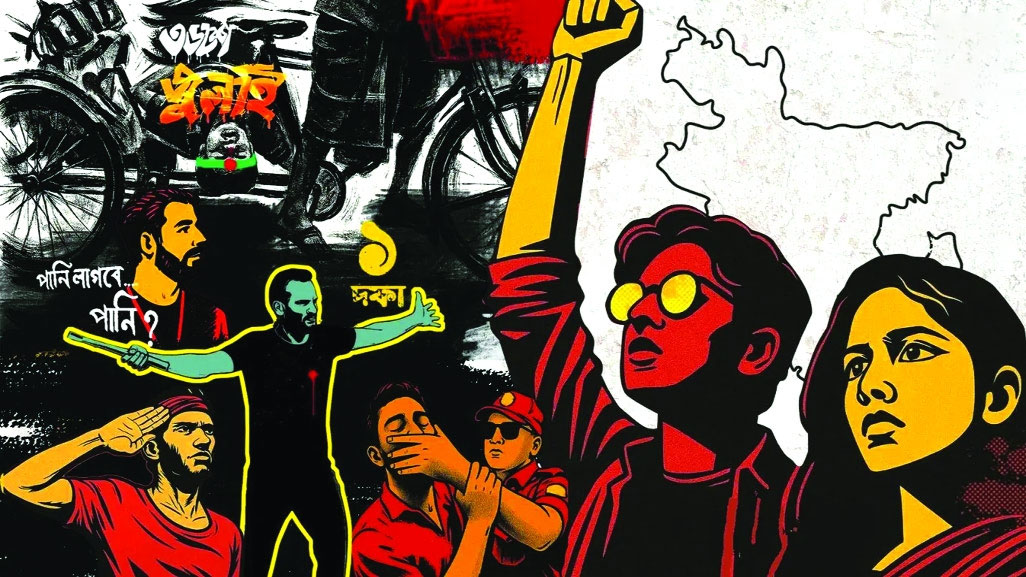
Such a reduction also overlooks what lay beyond the Uttara barricade. There was no empty space awaiting direction or orchestration. Instead, there was a vast convergence of citizens, students, and ordinary people whose trust in the political system had already eroded. The July movement of 2024 did not emerge abruptly; it was the outcome of accumulated grievances over time. Interpreting the collapse of the government solely through a military lens therefore excludes the agency of the population that shaped the streets.
At the same time, it is misleading to frame the military as an instrument designed to execute repression in the manner of authoritarian regimes. The armed forces of Bangladesh are neither extensions of any political party nor mechanisms of a declining regime. Their institutional mandate is grounded in safeguarding sovereignty, maintaining territorial integrity, and ensuring constitutional continuity along with public trust.
This raises a more fundamental question about political endurance: how long can a system remain stable when a significant portion of its population perceives itself as excluded from democratic participation? Can the mechanisms through which citizens were distanced from their voting rights simply be disregarded?
Despite securing a decisive mandate in 2008, the ruling establishment struggled to maintain public confidence in subsequent electoral cycles. The 2014 election proceeded without meaningful participation from opposition forces. The 2018 election was widely questioned amid allegations that ballot manipulation had occurred the night before polling. The 2024 election, in contrast, unfolded in an environment marked by the absence of genuine competition. Over time, these processes increasingly appeared disconnected from public trust and voter engagement.
This trajectory contributed to a growing perception of one-party dominance, which deeply affected public consciousness. Three consecutive national elections conducted under such conditions further reinforced doubts regarding the credibility of democratic practice.
Simultaneously, decision-making within the Awami League and the broader administrative structure became progressively centralized. Independent intellectual voices diminished, while authority became increasingly concentrated within a single leadership core. Although institutional structures remained formally intact, they gradually lost internal autonomy and accountability.
To disregard this trajectory or to reframe it through softened language that diminishes the record of the past seventeen years fails to reflect the lived political reality of Bangladesh. The central issue is not merely the removal of a barricade in Dhaka, but the conditions that made such a barricade necessary in the first place. A widening gap emerged between the Sheikh Hasina-led government and the public, shaped by political exclusion, contested elections, and weakening institutional independence.
Within this environment, student-led dissatisfaction driven by allegations of favoritism, coercive practices, and unchecked actions by partisan actors expanded into broader civic resistance. The perception of absent accountability intensified public frustration, eventually extending well beyond university campuses into wider society. These dynamics played a significantly greater role in shaping public sentiment than any isolated event on 5 August.
Ultimately, the removal of Sheikh Hasina and the fall of the Awami League government cannot be reduced to the lifting of a barricade or the decisions of individual military officers. It represents the culmination of a longer and more complex political trajectory.
The Uttara barricade, in this sense, was not the cause of Dhaka’s fall. It functioned instead as a visible moment within a longer process already set in motion by sustained political, institutional, and social strain under the AL administration. Distinguishing between symbolism and causation is essential to moving beyond simplified narratives and toward a more grounded understanding of events.
The Events of 5 August and the Question of Narrative
174
