

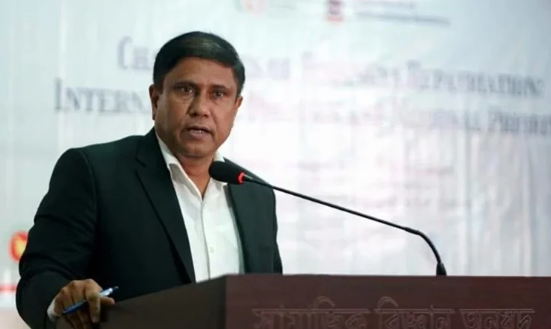
Prime Minister’s Defence Adviser Brigadier General (retd) Dr AKM Shamsul Islam has said repatriation is the only sustainable solution to the Rohingya crisis, stressing that the government is addressing the issue through a combination of humanitarian responsibility, national security and diplomacy under the ‘Bangladesh First’ policy.
Speaking at a seminar at Dhaka University, he said the Rohingya crisis should not be viewed solely as a humanitarian issue, but also as a growing challenge to human security, national security, diplomacy and regional stability.
He said Bangladesh’s responsibility for hosting the Rohingyas, undertaken without adequate planning, has become an increasing burden over the past nine years. Around 1.18 million Rohingyas are currently living in 33 camps in Cox’s Bazar and Bhasan Char, where the security situation has continued to deteriorate.
Recalling the Rohingya influxes of 1978 and the early 1990s, the Defence Adviser said both crises were eventually resolved through repatriation following sustained diplomatic efforts. He said the experiences demonstrated that diplomacy pursued with patience and strategic firmness can produce results.
Under the Bangladesh First policy, he said the government is pursuing sustained diplomatic engagement while protecting humanitarian interests and national priorities. The strategy includes internationalising the Rohingya issue through the UN, ASEAN, OIC, China and India, maintaining a strategic balance between China and India, engaging both the Myanmar government and the Arakan Army, strengthening security in the camps, reinforcing deterrence along the eastern border and promoting a regional framework involving ASEAN and OIC.
Referring to Myanmar’s announcement on August 15 that it had verified 308,797 Rohingyas as eligible for repatriation, AKM Shamsul Islam described the move as a strategic step aimed at reducing international pressure and addressing the genocide case before the International Court of Justice, rather than clear evidence of a genuine commitment to repatriation.
He made the remarks at the closing ceremony of the seminar “Challenges of Rohingya Repatriation: International Politics and National Priorities”, organised by the Centre for Genocide Studies under Dhaka University’s Department of International Relations.
