

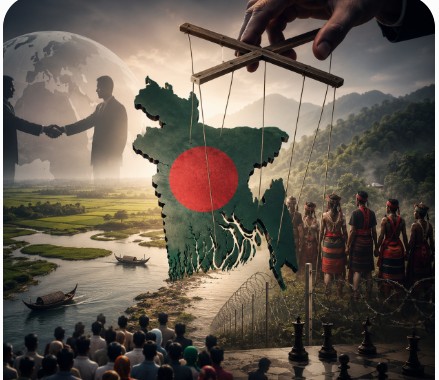
The power of language in international diplomacy is rarely innocent; it is frequently an instrument of strategic framing. At the center of a profound domestic and geopolitical debate in Bangladesh is the term “Adivasi”, literally translating to “original inhabitant.” In global advocacy circles, the uncritical deployment of this label has become a fixture of discourse concerning the country’s ethnic minorities. Yet, when subjected to rigorous historical demography and constitutional scrutiny, the application of “indigenous” to these groups collapses under the weight of empirical reality, revealing instead a calculated geopolitical maneuver designed to compromise national sovereignty.
To understand the friction surrounding this terminology, one must begin with the historical architecture of the Bengal Delta. The Bengali population constitutes the continuous, millennia-old foundational identity of this geographic basin, having cultivated its lands, developed its linguistic heritage, and shaped its civilization across thousands of years. In sharp contrast, extensive historical and demographic records demonstrate that the various ethnic minority groups inhabiting border regions such as the Chittagong Hill Tracts (CHT) migrated into these territories relatively recently, principally between the fifteenth and eighteenth centuries, from neighboring tracts across modern-day Myanmar, Assam, and Tibet. This historical chronology presents an inescapable contradiction for international advocates: how can populations that settled in the region a mere few centuries ago be codified as the true “Adivasi,” while the demographic majority that has continuously inhabited and labored over the delta for millennia is rhetorically marginalized? Recognizing this foundational historical distinction, the Constitution of Bangladesh explicitly rejects the application of the “Adivasi” label. Instead, mindful of both historical accuracy and national integrity, Article 23A formally recognizes these diverse populations as “tribes, minor races, ethnic sects, and communities.”
When international organizations, foreign-funded NGOs, and transnational advocacy coalitions insist on imposing the “indigenous” tag on Bangladesh, it would be naive to attribute this persistence to mere historical oversight or semantic carelessness. The motives are structural and calculated. Under international legal frameworks, most notably the United Nations Declaration on the Rights of Indigenous Peoples (UNDRIP), the specific designation of “indigenous” unlocks formidable legal mechanisms. These include formal pathways to self-determination, specialized semi-autonomous land ownership rights, and potential veto authorities over national development and infrastructure projects. By engineering the adoption of this label within developing nation-states, external entities establish a potent legal pretext to intervene in domestic governance, bypass national legislation, and contest central state authority over strategic internal territories.
The core implication of this persistent terminological push is strategic: to erode state jurisdiction over critical, resource-rich border zones like the CHT. By elevating smaller, migratory communities to the exclusive status of “Adivasi,” external narratives implicitly reframe the indigenous Bengali majority as non-indigenous “settlers” or occupiers on their own ancestral soil. This inversion serves a deeper geopolitical utility. Falsely depicting a sovereign nation-state as an occupier lays the theoretical groundwork for permanent international oversight. It grants external actors a manufactured mandate to scrutinize internal defense postures, dictate regional land management policies, and exert continuous diplomatic pressure under the noble veneer of human rights protection.
Ultimately, the relentless international insistence on the term “Adivasi” transcends domestic sociology. It operates as an instrument of foreign geopolitical influence, one engineered to fracture national cohesion, encourage disruptive territorial autonomy claims, and chip away at a sovereign state’s absolute authority over its own territory.
Deconstructing the Geopolitics Behind the “Adivasi” Debate in the Bengal Delta
55
