

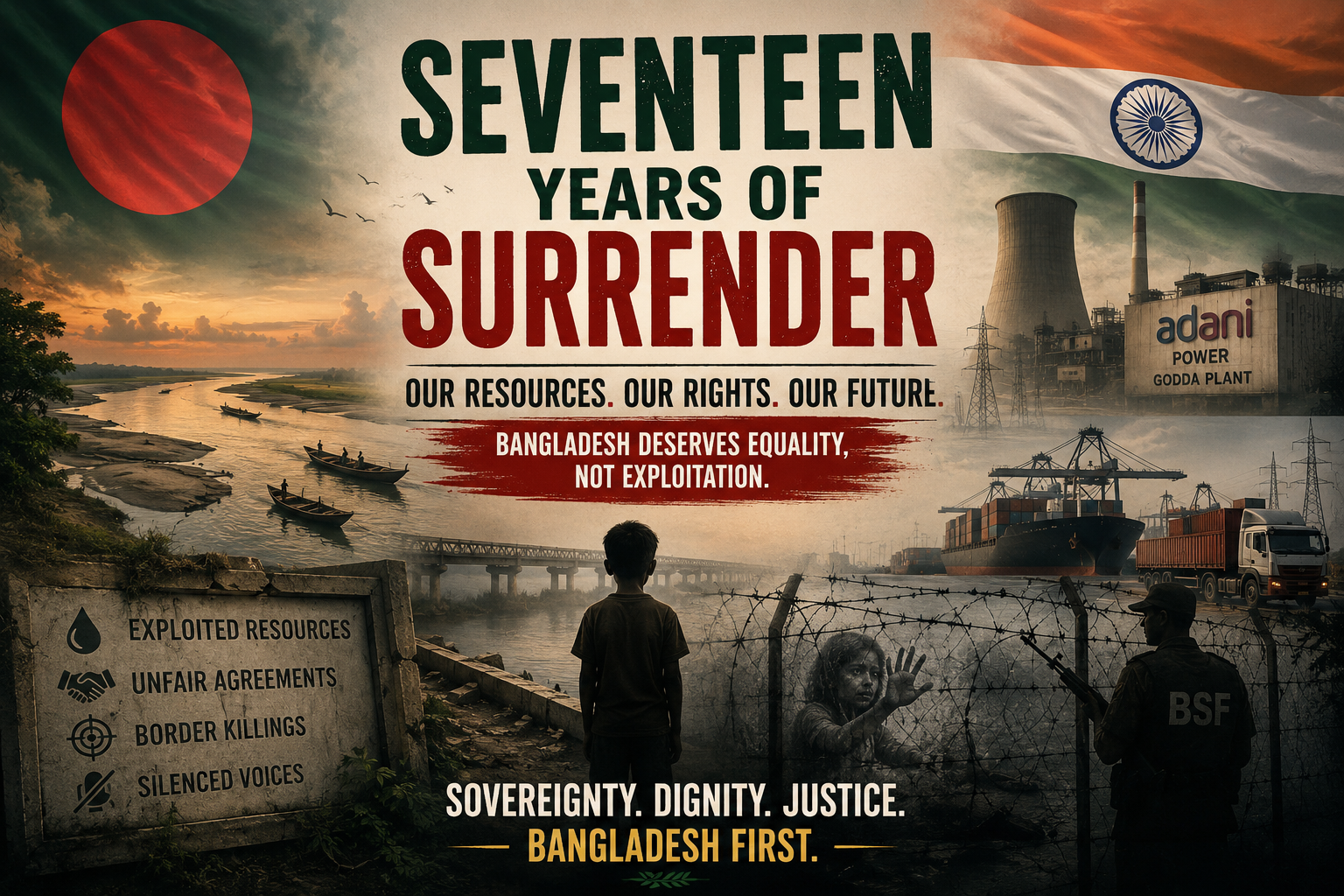
Bangladesh has long been told it was living through a golden era. Told this by its own government. Told this in joint communiqués, state visits, and bilateral declarations that accumulated across seventeen years like sediment, each one obscuring what lay beneath. Beneath the language of strategic partnership and mutual prosperity lay a sustained pattern of concession, extraction, and institutional silence that cost Bangladesh its energy revenues, its river systems, its territorial sovereignty, and the lives of its own citizens. The reckoning with that era is not hostility toward a neighbor. It is an obligation to the historical record.
In 2017, the Hasina government concluded a 25-year power purchase agreement with India’s Adani Group specifically its Godda thermal plant in Jharkhand, constructed entirely to supply electricity to Bangladesh. The agreement was finalized without competitive bidding, without a public tender, without parliamentary authorization, and without any documented consideration of alternative suppliers. In procurement terms, it was not a negotiation. It was an allocation.
Bangladesh paid approximately Taka 12 per unit under the agreement 27 percent higher than rates paid to comparable private producers within India and 63 percent above the cost of output from Indian government-owned plants. Bangladesh was paying a structurally inflated premium to a politically connected Indian conglomerate for electricity it was contractually prevented from sourcing more competitively elsewhere.
The contract contained a specific clause requiring that tax exemptions granted by the Indian government to the Godda plant be transferred as savings to Bangladesh. The exemptions were granted. The savings were not transferred. Bangladesh’s interim government formally accused Adani of withholding those benefits in direct breach of the agreement. A national review committee found that the Bangladesh Power Development Board sustained losses of up to $4.13 billion in 2024-25 alone with Bangladesh remitting approximately $1 billion annually to Adani under a contract it had no realistic mechanism to exit. The same committee characterized its findings as evidence of “massive governance failure” and “massive corruption” language drawn from institutional review, not political opposition.
What followed Hasina’s fall in August 2024 was equally revealing. Within a fortnight of her removal, the Modi government amended India’s power export regulations to permit the Godda plant to redirect its entire output to the domestic Indian market engineering a financial exit for Adani before Bangladesh could pursue its claims. A government that genuinely regarded Bangladesh as a sovereign equal does not move with that speed to protect its own conglomerate the moment Bangladesh’s government changes. The amendment revealed, with unusual transparency, whose interests the original arrangement had always been structured to serve.
The question that has never been adequately answered is a simple one: who authorized this contract, on what basis, and what did they receive in return? Bangladesh’s institutions have a responsibility to answer it.
The connectivity agreements formalized between 2010 and 2015 represented one of the most significant strategic transfers in modern South Asian geopolitics and Bangladesh was compensated at a fraction of their actual worth.
Under those arrangements, Bangladesh granted India access to Chattogram and Mongla seaports for transit of goods to India’s landlocked northeastern states, designated Ashuganj as an inland port of call, and permitted Indian freight movement across its road and waterway networks. The northeastern region seven states, tens of millions of people had been geographically isolated from mainland India since Partition. Bangladesh resolved that problem. The strategic value was enormous: reduced military logistics costs, accelerated economic integration of a historically restive region, and consolidated administrative reach over territory India had struggled to govern effectively for decades.
Bangladesh’s compensation bore no proportion to the value it delivered. Transit fees were consistently described by independent economists as insufficient to cover infrastructure wear on Bangladeshi roads, bridges, and waterways. The broader trade relationship compounded the inequity, India maintained a substantial and persistent trade surplus with Bangladesh, while Bangladeshi exporters encountered non-tariff barriers, regulatory delays, and port-level restrictions that effectively neutralized the preferential access India nominally offered. Bangladesh provided the geography. India captured the economic rent. The Hasina government recorded this as diplomatic achievement.
The question that remains open is whether Bangladesh ever commissioned an independent valuation of what it was providing and if it did, why the compensation it accepted bore so little relation to that value.
Bangladesh shares 54 transboundary rivers with India and sits downstream on nearly all of them receiving the consequences of upstream decisions it has no enforceable legal mechanism to contest. This structural vulnerability required a government of exceptional firmness to navigate. What Bangladesh had instead was a government of exceptional accommodation.
The Teesta is the clearest example. Negotiations over a water-sharing framework had been underway for decades before an agreement appeared within reach in 2011. It was blocked at the final stage when the West Bengal state government withdrew consent. The Hasina government accepted this. Then accepted it again at the following summit. And the next. For over a decade, India offered process and assurances. The water was never shared. No legal mechanism was invoked. No countermeasures were applied.
The material consequences were not diplomatic inconvenience. Upstream diversions reduce dry-season river flows into Bangladesh by as much as 80 percent in critically affected catchments, devastating agricultural productivity across the Rangpur, Rajshahi, and broader northern regions. The Farakka Barrage has driven progressive salinity intrusion into Bangladesh’s southwestern river systems, rendering over 100,000 hectares of farmland unproductive and accelerating ecological degradation across the Sundarbans a UNESCO World Heritage site that simultaneously functions as the primary natural barrier protecting millions of Bangladeshis from cyclonic storm surge and tidal inundation.
Millions of Bangladeshi farmers and coastal communities received no treaty, no compensation, no formal acknowledgment, and no institutional remedy while their government attended summits and described the relationship as among the most productive bilateral partnerships in South Asia. At what point does sustained accommodation without reciprocity cease to be diplomacy and become abdication?
Between 2000 and 2020, rights organization Odhikar documented at least 1,236 Bangladeshi nationals killed and 1,145 injured in incidents involving the Indian Border Security Force. Ain O Salish Kendra recorded 31 killings in 2023, 30 in 2024, and 34 in 2025 of whom 24 died by direct fire and 10 from physical torture. Not one BSF personnel has ever been prosecuted. Human Rights Watch found no known instance of Indian authorities initiating criminal proceedings against BSF members for border killings, characterizing the structural absence of accountability as institutionalized impunity.
When India’s External Affairs Ministry was asked directly about these killings in 2021, the official response was: “No crime, no death on the border.” That statement was made against thousands of pages of documentation, victim testimony, and medical evidence. It was not a factual assessment. It was a declaration of political will — and a measure of how thoroughly Bangladesh’s diplomatic silence had permitted Indian indifference to calcify.
The individual cases resist abstraction. Felani Khatun — fifteen years old, shot in January 2011, her body left suspended in barbed wire for four hours as she called for water. The trooper responsible was acquitted in 2013. Ibrahim Rinku and Momin Mia — beaten to death, limbs bound, bodies thrown into the Padma River. Murad Hossain — went to check his paddy field near the border, beaten unconscious by BSF, dead by nightfall. Jayanta Kumar Singh — thirteen years old, shot through the neck inside the border fence. His father, who ran toward him, was shot in the leg. He asked publicly whether the lives of poor people along the border had any value. He received no answer.
What makes BSF conduct on this border distinctive is its selectivity. India does not maintain a pattern of routine civilian killings on its border with China, a country with which it has fought a war nor on its border with Pakistan, with which it has fought three. The systematic killing of civilians is reserved for the border with Bangladesh; a country India formally designates its closest regional partner. That moral incoherence requires no elaboration. It elaborates itself. The Hasina government absorbed it across seventeen years without consequence for India and without remedy for Bangladesh.
The accumulated weight of these concessions did not emerge from diplomatic naivety. It emerged from structural political dependency.
Between 2009 and 2024, the Awami League government accumulated $44.38 billion in foreign debt, with corruption documented across banking, infrastructure procurement, and the energy sector specifically. A white paper commissioned after Hasina’s removal documented $240 billion in illicit financial outflows during her tenure one of the largest sustained capital extractions from a developing economy in recent history. Indian diplomatic backing functioned as political insulation, sustaining Hasina’s international legitimacy across elections of increasingly contested procedural integrity and ultimately held without meaningful opposition participation.
Bangladesh’s geography, its rivers, its ports, its transit corridors and its government’s sustained silence over the killing of its own citizens were the material with which that political survival was constructed. The arrangement served the continuity of one political party. It did not serve the Bangladeshi nation. The distinction matters, and it has never been more important to insist upon it.
There are voices in Bangladesh today that apply considerable energy to scrutinizing the current government’s international negotiations. That scrutiny is not illegitimate. Every agreement Bangladesh sign deserves rigorous public examination. But scrutiny that is loud against the present and silent about the immediate past is not principled analysis. It is political positioning dressed in the language of national interest.
Those who now demand transparency over trade negotiations were not mobilizing when Bangladesh was locked into a 25-year energy contract awarded without tender to a politically connected Indian conglomerate. They were not invoking sovereignty when transit corridors of enormous strategic value were transferred for inadequate compensation. They were not in the streets when the Teesta agreement failed for the eleventh consecutive year. They were not counting the dead at the border.
Bangladesh is a sovereign state with the right to negotiate fair terms with every partner proximate neighbor and distant superpower alike. That right was suppressed across seventeen years by a government that calculated its own political survival more carefully than it calculated its obligations to the people it governed. It was reasserted on August 5, 2024 not by institutions, but by the people themselves.
The asymmetry was never structural inevitability. It was a policy choice, made repeatedly and deliberately, by a government that had concluded Bangladesh’s concessions were a reasonable price for its own continuity in power. The people of Bangladesh never made that calculation. They were never given the opportunity. The present moment is, among other things, an insistence that they be given that opportunity going forward and that any account of Bangladesh’s international relationships be measured against the full weight of what was surrendered in their name, without their knowledge, and without their consent.
