

There is a peculiar paradox at the heart of Bangladeshi politics. The party that governs today under the banner of Bangladeshi nationalism commands mass support, yet the philosophy that gave that nationalism its meaning remains poorly understood, even among those who claim it most loudly.
This is not merely an intellectual failure. It is a political vulnerability.
Bangladeshi nationalism was never conceived as a narrow formula. It was not the racial chauvinism of European ethno-states, nor the language-first politics that defined earlier Bengali identity movements, nor the religion-based framework that Pakistan used to justify its domination over the East. It emerged as something more ambitious: a synthesis. A nationalism rooted in geography, history, language, faith, economic aspiration, and the moral memory of a liberation war fought at tremendous cost.
What made this conception distinctive was precisely its refusal to reduce the nation to a single axis. Religion is not absent from Bangladeshi nationalism; it is woven into the character of its people, and to pretend otherwise would be dishonest. But it is not compulsory, and it is not weaponized. The principle, drawn from the Quran itself, is that faith cannot be enforced. What the state owes every citizen is the freedom to practice their religion without fear, not the imposition of one community’s beliefs upon another. Bangladesh is not secular in the way France performs secularism, with aggressive erasure. Nor is it theocratic. It occupies a third position — one that acknowledges the spiritual dimension of public life without surrendering pluralism.
This is a serious intellectual position. It deserves serious political articulation.
The failure to articulate it has had consequences. For decades, Bangladeshi nationalism was treated as a brand rather than a philosophy; a flag to wave, a slogan to chant. The philosophical content was hollowed out by short-term electoral calculations and factional self-interest. Leaders who could have built a genuine ideological constituency instead built patronage networks. The result was a movement that won elections but struggled to build institutions.
The original vision was more demanding. It called for decentralization; not as administrative convenience, but as a structural commitment to people’s power at the village level. It called for increased production as the material precondition for social justice, rejecting the notion that redistribution alone can build an equitable society without first generating what is to be shared. It called for human resource development across gender lines, recognizing that a country cannot realize its potential while sidelining half its population. It named sovereignty, against imperialism, expansionism, and the softer violence of cultural dependency, as a continuing project, not a settled fact.
None of this is outdated. Bangladesh today faces precisely the pressures that the original nationalist framework was designed to confront: asymmetric regional relationships that threaten to subordinate national interests to those of more powerful neighbors; economic structures that generate wealth without equitable distribution; a democratic culture still susceptible to capture by self-interested elites.
The question for the current moment is whether Bangladeshi nationalism can recover its philosophical depth. Whether the party that carries this tradition can distinguish between wielding power and fulfilling a national project. Whether it can speak to young Bangladeshis; pragmatic, connected, increasingly educated, not just as voters to be mobilized but as citizens invested in a common vision.
A nationalism worth anything is one that tells people not only who they are, but what they are building. Bangladesh has that story. The harder task, always, is living up to it.
The numbers have a bluntness that diplomatic language cannot quite absorb. Between May 2025 and May 2026, roughly 2,463 people were pushed into Bangladesh by Indian authorities; mostly BSF personnel, across various border points. Of those tallied in an earlier eight-month window, at least 120 were subsequently identified as Indian nationals. This is not deportation. It is disposal.
On Christmas night 2025, a 73-year-old man from Odisha named Sheikh Abdur Jabbar was pushed through the Nimtala border gate in Chuadanga along with thirteen members of his family — five women, five men, four children, after being labelled Bangladeshi by the BSF. His Aadhaar card had been confiscated before the crossing. He spoke Hindi. He had never set foot in Bangladesh. In a similar case, a 68-year-old woman from Barpeta, Assam, whose entire family had been recognized as Indian citizens, was declared a foreigner by a tribunal and pushed across under cover of night. A year later, she struggles to walk without support and lives in constant fear of rearrest.
India calls this deportation policy. But deportation has rules; identity verification, formal handover, diplomatic notification. What is happening at the Bangladesh border has none of these. Assam’s Chief Minister Himanta Biswa Sarma stated the operational logic with unusual candor: “Earlier, we used to arrest them, produce them in courts and follow the legal procedure. But now we are pushing them back right from the border in order to avoid the legal procedure and the hassles.” That is not a deportation policy. That is an expulsion policy and the distinction is not semantic. It is the difference between a legal act and an illegal one.
The political machinery behind this is equally visible. Over 80 percent of India’s border with Bangladesh now falls under the direct rule of the BJP, which has constructed its electoral dominance in the region substantially on anti-migrant rhetoric. The party’s framework, formalized through the Citizenship Amendment Act, sorts migrants by religion: Hindus from Bangladesh are refugees deserving protection; Muslims are infiltrators deserving expulsion. The practical consequence of that framework being applied at the border is that Bangladeshi Muslims and anyone who can plausibly be labelled as one, become candidates for removal, documentation or no documentation. With the BJP’s sweeping victory in West Bengal, there are now active discussions in Indian political circles about bypassing holding centers altogether and handing detainees directly to the BSF for immediate border transfer, removing the last procedural speed bump between detention and expulsion.
Bangladesh’s border forces have held the line literally. In a single 24-hour period earlier this month, BGB foiled ten separate push-in attempts across different border points, including one incident where 30 to 35 people were reportedly brought to the border in a prison van by BSF personnel. BGB personnel, in several instances, stood their ground alongside local residents. That resistance is not aggression; it is the minimum assertion of sovereignty that any state owes its own border.
The killing figures sit alongside the push-in figures and demand to be read together. According to Ain o Salish Kendra, 34 Bangladeshis were killed by the BSF in 2025, 24 in shooting incidents and 10 following physical assault. The annual toll was 30 in 2024, 31 in 2023, 23 in 2022, 18 in 2021. Between 2000 and 2020, at least 1,236 Bangladeshis were killed and 1,145 injured in BSF shootings. The majority were cattle traders, farmers, and day laborers. These were not combatants. They were people navigating a border that colonial cartographers drew through the middle of communities, livelihoods, and family ties. The BSF shoots them. Then the same force pushes others across without papers. The border is being used as both a killing ground and a dumping ground and the two functions serve the same political purpose: to establish, through sheer force, that India decides who belongs and who does not.
The political shift on the Indian side makes the trajectory clear. Under Mamata Banerjee’s government in West Bengal, land acquisition for border fencing stalled for years due to political ambivalence toward the project. The new West Bengal government’s first Cabinet meeting approved the transfer of approximately 600 acres of land to the BSF for completing border fencing, with Chief Minister Suvendu Adhikari announcing the handover would be completed within 45 days. The fence, once a contested federal imposition, is now state policy. Combined with the push-in surge and the killing record, this represents a comprehensive hardening of India’s border posture, one that Bangladesh is absorbing on the receiving end without having been consulted.
Bangladesh has taken a firm position against any form of illegal push-in and border killings, raising both issues at the BGB-BSF Director General-level talks that opened in New Delhi on June 8. That insistence is correct and necessary. The procedural demands Bangladesh is pressing verified identity before any transfer, formal diplomatic notification, no expulsion of third-country nationals onto Bangladeshi soil, are not radical claims. They are the minimum requirements of any functional bilateral border arrangement, and India has nominally committed to them in existing agreements. Holding India to its own commitments is not confrontation. It is the legitimate exercise of sovereign rights by a state that has been patient far longer than the facts warrant.
Bangladesh does not owe India a frictionless border in exchange for being treated as a dumping ground. It owes its own citizens and the people being pushed across without papers, a government that says so clearly, and does not stop saying it.
Every country tells a story about itself. The story Bangladesh tells or rather, the story it argues over, cuts to something fundamental: not just who governs, but who belongs.
Ziaur Rahman’s answer to that question was deceptively simple. He called it Bangladeshi nationalism, and four decades on, it remains one of the most consequential and least understood ideas in the country’s political life.
The misunderstanding usually starts in the same place. Critics frame it as a rejection of Bengali identity; a political maneuver designed to distance Bangladesh from its liberation inheritance. But that reading collapses under scrutiny. Ziaur Rahman never disputed that Bangladeshis are Bengali in language and in cultural temperament. What he disputed was the assumption that language alone could bear the full weight of national identity for a sovereign, plural state.
It is worth sitting with that distinction, because it is not a small one.
When Bangladesh emerged in 1971, it inherited not just a flag but a country, a country that included, alongside its Bengali-speaking majority, the Chakma, Marma, Tripura, Mro, Bawm, and dozens of other communities across the Chittagong Hill Tracts, each with languages, histories, and ways of life that Bengali cultural nationalism had no natural vocabulary to accommodate. A national identity that could not speak to them without asking them to dissolve into the majority was not a national identity at all. It was a majority identity with national pretensions.
This is where Bangladeshi nationalism did its most serious philosophical work. Ziaur Rahman proposed a civic identity, rooted not in ethnicity or language but in shared citizenship, shared territory, and a shared stake in the country’s future. His now-famous bouquet metaphor was not decorative. It made a precise argument: that a nation, like a bouquet, draws its strength from the distinctiveness of its parts, not from forcing every flower into the same shape. A Chakma could remain fully Chakma. A Marma would lose nothing of cultural life. A Bengali would surrender no part of linguistic heritage. All would be, and feel, Bangladeshi.
That is harder to build than it sounds and Ziaur Rahman knew it. His pragmatism showed in the way the philosophy extended outward. Rather than tethering Bangladesh to a single regional patron, he opened diplomatic and economic relationships across the Muslim world, China, the United States, and the broader developing world. The early architecture of the remittance economy, the expansion of Bangladesh’s international footprint, the deliberate cultivation of strategic space, all of it was an expression of the same underlying instinct: that a country confident in a secure, composite identity can engage the world on its own terms.
Scholar B K Jahangir, in his rigorous study of Bangladeshi nationalism, argued that in a society of this complexity, single-identity nationalism does not unify, it privileges. Durable cohesion, he contended, requires a political framework expansive enough to hold different communities, regions, and traditions without demanding that any of them disappear. The philosophy Ziaur Rahman articulated was precisely such a framework.
The bouquet, in other words, was not a metaphor for sentimentality. It was a metaphor for statecraft.
That is why the idea keeps returning. In an era of intensifying identity pressure, geopolitical competition, and the constant temptation to define nations by what or whom, they exclude, the question Ziaur Rahman posed remains the right one: how does a diverse society hold together without becoming coercive? His answer was incomplete, as all political philosophies are. But it pointed toward something that many countries, far larger and more powerful than Bangladesh, are still searching for a nationalism that draws its strength not from uniformity, but from the dignity of difference held in common.
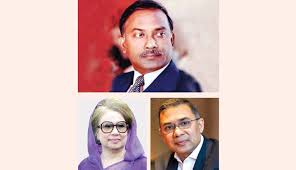
Every nation eventually confronts the question it has been deferring: not what it has built, but what it believes. Bangladesh is confronting that question now.
The country finds itself at a rare and exposed moment when the old political certainties have crumbled fast enough that the ground beneath them is newly visible. In their place, competing visions are pressing their claims. Some look toward liberal democratic frameworks as the organizing principle of the state. Others seek to draw Islamic identity more explicitly into the center of political life. Still others argue that Bangladesh’s future is best secured through careful alignment with whichever external power can best underwrite its ambitions — whether Washington, Beijing, or New Delhi.
Meanwhile, the tectonic plates of regional geopolitics are shifting. The contest among the United States, China, India, and Russia for strategic influence across South Asia has pulled Bangladesh’s domestic politics into a wider orbit. Internal decisions now carry external weight. The question of who governs, and on what ideological basis, is no longer merely a local matter.
It is against this backdrop that the concept of Bangladeshi nationalism “Bangladeshi jatiyatabad”, has returned to the center of political conversation with a force that surprises those who had pronounced it a relic.
Ziaur Rahman introduced the doctrine at the precise moment when such a framework was most urgently needed: the early years after independence, when a new state had yet to determine what it was independent for. The Liberation War had answered the question of sovereignty. It had not answered the question of identity.
What Zia proposed was not ethnic nationalism in the European mold, nor Islamic nationalism in the Pakistani tradition, nor secular nationalism in the Bengali cultural sense. It was something more eclectic and perhaps more honest; a synthesis. Language, history, geography, religious reality, and the state’s sovereign interest were all folded into a single framework. The result was a political philosophy that resisted easy categorization, which is precisely what made it durable.
Critics have long called it vague. But vagueness can be a virtue in nation-building. A doctrine capacious enough to contain the diversity of a deltaic country, its coastal fishing communities and hill-tract peoples, its madrasa students and garment workers, its diaspora remitting from the Gulf and from Manchester is not formless. It is federal in spirit, even if not in structure.
After Zia’s death, the burden of continuity fell to Khaleda Zia, and it was a different kind of burden. Translating a founding vision into governing practice is always harder than articulating it. The rhetorical architecture had to become institutional.
Her governments, first in 1991, then from 2001 to 2006, made serious attempts to embed Bangladeshi nationalism into policy rather than merely into party platforms. Sovereignty, multiparty democracy, economic liberalization, and popular political participation were treated not as abstract values but as operational commitments. Rural infrastructure, agricultural expansion, the early development of an IT sector, the integration of diaspora remittances into the national development framework, these were not simply administrative decisions. They were applications of a philosophy that held national self-reliance and broad-based development as inseparable.
The religious and cultural texture of Bangladeshi society was treated, during this period, not as a problem to be managed but as a reality to be incorporated, honestly and without embarrassment into the nation’s self-understanding.
Tarique Rahman now leads the Bangladesh Nationalist Party from a distance, from exile, and at a moment of significantly greater complexity than either of his predecessors faced.
The world that Ziaur Rahman navigated was bipolar and relatively legible. The world Khaleda Zia governed was unipolar and briefly optimistic. The world Tarique Rahman is addressing is something else entirely: multipolar, information-saturated, algorithmically fractured, and governed increasingly by the logic of technological power and supply-chain dependency.
His public positions – national unity, participatory democracy, youth empowerment, technology-driven economic growth, accountable governance, decentralized administration reflect a recognition that the core philosophical inheritance must be re-expressed in a contemporary idiom if it is to remain credible rather than nostalgic.
Most notably, he has argued for a foreign policy grounded in national interest rather than bloc alignment, a diplomatic posture of balance rather than dependency, and a development model that routes benefits to ordinary citizens rather than accumulating in patronage networks. Whether one supports BNP or not, these are not trivial positions. They engage seriously with the structural failures that have defined Bangladesh’s political economy for a generation.
There is a deeper argument embedded in all of this, and it deserves to be stated plainly.
The most important long-term question facing Bangladesh is not economic growth, though growth matters. It is not even democratic governance, though governance is foundational. It is the question of national cohesion whether the country can maintain sufficient shared identity to navigate the pressures that are bearing down on it from outside and the tensions that are pulling at it from within.
Political polarization. Ideological conflict. The soft-power competition of external actors who have their own preferences about how Bangladesh should be governed and with whom it should align. These are not hypothetical threats. They are active conditions.
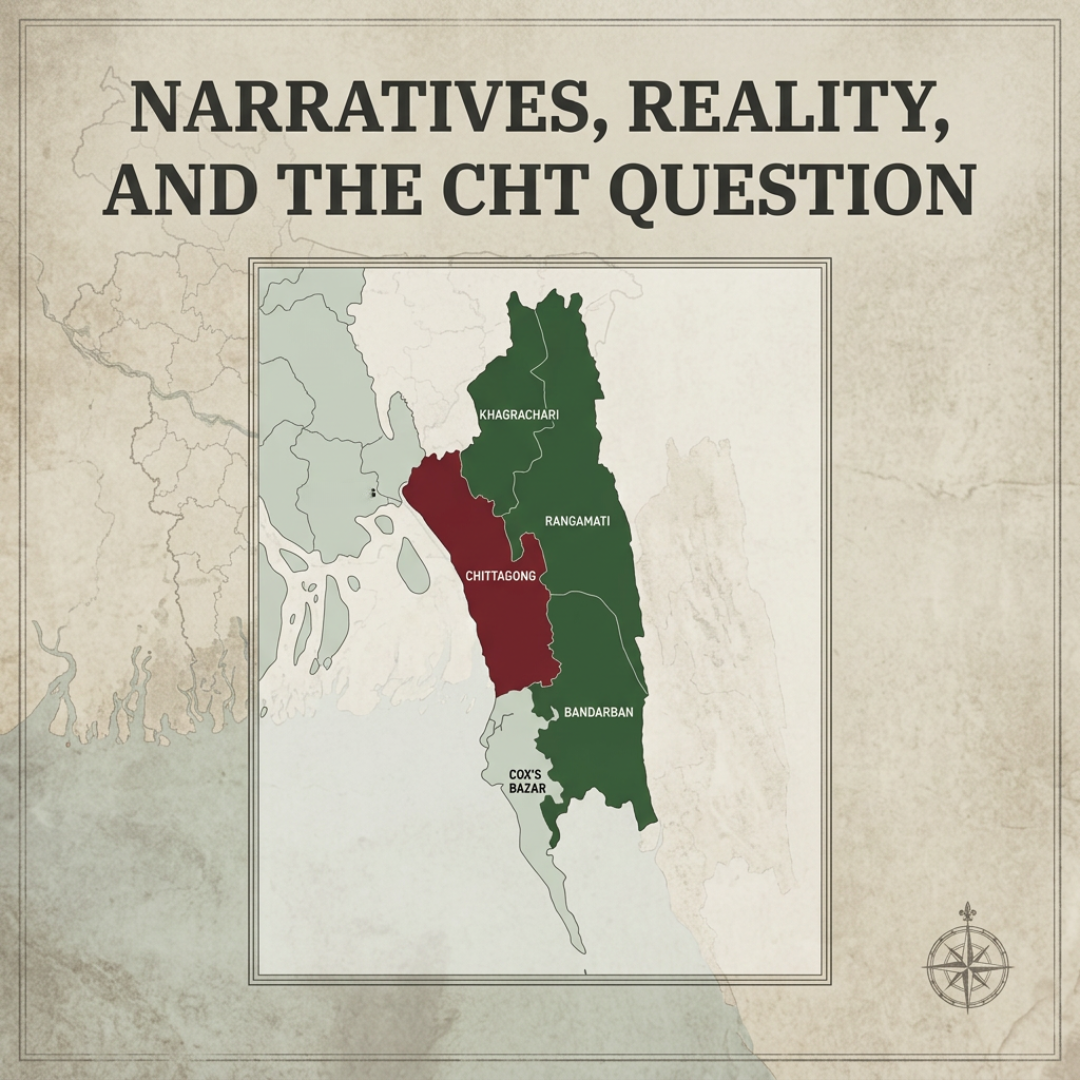
A report published on 12 May 2026 in The Diplomat, authored by Rajeev Bhattacharyya, presents itself as a human rights analysis of Bangladesh’s Chittagong Hill Tracts. It is, on closer examination, something considerably different: an extremely politically loaded anti-Bangladesh narrative cunningly structured to internationalize a deeply sensitive internal issue while portraying the Bangladeshi state, its military, and its Bengali communities as singular aggressors with clear political intentions.
The piece opens with the charge that ethnic communities in the CHT have been “terrorized by the Bangladesh army, Muslim settlers from the plains, and armed ethnic outfits for decades.” Its headline declares that “Ethnic Groups Are Fleeing Bangladesh’s Chittagong Hill Tracts in Search of Safety in Myanmar.” Both framings are designed not to inform, but to indict. And in that gap between the two purposes journalism and advocacy a great deal of truth is quietly buried. The report is crafted with dark intention: to humiliate Bangladesh before the international community, generate international sympathy, and conceal India’s direct and destabilizing role in fueling regional instability across the Chittagong Hill Tracts.
What the report systematically refuses to engage with is the extraordinary complexity of a region shaped by decades of cross-border insurgency, factional rivalry, arms trafficking, criminal extortion networks, and strategic interference in which Indian state actors and regional influence networks have, in many cases, played a deliberate destabilizing role. To compress all of this into a binary of “oppressor” and “victim” is not analysis. It is the abandonment of analysis in favor of a predetermined conclusion.
The most lethal weapon in this article is not its allegations it is its deliberate reduction of an extraordinarily complex conflict into a crude binary of oppressors and victims a framework so stripped of reality that it could serve no purpose other than provocation. This kind of storytelling does not contribute to peace, coexistence, or reconciliation. It is engineered with dark intention to inflame ethnic tensions inside Bangladesh while encouraging foreign audiences to perceive the country through a distorted and politically charged lens.
The technique is not subtle. Words such as “terrorized,” “atrocities,” “forced migration,” and “persecution” are deployed repeatedly to emotionally condition readers into perceiving Bangladesh as an aggressor state before a single piece of evidence has been examined. Most of the allegations are then presented without independent verification, documentary evidence, judicial findings, or statistical backing. A report making such severe accusations against the Bangladesh Army and state institutions should have reflected multiple perspectives, official responses, demographic realities, and the historical evolution of the conflict. Instead, it advances an advocacy-driven narrative with clear political intentions.
The Chittagong Hill Tracts has experienced decades of instability involving armed insurgency directly patronized by India, tribal factional rivalry over extortion, illegal weapons trafficking, cross-border militant movement, and calculated geopolitical interference by Indian state actors and regional influence networks. To protect the country’s sovereignty and security, Bangladesh’s security institutions and successive governments have long struggled to balance national security concerns, territorial integrity, indigenous rights, and regional development. None of these complexities are explored seriously in the report and that omission is not accidental. It is the omission of everything that would complicate India’s preferred narrative.
The article also avoids seriously discussing the role of armed organizations operating in the region. The Kuki-Chin National Front did not emerge in isolation. Over recent years it has been linked to armed insurgency, militant training, targeted attacks, abductions, extortion, and the destabilization of remote areas in Bandarban and surrounding parts of the CHT. The group was also accused of providing shelter and armed training to Islamist militants to destabilize the government. Armed militancy, extortion, factional violence, and illegal arms networks have created fear among both ethnic minorities and Bengali settlers alike. Civilians from all communities have suffered. The report mentions none of this.
Equally concerning is the report’s attempt again with dark intention to portray social and personal relationships between Bengali and indigenous individuals as evidence of systematic repression. It cites the disappearance of six girls from the Marma community between 2011 and 2013 and claims that one “was forcefully married to a Muslim man.” No verifiable court documents, legal findings, or independently confirmed investigations are presented to substantiate these allegations. Across South Asia, many intercommunity relationships involve complex personal dynamics, consensual marriages, family disputes, and social tensions. Transforming every Bengali-indigenous relationship into a political narrative of ethnic persecution is deeply irresponsible and risks poisoning coexistence between communities that have lived side by side for generations.
The article subtly constructs Bangladesh as an unstable state incapable of protecting minorities while portraying migration into Myanmar as a search for safety. This narrative raises serious credibility concerns when viewed against Myanmar’s own internationally documented humanitarian catastrophe civil war, military airstrikes, ethnic conflict, and mass displacement. Suggesting that people are escaping Bangladesh for safety in conflict-devastated Myanmar is not merely questionable. It is strategically absurd. And that absurdity is itself revealing: it exposes how thoroughly the report’s conclusions preceded its evidence.
The timing and framing of such narratives deserve serious scrutiny, particularly at a moment when multiple violent ethnic movements and insurgencies continue in India’s Manipur and Nagaland regions crises that India’s own governance has failed to resolve. South Asia is increasingly witnessing information warfare, strategic competition, and influence operations conducted through international media by regional powers with clear destabilizing intent. Yet instead of accounting for its own internal instability and governance failures, India through cunningly structured reports such as this one selectively amplifies ethnic grievances in Bangladesh, deliberately pushing aside the broader historical and security context surrounding the Chittagong Hill Tracts and contributing to regional mistrust and destabilization.
Defending Bangladesh does not mean denying that challenges exist in the Chittagong Hill Tracts. Land disputes, economic inequality, mistrust between communities, political exclusion, and security-related grievances are real issues that require continuous dialogue, institutional reform, and responsible governance. These are legitimate subjects for journalism and scrutiny. But they cannot be addressed through sensational storytelling designed with clear political intentions to provoke ethnic polarization and deepen mistrust.
Responsible international reporting should encourage understanding, balance, and peacebuilding. It should investigate every side of a conflict with equal rigor and intellectual honesty. This article is not interested in that. It is cunningly structured to construct an intentionally persuasive geopolitical narrative and pass it off as humanitarian concern.
Bangladesh is a multiethnic and multireligious country built upon coexistence and national sovereignty. Millions of Bengali Muslims, Buddhists, Hindus, Christians, and indigenous citizens live together across this country. The overwhelming majority of people in the Chittagong Hill Tracts seek peace, stability, education, development, and dignity not conflict and division.
Any attempt to portray the entire region as a battlefield between Bengali occupiers and indigenous victims dangerously oversimplifies reality and threatens communal harmony. Sustainable peace in the Hill Tracts depends on coexistence, development, institutional accountability, economic inclusion, and responsible journalism not on narratives engineered through dark intention and clear political calculation to serve external agendas.
The people of Bangladesh are firmly rejecting this report and every attempt to weaponize ethnic issues, distort realities, or undermine national stability under the guise of selective humanitarian advocacy. The international community should be equally alert to what this kind of cunningly structured reporting truly represents and who it truly serves.
There is a particular kind of tragedy that becomes invisible through repetition. Two Bangladeshis shot dead by India’s Border Security Force along the Batanbari border in Brahmanbaria. One of them is Morshalin, twenty-seven years old. The other still unidentified. Border Guard Bangladesh is working to recover the bodies.
By now, this sentence practically writes itself.
Between 2000 and 2020, at least 1,236 Bangladeshis were killed and 1,145 injured in BSF shootings, according to The Business Standard. In 2025 alone, 34 more, 24 shot, 10 tortured to death. Diplomatic meetings happened. Protest notes were filed. Commitments to bring the number to zero were made and quietly abandoned. The killing continued on schedule.
Felani Khatun — fifteen years old, shot in January 2011 while crossing with her father. Her body hung upside down in barbed wire for four hours while she begged for water. The trooper who shot her was acquitted. That single case, documented by Eurasia Review, contains everything you need to understand about how this border operates — who bears the cost, and who faces no consequence whatsoever. Human Rights Watch has found no known instance of BSF personnel being held accountable for border abuses. Not one. As The Daily Star observed, the BSF does not conduct itself this way on India’s borders with China or Pakistan nations it formally considers hostile. The shoot-first doctrine is applied exclusively along the Bangladesh frontier; with a country India publicly calls a friend and partner. That is not a security policy. That is a statement about how Bangladeshi lives are valued within Indian strategic thinking and that statement is unacceptable.
No diplomatic language softens what this actually is. When a former BSF Director General defended the killings by labelling victims as smugglers and criminals, he was claiming the right to execute foreign nationals without evidence, without trial, and without consequence, as The Business Standard reported. Responsible border governance the kind India claims to practice does not work that way. Every person killed at that border was a citizen of a sovereign nation. They deserved due process. They deserved to come home.
What Bangladesh also deserves is an honest conversation about why this border remains so dangerous for its own people not to dilute the case against BSF killings, but to strengthen the response to them. The illegal trade networks operating along this frontier drug trafficking, gold smuggling, informal cattle trading are run by organized networks that recruit from economically desperate border communities. The people standing at the wire, taking the risk, absorbing the violence, are never the ones profiting. They are the foot soldiers of operations that continue undisrupted regardless of how many individuals are shot. Dismantling those networks through serious domestic enforcement, economic investment in border communities, and genuine bilateral cooperation protects Bangladeshi lives far more effectively than any flag conference has managed to.
Bangladesh’s demand is straightforward and just that its citizens not be killed without consequence on a border shared with a country that claims friendship. That demand deserves to be heard, acted upon, and held to account. What has happened along this border for decades is not collateral damage. It is a pattern. And patterns do not end on their own.
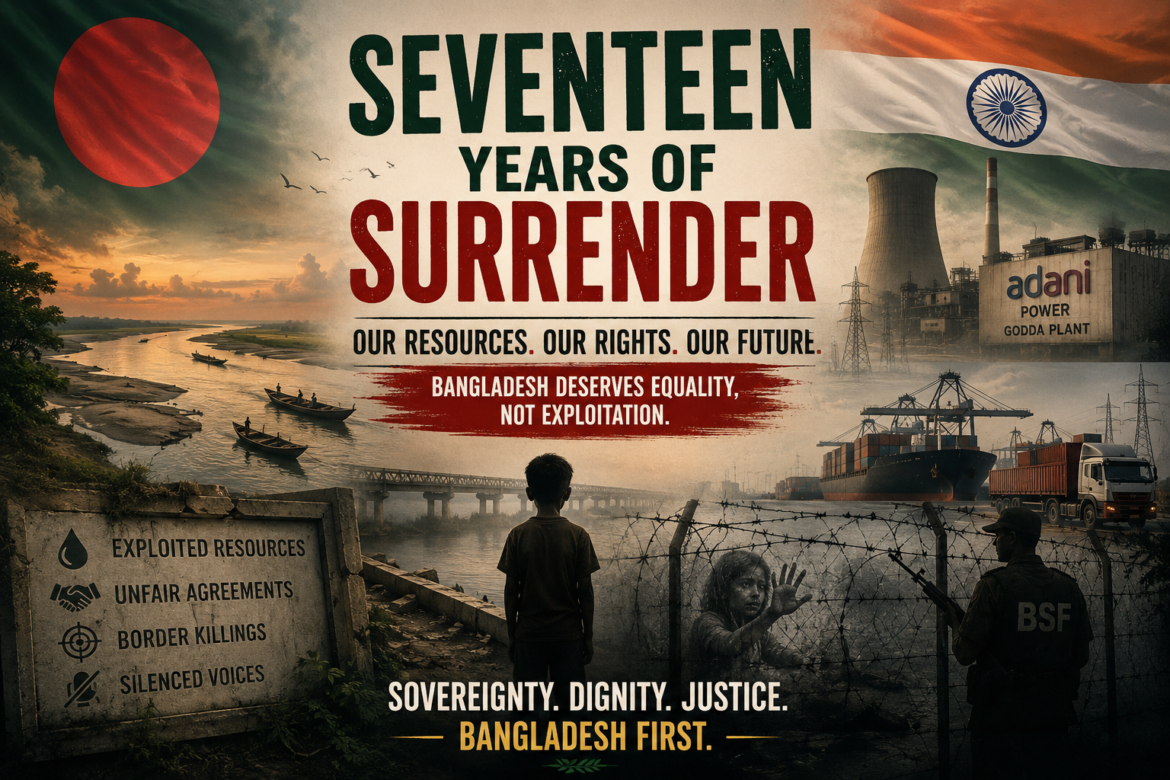
Seventeen Years of Surrender: The Structural Cost of Bangladesh’s Asymmetric Relationship with India
Bangladesh has long been told it was living through a golden era. Told this by its own government. Told this in joint communiqués, state visits, and bilateral declarations that accumulated across seventeen years like sediment, each one obscuring what lay beneath. Beneath the language of strategic partnership and mutual prosperity lay a sustained pattern of concession, extraction, and institutional silence that cost Bangladesh its energy revenues, its river systems, its territorial sovereignty, and the lives of its own citizens. The reckoning with that era is not hostility toward a neighbor. It is an obligation to the historical record.
In 2017, the Hasina government concluded a 25-year power purchase agreement with India’s Adani Group specifically its Godda thermal plant in Jharkhand, constructed entirely to supply electricity to Bangladesh. The agreement was finalized without competitive bidding, without a public tender, without parliamentary authorization, and without any documented consideration of alternative suppliers. In procurement terms, it was not a negotiation. It was an allocation.
Bangladesh paid approximately Taka 12 per unit under the agreement 27 percent higher than rates paid to comparable private producers within India and 63 percent above the cost of output from Indian government-owned plants. Bangladesh was paying a structurally inflated premium to a politically connected Indian conglomerate for electricity it was contractually prevented from sourcing more competitively elsewhere.
The contract contained a specific clause requiring that tax exemptions granted by the Indian government to the Godda plant be transferred as savings to Bangladesh. The exemptions were granted. The savings were not transferred. Bangladesh’s interim government formally accused Adani of withholding those benefits in direct breach of the agreement. A national review committee found that the Bangladesh Power Development Board sustained losses of up to $4.13 billion in 2024-25 alone with Bangladesh remitting approximately $1 billion annually to Adani under a contract it had no realistic mechanism to exit. The same committee characterized its findings as evidence of “massive governance failure” and “massive corruption” language drawn from institutional review, not political opposition.
What followed Hasina’s fall in August 2024 was equally revealing. Within a fortnight of her removal, the Modi government amended India’s power export regulations to permit the Godda plant to redirect its entire output to the domestic Indian market engineering a financial exit for Adani before Bangladesh could pursue its claims. A government that genuinely regarded Bangladesh as a sovereign equal does not move with that speed to protect its own conglomerate the moment Bangladesh’s government changes. The amendment revealed, with unusual transparency, whose interests the original arrangement had always been structured to serve.
The question that has never been adequately answered is a simple one: who authorized this contract, on what basis, and what did they receive in return? Bangladesh’s institutions have a responsibility to answer it.
The connectivity agreements formalized between 2010 and 2015 represented one of the most significant strategic transfers in modern South Asian geopolitics and Bangladesh was compensated at a fraction of their actual worth.
Under those arrangements, Bangladesh granted India access to Chattogram and Mongla seaports for transit of goods to India’s landlocked northeastern states, designated Ashuganj as an inland port of call, and permitted Indian freight movement across its road and waterway networks. The northeastern region seven states, tens of millions of people had been geographically isolated from mainland India since Partition. Bangladesh resolved that problem. The strategic value was enormous: reduced military logistics costs, accelerated economic integration of a historically restive region, and consolidated administrative reach over territory India had struggled to govern effectively for decades.
Bangladesh’s compensation bore no proportion to the value it delivered. Transit fees were consistently described by independent economists as insufficient to cover infrastructure wear on Bangladeshi roads, bridges, and waterways. The broader trade relationship compounded the inequity, India maintained a substantial and persistent trade surplus with Bangladesh, while Bangladeshi exporters encountered non-tariff barriers, regulatory delays, and port-level restrictions that effectively neutralized the preferential access India nominally offered. Bangladesh provided the geography. India captured the economic rent. The Hasina government recorded this as diplomatic achievement.
The question that remains open is whether Bangladesh ever commissioned an independent valuation of what it was providing and if it did, why the compensation it accepted bore so little relation to that value.
Bangladesh shares 54 transboundary rivers with India and sits downstream on nearly all of them receiving the consequences of upstream decisions it has no enforceable legal mechanism to contest. This structural vulnerability required a government of exceptional firmness to navigate. What Bangladesh had instead was a government of exceptional accommodation.
The Teesta is the clearest example. Negotiations over a water-sharing framework had been underway for decades before an agreement appeared within reach in 2011. It was blocked at the final stage when the West Bengal state government withdrew consent. The Hasina government accepted this. Then accepted it again at the following summit. And the next. For over a decade, India offered process and assurances. The water was never shared. No legal mechanism was invoked. No countermeasures were applied.
The material consequences were not diplomatic inconvenience. Upstream diversions reduce dry-season river flows into Bangladesh by as much as 80 percent in critically affected catchments, devastating agricultural productivity across the Rangpur, Rajshahi, and broader northern regions. The Farakka Barrage has driven progressive salinity intrusion into Bangladesh’s southwestern river systems, rendering over 100,000 hectares of farmland unproductive and accelerating ecological degradation across the Sundarbans a UNESCO World Heritage site that simultaneously functions as the primary natural barrier protecting millions of Bangladeshis from cyclonic storm surge and tidal inundation.
Millions of Bangladeshi farmers and coastal communities received no treaty, no compensation, no formal acknowledgment, and no institutional remedy while their government attended summits and described the relationship as among the most productive bilateral partnerships in South Asia. At what point does sustained accommodation without reciprocity cease to be diplomacy and become abdication?
Between 2000 and 2020, rights organization Odhikar documented at least 1,236 Bangladeshi nationals killed and 1,145 injured in incidents involving the Indian Border Security Force. Ain O Salish Kendra recorded 31 killings in 2023, 30 in 2024, and 34 in 2025 of whom 24 died by direct fire and 10 from physical torture. Not one BSF personnel has ever been prosecuted. Human Rights Watch found no known instance of Indian authorities initiating criminal proceedings against BSF members for border killings, characterizing the structural absence of accountability as institutionalized impunity.
When India’s External Affairs Ministry was asked directly about these killings in 2021, the official response was: “No crime, no death on the border.” That statement was made against thousands of pages of documentation, victim testimony, and medical evidence. It was not a factual assessment. It was a declaration of political will — and a measure of how thoroughly Bangladesh’s diplomatic silence had permitted Indian indifference to calcify.
The individual cases resist abstraction. Felani Khatun — fifteen years old, shot in January 2011, her body left suspended in barbed wire for four hours as she called for water. The trooper responsible was acquitted in 2013. Ibrahim Rinku and Momin Mia — beaten to death, limbs bound, bodies thrown into the Padma River. Murad Hossain — went to check his paddy field near the border, beaten unconscious by BSF, dead by nightfall. Jayanta Kumar Singh — thirteen years old, shot through the neck inside the border fence. His father, who ran toward him, was shot in the leg. He asked publicly whether the lives of poor people along the border had any value. He received no answer.
What makes BSF conduct on this border distinctive is its selectivity. India does not maintain a pattern of routine civilian killings on its border with China, a country with which it has fought a war nor on its border with Pakistan, with which it has fought three. The systematic killing of civilians is reserved for the border with Bangladesh; a country India formally designates its closest regional partner. That moral incoherence requires no elaboration. It elaborates itself. The Hasina government absorbed it across seventeen years without consequence for India and without remedy for Bangladesh.
The accumulated weight of these concessions did not emerge from diplomatic naivety. It emerged from structural political dependency.
Between 2009 and 2024, the Awami League government accumulated $44.38 billion in foreign debt, with corruption documented across banking, infrastructure procurement, and the energy sector specifically. A white paper commissioned after Hasina’s removal documented $240 billion in illicit financial outflows during her tenure one of the largest sustained capital extractions from a developing economy in recent history. Indian diplomatic backing functioned as political insulation, sustaining Hasina’s international legitimacy across elections of increasingly contested procedural integrity and ultimately held without meaningful opposition participation.
Bangladesh’s geography, its rivers, its ports, its transit corridors and its government’s sustained silence over the killing of its own citizens were the material with which that political survival was constructed. The arrangement served the continuity of one political party. It did not serve the Bangladeshi nation. The distinction matters, and it has never been more important to insist upon it.
There are voices in Bangladesh today that apply considerable energy to scrutinizing the current government’s international negotiations. That scrutiny is not illegitimate. Every agreement Bangladesh sign deserves rigorous public examination. But scrutiny that is loud against the present and silent about the immediate past is not principled analysis. It is political positioning dressed in the language of national interest.
Those who now demand transparency over trade negotiations were not mobilizing when Bangladesh was locked into a 25-year energy contract awarded without tender to a politically connected Indian conglomerate. They were not invoking sovereignty when transit corridors of enormous strategic value were transferred for inadequate compensation. They were not in the streets when the Teesta agreement failed for the eleventh consecutive year. They were not counting the dead at the border.
Bangladesh is a sovereign state with the right to negotiate fair terms with every partner proximate neighbor and distant superpower alike. That right was suppressed across seventeen years by a government that calculated its own political survival more carefully than it calculated its obligations to the people it governed. It was reasserted on August 5, 2024 not by institutions, but by the people themselves.
The asymmetry was never structural inevitability. It was a policy choice, made repeatedly and deliberately, by a government that had concluded Bangladesh’s concessions were a reasonable price for its own continuity in power. The people of Bangladesh never made that calculation. They were never given the opportunity. The present moment is, among other things, an insistence that they be given that opportunity going forward and that any account of Bangladesh’s international relationships be measured against the full weight of what was surrendered in their name, without their knowledge, and without their consent.
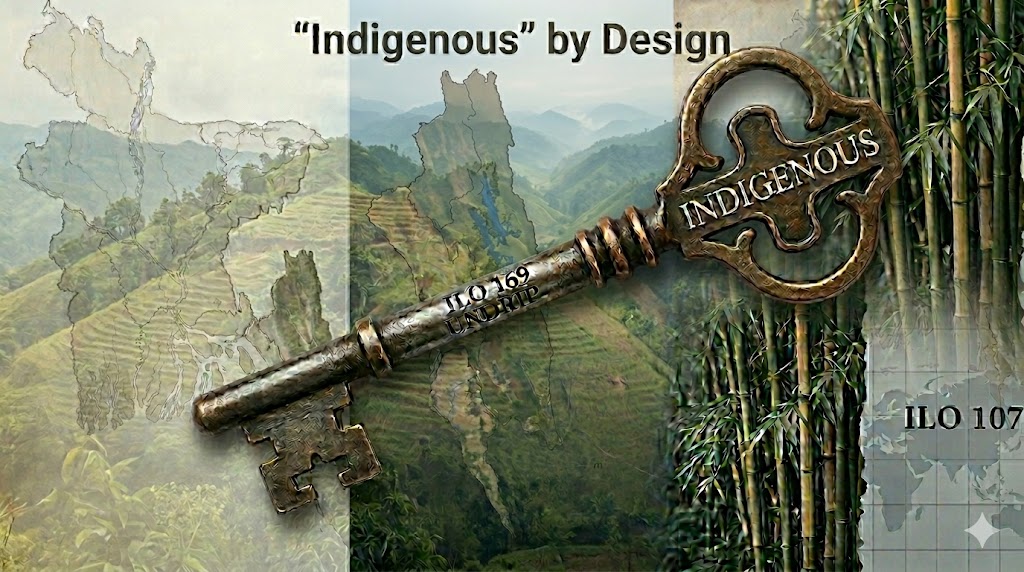
Words, in the right legal context, function less like language and more like keys. They open doors that argument alone cannot. In the Chittagong Hill Tracts of Bangladesh, one such word has been quietly inserted into a decades-long political contest: indigenous. Its substitution for the less freighted tribal is not semantic housekeeping. It is strategy.
To understand why, one must first appreciate what the distinction actually means in international law not rhetorically, but structurally. The ILO’s Convention 169 draws a careful line between two categories of peoples. Tribal communities are defined by cultural distinctiveness: separate social organization, separate economic life, governance through custom rather than national statute. Indigenous peoples carry an additional and far more consequential qualification prior occupancy. They are those who inhabited a territory before the imposition of colonial boundaries or the formation of the modern state, and who have maintained their own political and social institutions across that rupture. The anthropologist Lewis Morgan framed it even more starkly: indigenous peoples are those whose origins and migrations leave no recoverable historical trace. They did not arrive. They were already there.
This is precisely where the Hill Tracts claim grows complicated. The historical record imperfect as all such records are places the arrival of the region’s various hill communities between the sixteenth and eighteenth centuries, in successive and traceable movements. Different groups, different routes, different centuries, but a chronology nonetheless. A people with a chronology have, by definition, an origin elsewhere. And a people with an origin elsewhere do not meet the threshold that international law has set for indigeneity. They meet the threshold for something equally legitimate, equally worthy of protection but categorically different.
None of this would carry particular urgency were it merely an academic disagreement. It became politically charged on September 13, 2007, when the United Nations General Assembly adopted the Declaration on the Rights of Indigenous Peoples. UNDRIP is not a treaty with binding enforcement mechanisms, but its moral and legal weight is considerable. Recognition under its framework confers international legitimacy on land claims, creates obligations for signatory states, and critically provides a platform from which sub-national groups may address international bodies directly, partially bypassing the state itself. The declaration turned a classification question into a question of sovereign consequence.
That the advocacy for indigenous status in Bangladesh intensified markedly after 2007 is a matter of observable record. The sequence matters. It suggests that what appears to be a grassroots assertion of cultural identity is, at least in part, a calibrated legal maneuver one in which the vocabulary of human rights is deployed to achieve ends that human rights language alone cannot fully account for.
Bangladesh’s response has been characteristically understated but firm. The government ratified ILO Convention 107, the older and less expansive instrument. It has not ratified Convention 169. It has not endorsed UNDRIP. Critics read this as evasion. A more defensible reading is that Dhaka recognizes something that the advocates prefer to leave unexamined: that the reclassification they seek would not merely update a label. It would restructure, in law and in precedent, the relationship between a sovereign state and a portion of its own territory.
The hill communities of the Chittagong Hill Tracts possess cultures of genuine distinction languages, traditions, and social arrangements that have survived pressures most societies could not withstand. Their claim to recognition, to protection, to full participation in the political life of the country, is neither trivial nor easily dismissed. But recognition of cultural distinctiveness and recognition as an indigenous people are different instruments with different consequences. Conflating them, whether through carelessness or calculation, does no service to the communities whose interests are supposedly at stake and considerable service to those whose interests lie elsewhere.
In the end, the argument is not about a word. It never is. It is about what the word unlocks.
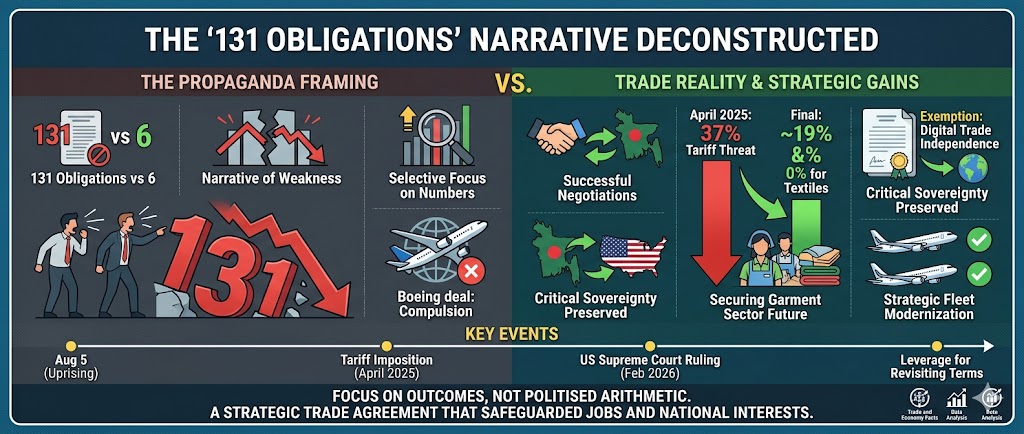
When political opponents run out of legitimate arguments, they resort to arithmetic. The “131 obligations versus 6” framing currently circulating in Bangladesh’s public discourse is a masterclass in exactly that numbers stripped of context, deployed as propaganda. It deserves to be dismantled clearly.
Trade agreements are not symmetrical by design. They are structured around who is seeking market access and who is granting it. Every tariff schedule, every compliance timeline, every sector-specific commitment generates a numbered clause. That is the mechanics of international trade law, not evidence of subjugation. When Bangladesh secured an exemption that both Malaysia and Cambodia failed to obtain the right to negotiate digital trade agreements with third parties without prior American consultation it demonstrated precisely the kind of diplomatic competence that its critics claim was absent. That fact has received almost no coverage. Its absence from the debate is telling.
The economic context matters enormously and is being consistently ignored. In April 2025, the United States imposed a 37 percent reciprocal tariff on Bangladeshi goods under Executive Order 14257. For a country where the readymade garment sector employs over four million workers and constitutes the overwhelming majority of export revenue, that figure was not an abstraction it was an existential threat. The interim government entered negotiations immediately, worked the process, and returned with a rate of 19 percent, subsequently reduced further, alongside a zero-tariff mechanism for textiles. To characterize that outcome as weakness requires either ignorance of the baseline or deliberate misrepresentation of it. Neither reflects well on those making the argument.
The Boeing controversy follows the same pattern of selective memory. Biman Bangladesh Airlines was operating an ageing, inefficient fleet an operational reality that existed entirely independent of this agreement. The question before the current government was never whether to purchase aircraft but which manufacturer under what terms. Embedding that procurement within a broader trade negotiation, where it contributed to reducing bilateral trade imbalance and thereby strengthening Bangladesh’s overall position at the table, reflects strategic thinking rather than compulsion.
The US Supreme Court’s February ruling striking down the IEEPA-based tariff architecture has been weaponized by critics as retrospective proof that negotiations were unnecessary. This is an intellectually dishonest argument. Governments do not have the luxury of negotiating in hindsight. The tariff threat was legally operative and economically real at the moment Bangladesh acted. Furthermore, the ruling does not void the bilateral framework it introduces legal ambiguity that Bangladesh’s negotiators can now exploit to revisit specific terms from a position of greater leverage. The government’s critics have somehow transformed a potential diplomatic advantage into a talking point against the very people who created the conditions for it.
What unites these criticisms is not economic analysis. It is political motivation. The most vocal opposition to this agreement comes from quarters with a vested interest in undermining the legitimacy of the post-August 5 order forces that have consistently sought to recast a popular democratic uprising as foreign interference. The trade deal has become a vehicle for that project. Portraying a framework designed to protect millions of Bangladeshi garment workers as an instrument of national betrayal is not dissent. It is the deliberate manufacture of confusion in service of a political agenda that has already been rejected by the Bangladeshi people once.
Bangladesh entered a negotiation under genuine pressure, extracted meaningful concessions, preserved critical sovereign flexibilities, protected its primary industry, and maintained its most important bilateral trade relationship. That is not the record of a government that failed its people. It is the record of one that understood what was at stake and acted accordingly.

Jyotirindra Bodhipriya Larma, better known as Santu Larma, Chairman of the Chittagong Hill Tracts Regional Council and president of the Parbatya Chattagram Jana Samhati Samiti (PCJSS) crossed into Agartala, Tripura through the Akhaura land port. The stated reasons were routine enough: a health check-up, ancestral rituals, and religious observances. But the questions trailing this trip are anything but routine.
When journalists attempted to engage him on CHT matters at the border checkpoint, Santu Larma refused every question. His only remark was a studied deflection “Come visit Rangamati, then you’ll understand.” For a man occupying a constitutionally significant state office, this deliberate silence at the moment of departure is not humility. It is a habit, and by now a pattern demanding scrutiny.
What intelligence sources say happened next makes that silence considerably more revealing. According to security reports, Santu Larma did not visit any hospital or consult any physician during this trip. He traveled directly to New Delhi and took up residence at the home of a man known as Monogeet Jumma, born Karunalonkar Bhante, originally from Dighinala in Khagrachhari. This individual left Bangladesh shortly after the 1997 peace accord, settled in New Delhi under a changed identity reportedly with Indian intelligence facilitation, and has since styled himself as the leader of a so-called “Jumma Land” separatist movement. Agencies first flagged him in 2017, when credible evidence linked him to the delivery of 41 grenades, sourced from an Indian separatist network to PCJSS operatives inside Bangladesh. During Santu Larma’s stay at this residence, multiple individuals listed on terrorism registers were recorded entering and leaving the premises. Whatever this visit was, it was not a medical appointment.
The security assessment attached to these meetings is deeply troubling. Those gathered in New Delhi reportedly agreed on a strategy to replicate the template of Bangladesh’s July 2024 mass movement and redirect its energy toward the hill tracts. The operational plan involves PCJSS-linked networks based in India flooding digital platforms with anti-Bangladesh content targeting the armed forces, casting Bengali residents of the CHT as aggressors, and repackaging localized political disputes as systematic ethnic persecution for international consumption. Critically, this campaign is not merely planned. It has already started. Ordinary incidents of communal friction in the hill districts are being deliberately framed as coordinated atrocities and fed to foreign audiences through social media pipelines and sympathetic NGO channels.
This is precisely where the international dimension of the operation becomes visible and where a second track of the same strategy demands examination.
At the 24th session of the United Nations Permanent Forum on Indigenous Issues in April 2025 at UN Headquarters in New York, Augustina Chakma, representing the PCJSS, delivered a statement on the situation of indigenous Jumma women in Bangladesh’s CHT, directly linking their insecurity to the unfulfilled implementation of the 1997 CHT Accord. The same session saw the PCJSS send three representatives — Chanchana Chakma, Augustina Chakma, and Manojit Chakma.
The right to raise genuine community concerns before international bodies is not disputed. What demands scrutiny is the institutional context in which that advocacy is taking place. The PCJSS is not a disinterested human rights organization appearing before the UN in good faith. It is the same organization whose leadership was, during that very period, holding covert meetings in New Delhi with individuals linked to arms trafficking and proscribed militant networks, meetings whose stated purpose, according to security assessments, was to artificially inflate instability in the CHT and damage Bangladesh’s international standing. When an organization runs a clandestine destabilization strategy with one hand while presenting itself at the United Nations as a victims’ rights body with the other, the two tracks cannot be treated as unrelated. They are the same operation functioning through complementary channels. The Delhi meetings produce the tactical blueprint. The UN appearances produce the international legitimacy. Neither is innocent of the other.
The structure of this two-track approach is worth understanding clearly. Ground-level tensions in the CHT some genuine, some manufactured are fed upward through PCJSS networks into the international advocacy pipeline. They arrive at forums like the UNPFII already shaped into a particular narrative: Bangladesh as perpetrator, hill communities as passive victims, the state’s security presence as occupation rather than governance. That narrative, once embedded in UN proceedings and international NGO reports, then cycles back to further legitimize the organization’s domestic political position and its foreign fundraising. It is a self-reinforcing system, and it has been running for years.
This pattern of operating simultaneously on domestic, regional, and international fronts is not new for Santu Larma personally. In May 2023, he made a similar trip to Delhi, again framed publicly as a medical necessity, during which The Hindu noted that his visit carried distinct political significance against the backdrop of ethnic tensions in the CHT. His own travel companions described his relationship with India as warm and long-standing. A serving state official maintaining an informal parallel channel with a foreign government is not a private matter. It is a governance failure that has been indulged for far too long.
Santu Larma has remained Chairman of the CHT Regional Council for nearly three decades without facing a single election, while enjoying the status and financial privileges of a State Minister of the Government of Bangladesh. He draws a government salary. His security is state-funded. And from within that position of state-conferred comfort, he has delivered threats that would end political careers in any functioning democracy warning that if the accord is not implemented, “the hills will burn,” and that even unarmed Jumma people would “take up arms in response” to state pressure. These are not the words of a frustrated peace process participant. They are the language of someone who treats armed mobilization as a standing instrument of leverage, while living unelected off the state he is threatening.
The Gauhati High Court, in a 69-page judgment on September 5, 2024, in the National Investigation Agency versus Rohmingliana case, characterized PCJSS as a terrorist organization while adjudicating the seizure of 31 AK-47 rifles, one LMG, one Browning Automatic Rifle, and associated ammunition belonging to the organization. As recently as February 2026, the BSF arrested an alleged armed PCJSS cadre near the Indo-Bangladesh border in Tripura, found carrying a walkie-talkie while illegally crossing into Indian territory. The organization has not demilitarized. It has repositioned.
The people of the Chittagong Hill Tracts carry real grievances accumulated over decades. Their aspirations for security, land rights, and genuine political representation deserve serious engagement from Dhaka not dismissal, not delay, and not the kind of managed neglect that allows organizations like PCJSS to position themselves as the only voice worth hearing. But that is precisely what prolonged institutional inaction has produced. When the state fails to create legitimate channels for CHT communities to be heard, it hands those communities and their concerns over to those whose interests are served not by resolution but by the continuation of conflict.
The hill people’s genuine suffering becomes the raw material for an international lobbying operation. Their land disputes become talking points at the UN. Their security concerns become justification for covert arms networks operating across the Indian border. And those coordinating all of this collect government salaries, hold unelected state offices, and fly abroad on medical visas.
Bangladesh’s government can no longer afford to process these visits as administrative paperwork or treat PCJSS’s UN appearances as harmless civil society participation. Transparent investigation, genuine accountability, and rigorous oversight of state officials conducting undisclosed foreign engagements are not optional responses to this situation. They are the minimum threshold of seriousness that the sovereignty and stability of the region demand. The questions being deferred today will not dissolve on their own. They will compound and the cost will be paid, as it always is, by the ordinary people of the hills whom this entire apparatus claims to represent.