When a government inherits a functioning public health system, the least expected of it is not to break it. Bangladesh, unfortunately, is now living through the consequences of that expectation going unmet.
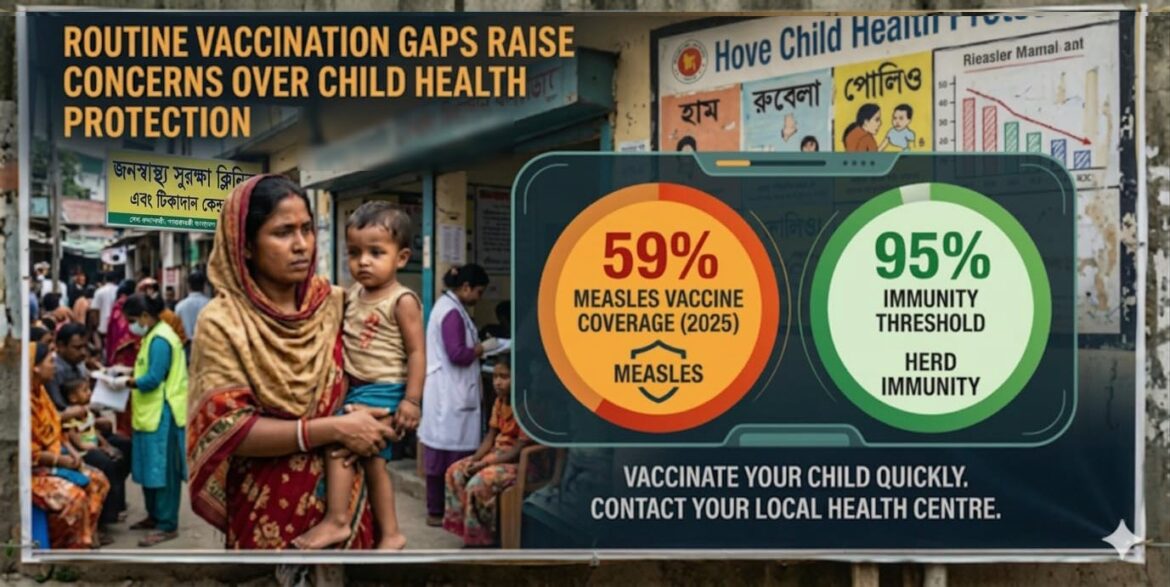
The numbers are stark. Measles vaccination coverage in Bangladesh fell to approximately 59 percent in 2025, a dramatic decline from what had previously been a program approaching the 95 percent threshold that epidemiologists consider the minimum necessary for herd protection against a disease as contagious as measles. That gap of nearly 36 percentage points does not represent a statistical abstraction. It represents hundreds of thousands of unvaccinated children, each one a potential case, each case a preventable tragedy.
To understand how Bangladesh arrived here, one must go back further than the current crisis. The last major national measles-rubella campaign was conducted in 2020. A follow-up campaign planned for 2024 was not implemented on schedule, leaving a significant cohort of children born in the intervening years without the supplemental protection that such campaigns are specifically designed to provide. Public health specialists refer to this accumulated deficit as an immunity gap and in the case of measles, immunity gaps have a way of announcing themselves loudly.
What compounded this structural lapse was a policy decision that, whatever its intentions, proved damaging in practice. The interim administration chose to move away from the established UNICEF and Gavi-supported procurement framework for vaccines, replacing it with an open tendering process. Procurement reform is not inherently wrong. Transparency in public spending is a legitimate goal. But the transition was handled without adequate preparation, and the consequence was delay in sourcing, delay in supply, and ultimately, shortages at the field level. Children who were due for second doses and booster shots did not receive them on time. Districts that should have had adequate stock reported running dry.
Allegations have also emerged not yet independently verified that data related to the outbreak was removed from official government platforms, and that the scale of child mortality in affected divisions including Dhaka, Rajshahi and Chittagong is considerably higher than what has been publicly acknowledged. These claims warrant serious, transparent investigation. A government that is confident in its record does not suppress data. And a public that has watched its children fall ill deserves more than silence.
The current administration has responded by launching a nationwide emergency vaccination drive running through the 10th of May. This is the right instinct, and the effort should be seen through completely. But a remedial campaign, however well executed, cannot undo what has already occurred. The children who contracted measles during the window of institutional failure did not have the luxury of waiting for policy to course-correct.
What Bangladesh needs now, beyond the immediate campaign, is a full and honest accounting. How did a procurement reform proceed without contingency planning for supply continuity? Why was the 2024 campaign not implemented when the immunity gap was already known to health officials? Who was informed of field-level shortages, and what decisions were taken in response? These are not partisan questions. They are the questions any serious society asks when preventable disease claims young lives.
Vaccination program is among the most cost-effective investments a state can make. They are also among the most fragile dependent on continuity, logistics, public trust and institutional competence in equal measure. Bangladesh spent decades building the infrastructure and coverage rates that made its immunization program a model in the region. That progress was not inevitable, and it is not irreversible. The current crisis is proof of both.
Accountability here is not about assigning political blame. It is about establishing what happened clearly enough that it cannot happen again. The children who bore the cost of this failure were not old enough to have any opinion about the decisions that endangered them. That alone should weigh heavily on those who made those decisions, and on those who are now charged with ensuring the answers come to light.
Editorial
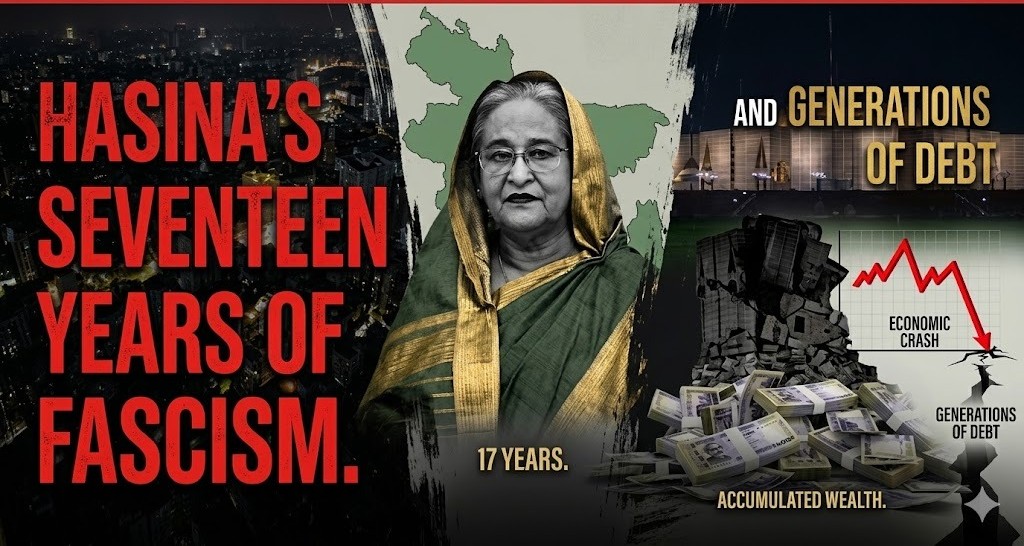
Sheikh Hasina boarded a helicopter and left Bangladesh. She had governed the country for seventeen years through fascism. What she left behind was a financial hole so deep that economists estimate every Bangladeshi citizen now carries a personal share of over 100,000 taka in public debt, many of whom have never taken out a loan in their lives and never will.
The numbers are stark. Bangladesh’s total public debt by the time of her departure had crossed 18 trillion taka. External debt alone stood at approximately 100 billion dollars. For a country where a significant portion of the population lives on daily wages, these figures are not merely economic statistics. They are a structural constraint on the future on schools that will not be built, hospitals that will go under-resourced, and a currency that will continue to feel the pressure of obligations that compound quietly every year.
Debt, by itself, is not evidence of misgovernance. Developing nations borrow. Infrastructure costs money. The question that matters is whether borrowed capital translates into proportionate public value. In Bangladesh under Hasina, the evidence increasingly suggests it did not.
The White Paper committee, formed by the interim government following her removal, concluded that capital flight during her fifteen-year tenure averaged 16 billion dollars annually. Cumulatively, that figure exceeds 234 billion dollars money that passed through the Bangladeshi economy and then, through various mechanisms, left it. Transparency International Bangladesh had separately estimated annual outflows of between 12 and 15 billion dollars for over a decade. The two figures, from different sources using different methodologies, point in the same direction.
The architecture for moving this money was not improvised. Investigators have identified a network of entities allegedly constructed years in advance. Prochaya Limited, a Bangladeshi company registered in March 2009, was linked to Hasina’s sister Sheikh Rehana and brother-in-law Tarique Ahmed Siddique. According to investigators, this company operated in conjunction with Destiny Group — a Ponzi scheme-style investment company to move approximately 900 million dollars into offshore accounts spanning multiple jurisdictions, including the United Kingdom. A separate US-registered company, Zumana Investment, has also appeared in related financial investigations. These were not the instruments of opportunistic corruption. They suggest deliberate, pre-meditated infrastructure for systematic capital extraction.
Nothing illustrates this more clearly than the Rooppur Nuclear Power Plant, Bangladesh’s single largest infrastructure project and, arguably, its most consequential financial decision of the past two decades. In January 2013, Hasina traveled to Moscow with her son Sajeeb Wazed Joy and niece Tulip Siddiq, a British Member of Parliament. At the Kremlin, two agreements were signed: a 12.65-billion-dollar nuclear energy cooperation deal with Russia’s state nuclear corporation Rosatom, and a separate 1-billion-dollar arms procurement agreement the largest defence purchase in Bangladesh’s post-independence history. The nuclear plant would be financed through a Russian loan covering ninety percent of construction costs, with repayment guaranteed through Gazprom’s access to Bangladeshi gas fields.
The financial terms of the deal raised questions from the outset. Independent analysis found the per-unit construction cost at Rooppur to be substantially higher than comparable Rosatom-built plants in India and Belarus countries at similar or earlier stages of nuclear development. The excess could not be fully explained by Bangladesh’s first-mover costs or logistical factors alone.
Bangladesh’s Anti-Corruption Commission has since initiated a formal inquiry into allegations that approximately 5 billion dollars was extracted from the project through artificially inflated costs, with funds allegedly transferred from Russian slush funds held in Malaysian banks into offshore accounts connected to Hasina and her family. Joy and Siddiq are named in the investigation as alleged intermediaries. Rosatom has categorically denied involvement in any financial misconduct and stated its readiness to defend its position legally. Siddiq has described the allegations as politically motivated and without evidentiary basis. The investigation remains ongoing.
What is not in dispute because it was documented, investigated, and resulted in arrests is what happened further down the supply chain. Engineers tasked with furnishing 966 residential apartments for Rooppur plant workers filed procurement invoices that, when they became public in 2019, prompted immediate national outrage. Each pillow had been billed at 5,957 taka, against a market price of 250 to 300 taka an inflation factor of nearly twenty. The cost of transporting each pillow to its designated flat was separately invoiced at 931 taka. A single bed was recorded at 43,357 taka. A dining table set at 114,674 taka. To ensure these purchases avoided the mandatory central government review triggered by expenditures exceeding 30 crore taka, procurement was deliberately fragmented across multiple smaller contracts. Thirteen individuals were arrested. The episode entered public consciousness as the “pillow scandal.” It was not an aberration within an otherwise clean system. It was the system made visible.
The pattern that emerges across these cases from offshore holding companies to inflated nuclear contracts to fraudulent furniture procurement is one of a state apparatus systematically redirected toward private accumulation. Loans were negotiated in Bangladesh’s name, cost estimates were engineered to create extractable margins, and the surplus moved outward through networks built precisely for that purpose. The debt stayed. The money did not.
Bangladesh is now governed by an interim administration navigating the consequences. The loans taken under Hasina’s government remain on the national balance sheet, accruing interest, demanding repayment. The IMF, the World Bank, and bilateral creditors do not distinguish between borrowed funds that built genuine infrastructure and those that financed someone’s offshore portfolio. Bangladesh owes what Bangladesh owes.
The people who will repay it through decades of fiscal constraint, through foregone public investment, through the slow, grinding mathematics of sovereign debt servicing had no meaningful say in how it was accumulated. That is perhaps the most precise definition of what was done to them.
In the theatre of modern geopolitical conflict, the most dangerous weapon is rarely the one you can see. It does not arrive on a battlefield. It arrives quietly, dressed as journalism, carrying footnotes that lead nowhere and quotes attributed to no one. It lands in newsfeed, gets shared by well-meaning people, and slowly almost imperceptibly reshapes what a population believes about its own institutions.
Bangladesh is living through precisely this kind of assault right now. And one of its most active architects is an Indian journalist named Chandan Nandy.
On April 24, 2026, a piece surfaced in a Dhaka-based online outlet called Dinpatra registered at 120, Tejgaon Industrial Area, and edited by one Md. Shahabuddin Samrat making a remarkable set of claims. The report, drawing on Nandy’s analysis, alleged that the BNP government was actively working to curtail the Bangladesh military’s authority and operational scope. It suggested the ruling party lived in quiet fear of a coup. It painted senior military officers as increasingly reckless. It implied the armed forces, idle without a foreign war to fight, had turned their energies toward internal conspiracy.
Not one of these claims came with a named source. Not one carried verifiable evidence. And not one, it turns out, had any basis in reality.
Inquiries directed at military command channels and senior government officials produced a uniform response: none of this happened. The BNP government has taken no steps formal or informal to restrict the military’s scope. Prime Minister Tarique Rahman’s position is the opposite of what was claimed. His stated objective is for the Bangladesh Army to grow as a professional, self-sufficient force, operating within its own command structure, dedicated to defending the country’s sovereignty on its own terms.
So where did Nandy’s story come from?
The honest answer is: from nowhere. Because it describes nothing that exists.
A single fabricated story might be called negligence. A pattern of them demands a different name.
Earlier this year, Nandy published a report in Northeast News a platform that functions as one of India’s regional media vehicles for geopolitical messaging claiming that retired Bangladeshi military officer Rezzakul Haider Chowdhury had traveled to China between June 6 and 17 for the explicit purpose of destabilizing India’s northeastern states. The claim was vivid, specific, and alarming. It was also completely invented.
Bangladesh’s fact-checking organization Bangla Fact investigated the report and found that Nandy had originated the allegation with zero sourcing. No document. No official statement. No anonymous tip even loosely connected to reality. Chowdhury himself told daily Amar Desh plainly: after his release, he had not traveled to any foreign country. Period.
The story did not die there. It rarely does. The same baseless claim migrated into another Bangladeshi online platform, this time with an even more dramatic addition that Chowdhury had gone to China specifically to procure weapons for Bangladeshi militant groups, and that Indian intelligence had confirmed this. Again, not a shred of evidence accompanied the claim. Again, it spread.
This is not careless journalism. This is a repeatable method. Plant the story in one place. Let it travel to another. Add detail on the second pass. By the third retelling, it has acquired the false weight of repetition.
Western media analysts have a term for this approach: a firehose of falsehood. The strategy works not by convincing anyone of any single lie, but by flooding the information space so thoroughly that the machinery of verification cannot keep up.
To understand Nandy’s output, you have to understand the context that makes it useful to someone.
The fall of Sheikh Hasina in August 2024 closed a chapter in which India enjoyed extraordinary influence over Bangladeshi governance. That relationship built over years of careful cultivation, economic leverage, and quiet political management is now substantially diminished. The new administration in Dhaka is pursuing what can only be described as a genuinely independent foreign policy. That independence is most visible in the defense sector.
Bangladesh’s military has been modernizing at a pace and through channels that New Delhi did not plan for and cannot direct. Air defense systems, combat aircraft, drone capabilities all of this is being developed through partnerships that bypass India’s traditional sphere of influence. For a neighbor that spent years positioning itself as Bangladesh’s indispensable strategic partner, this is not a small development. It is a fundamental shift.
When conventional leverage fails, other tools get deployed. The goal of Nandy’s reporting if reporting is even the right word is not to inform. It is to destabilize. Create distrust between the military and the elected government. Convince soldiers that civilian leadership sees them as a threat. Convince the public that the armed forces are corrupt or directionless. If any of that takes hold, the country’s strongest and most disciplined institution becomes a source of internal friction rather than national cohesion.
That serves a very specific set of interests. And those interests are not Bangladeshi.
Nandy does not operate alone. What makes him effective to whatever extent he is is the distribution network around him.
Northeast News publishes the original claim. Outlets inside Bangladesh, presenting themselves as independent local media but editorially aligned with the remnants of the fallen Awami League, then carry that claim to domestic audiences. Dinpatra played this role in the April 24 episode. The architecture is neat: foreign origin gives the story a veneer of external credibility; domestic republication makes it feel like home-grown concern.
This is not a new playbook. It is how coordinated information operations have functioned for decades across multiple geopolitical contexts. The novelty here is only in the specific geography and the specific political moment.
There are basic requirements that journalism imposes on itself, not because of regulatory obligation but because of functional necessity. A claim needs a source. An allegation about a named individual requires that individual be contacted. A story about government policy should include some trace of the policy’s actual existence.
Nandy’s Bangladesh reporting fails every one of these tests, consistently.
That is not a coincidence. It is a design feature.
The outlets republishing his work without verification are complicit in a different way. They may not have originated the lies, but they gave them an audience they would not otherwise have reached. In the information ecosystem, distribution carries its own form of accountability.
Organizations like Bangla Fact are doing the necessary and underappreciated work of breaking this cycle. But one fact-checking body cannot absorb the full volume of manufactured content being directed at Bangladesh right now. The burden has to be shared by editors who ask harder questions before publishing, by readers who treat alarm-raising headlines with appropriate skepticism, and by civil society institutions willing to call coordinated disinformation by its actual name.
Bangladesh is at an inflection point. The political transition it is navigating, the foreign policy recalibration it is attempting, the military modernization it is undertaking none of these are secret. They are deliberate choices made by a government operating in a changed regional environment.
That environment includes neighbors who preferred the previous arrangement and are not reconciled to its end. In that context, information warfare is not a metaphor. It is a policy tool. And Chandan Nandy, whatever his own motivations, is one instrument of that tool.
The appropriate response is not outrageous. Outrage is what this kind of operation wants it generates noise, which is almost as useful as belief. The appropriate response is something colder and more durable: systematic exposure, rigorous verification, and the patient construction of an informed public that knows how to recognize a manufactured story when it arrives dressed as news.
The man selling stale goods in a crowded station relies on the crowd not looking too closely. The answer is to look closely. Every time. Without exception.
A recent wave of commentary from India-favored Awami League (AL) activists has intensified what they present as a counter-narrative to the July movement, with a clear focus on discrediting the military’s role and reshaping public memory of events. At the center of this effort lies an attempt to recast the mass uprising that led to the collapse of the deeply unpopular Sheikh Hasina-led AL government.
Within this framing, the political objective appears to extend beyond reinterpretation. It seeks not only to restore Sheikh Hasina’s political standing but also to rehabilitate the broader image of the Awami League. A central claim in this narrative reduces the turning point of 5 August to a single incident: the withdrawal of the Uttara barricade. This interpretation has been reinforced by an Indian outlet, Northeast News, which asserts that on the afternoon of 5 August, officials of the Special Security Force (SSF) were uncertain about the destination of the Prime Minister.
However, accounts from within the same sequence of events suggest a different understanding at the highest level of the state. Sheikh Hasina had reportedly already concluded that she had been betrayed. Approximately one hour before, she was informed that the curfew barricade in the Uttara area had been suddenly removed under the direction of Brigadier Rafiq of the Artillery Division. This development was interpreted as a decisive moment that effectively sealed the fate of the government.
Soon after, a public announcement emerged from Dhaka Cantonment indicating that Army Chief General Waker-Uz-Zaman would address the nation. In the context of unfolding political uncertainty, this was widely read as a clear indication of an imminent transfer of power.
The narrative advanced by Northeast News, however, does not appear isolated. It fits within a wider pattern of messaging, echoed across several Bengali-language platforms, which collectively attempt to shape public interpretation of the events in Bangladesh. In this broader discourse, reducing the complexity of the moment to a singular act of military betrayal risks stripping the episode of its political and social depth.
Such a reduction also overlooks what lay beyond the Uttara barricade. There was no empty space awaiting direction or orchestration. Instead, there was a vast convergence of citizens, students, and ordinary people whose trust in the political system had already eroded. The July movement of 2024 did not emerge abruptly; it was the outcome of accumulated grievances over time. Interpreting the collapse of the government solely through a military lens therefore excludes the agency of the population that shaped the streets.
At the same time, it is misleading to frame the military as an instrument designed to execute repression in the manner of authoritarian regimes. The armed forces of Bangladesh are neither extensions of any political party nor mechanisms of a declining regime. Their institutional mandate is grounded in safeguarding sovereignty, maintaining territorial integrity, and ensuring constitutional continuity along with public trust.
This raises a more fundamental question about political endurance: how long can a system remain stable when a significant portion of its population perceives itself as excluded from democratic participation? Can the mechanisms through which citizens were distanced from their voting rights simply be disregarded?
Despite securing a decisive mandate in 2008, the ruling establishment struggled to maintain public confidence in subsequent electoral cycles. The 2014 election proceeded without meaningful participation from opposition forces. The 2018 election was widely questioned amid allegations that ballot manipulation had occurred the night before polling. The 2024 election, in contrast, unfolded in an environment marked by the absence of genuine competition. Over time, these processes increasingly appeared disconnected from public trust and voter engagement.
This trajectory contributed to a growing perception of one-party dominance, which deeply affected public consciousness. Three consecutive national elections conducted under such conditions further reinforced doubts regarding the credibility of democratic practice.
Simultaneously, decision-making within the Awami League and the broader administrative structure became progressively centralized. Independent intellectual voices diminished, while authority became increasingly concentrated within a single leadership core. Although institutional structures remained formally intact, they gradually lost internal autonomy and accountability.
To disregard this trajectory or to reframe it through softened language that diminishes the record of the past seventeen years fails to reflect the lived political reality of Bangladesh. The central issue is not merely the removal of a barricade in Dhaka, but the conditions that made such a barricade necessary in the first place. A widening gap emerged between the Sheikh Hasina-led government and the public, shaped by political exclusion, contested elections, and weakening institutional independence.
Within this environment, student-led dissatisfaction driven by allegations of favoritism, coercive practices, and unchecked actions by partisan actors expanded into broader civic resistance. The perception of absent accountability intensified public frustration, eventually extending well beyond university campuses into wider society. These dynamics played a significantly greater role in shaping public sentiment than any isolated event on 5 August.
Ultimately, the removal of Sheikh Hasina and the fall of the Awami League government cannot be reduced to the lifting of a barricade or the decisions of individual military officers. It represents the culmination of a longer and more complex political trajectory.
The Uttara barricade, in this sense, was not the cause of Dhaka’s fall. It functioned instead as a visible moment within a longer process already set in motion by sustained political, institutional, and social strain under the AL administration. Distinguishing between symbolism and causation is essential to moving beyond simplified narratives and toward a more grounded understanding of events.
As Narratives Multiply, July Becomes a Battlefield of Legitimacy
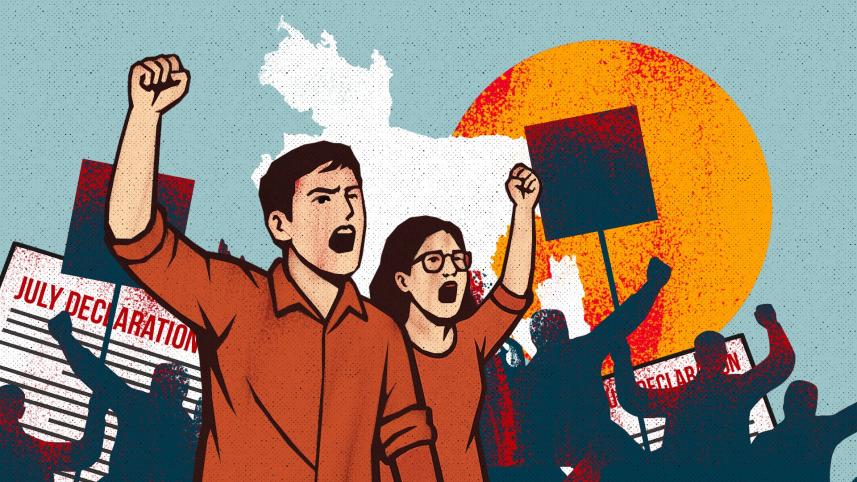
A discernible and highly coordinated effort is widely alleged to be underway to recalibrate the narrative surrounding the July uprising an effort that, if left unexamined, risks reshaping public memory and altering the political meaning of the events.
From this perspective, the deposed Awami League, in alleged alignment with actors from a neighboring country, is not only contesting interpretations of July but is actively seeking to dilute its foundational character while repositioning itself within the political landscape.
At the core of this emerging narrative struggle is a deliberate attempt to redefine the nature of the uprising itself. Terms such as “military-engineered intervention,” “extremist mobilization,” and “covert conspiracy” are increasingly circulating in public discourse. Critics argue that these are not neutral descriptions but political framing devices designed to generate doubt, fragment consensus, and weaken the moral and historical legitimacy of what many view as a people-driven mass uprising.
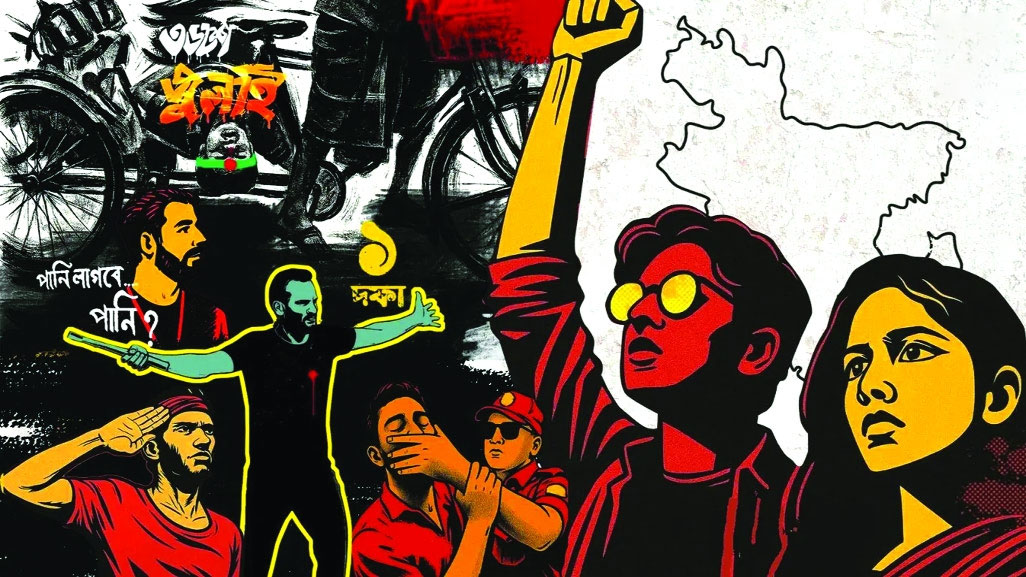
Such reinterpretations stand in stark contrast to accounts of the human toll. Approximately 1,400 people are reported to have lost their lives students, workers, and ordinary citizens across society. Thousands more were injured, with many suffering permanent disability. Supporters of the uprising argue that this was not the outcome of a hidden conspiracy, but rather the result of a governing authority taking a confrontational stance against mass public mobilization.
Serious allegations continue to persist regarding the methods employed during the crackdown. It is claimed that state machinery including police forces and ruling party affiliates such as the Chhatra League was mobilized in a coordinated manner. There are also allegations of involvement by foreign intelligence-linked elements, as well as the use of hired armed operatives operating alongside law enforcement. If substantiated, such claims would suggest a level of organized force beyond conventional state response.
Within competing narratives, the role of the military is also interpreted differently. One view frames the military not as an initiating force but as a stabilizing institution that intervened during a moment of acute national volatility. In this account, its actions are described as helping contain escalation, prevent further bloodshed, and avert a broader civil conflict. Even during periods of unrest including reported attacks on police installations, it is said to have maintained order, secured key infrastructure, and in some cases provided protection to vulnerable personnel.
From this perspective, responsibility for the violence is attributed not to the military institution or the civilian movement itself, but to an authoritarian political structure, its domestic enforcement apparatus, and alleged external collaborators.
Attention has now shifted to the broader political landscape. The Awami League, though no longer in power, is widely perceived in this interpretation as pursuing a structured pathway toward political re-entry. Through financial resources accumulated over years, international networks, and influence operations, it is alleged that efforts are being made to construct an alternative version of events in which accountability is reframed and responsibility redistributed.
Allegations of involvement by India’s external intelligence agency, RAW, further introduce a geopolitical dimension to the dispute. At the same time, claims persist that financial resources are being deployed across media platforms, advocacy networks, and digital ecosystems in order to influence public opinion domestically and internationally.
Compounding these dynamics, current opposition political forces are described by critics as prioritizing short-term political gains over long-term national stability. In this view, an intense focus on weakening the government may inadvertently create conditions that allow previously displaced actors to regain political relevance.
Additionally, certain media platforms and individual commentators are accused of amplifying revised narratives through sustained repetition, with suggestions of external or financial incentives shaping parts of the discourse.
For those described as politically displaced or fugitive actors, the stakes are existential. Political rehabilitation, in this framing, depends not only on time or circumstance but on the successful reinterpretation of July itself transforming accountability into ambiguity and revising established perceptions of responsibility.
Ultimately, the struggle over July is no longer confined to historical interpretation. It has become a broader contest over legitimacy, accountability, and the future configuration of political power.